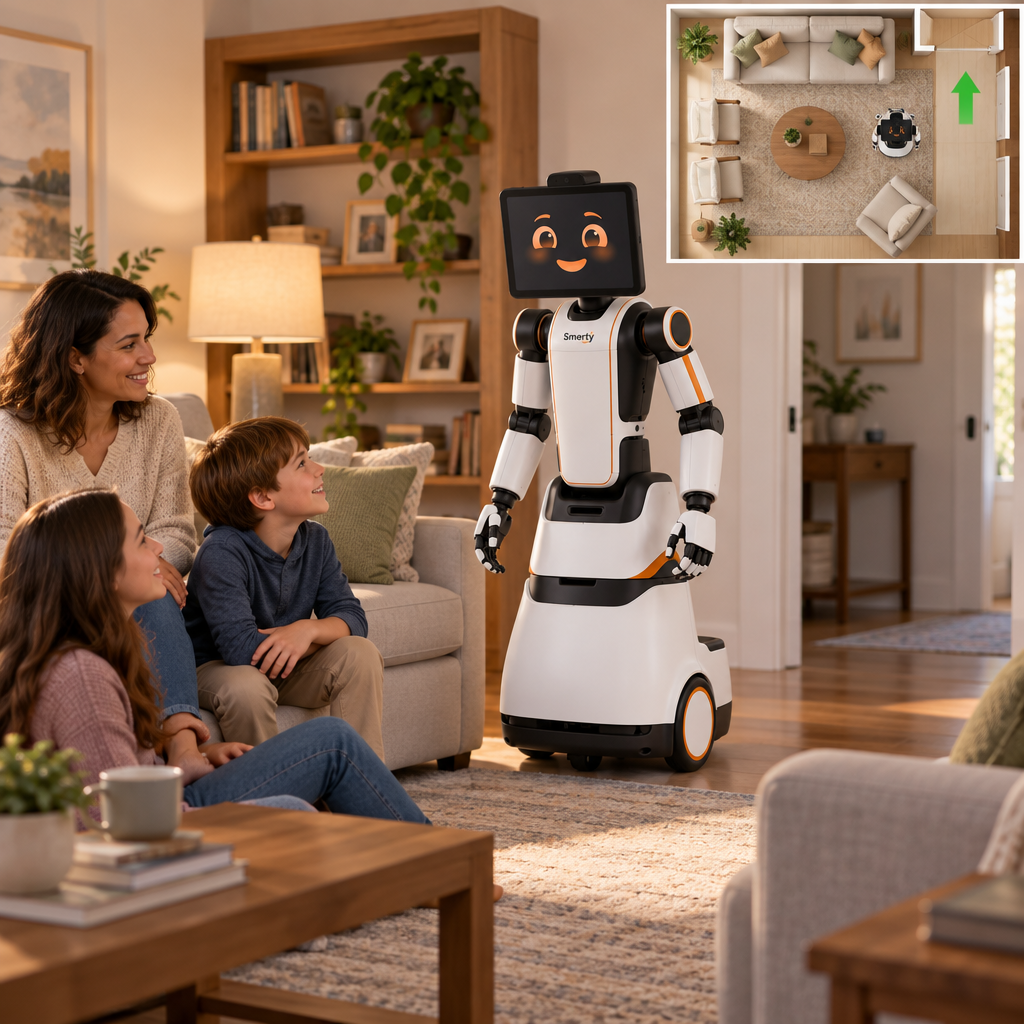
Smooth Floors, Busy Rooms: Is Your Layout Ready for Shared Movement?
Smooth Floors, Busy Rooms: Is Your Layout Ready for Shared Movement?
18 November 2026 · Editorial draft for owner approval
A living room can have a beautifully smooth floor and still be a complicated place to move. Dining chairs slide out, a school bag lands beside the sofa, and someone pauses in a doorway to finish a conversation. The useful question is not simply whether a mobility system suits the floor. It is whether the room can comfortably accommodate another moving presence without making family life feel like an obstacle-management job.
This checklist supports one specific decision: would a modest layout change make shared movement practical, or would the household have to give up too much usable space? It is not a stair assessment, a product ranking or proof that any particular product can navigate your home.
What the evidence actually establishes
A review of ground-mobile locomotion systems compares wheels, tracks, legs and hybrids across factors including speed, obstacles, energy and complexity. That is a useful basis for considering mobility trade-offs. It is not a trial showing that wheeled assistance works reliably in occupied family rooms.
A domestic humanoid design study describes a specific wheeled prototype tested for indoor movement, small bumps and small-item pickup. Those narrow demonstrations do not establish broad domestic competence, nor do they establish Smerty's capabilities.
The practical implication is simple: assess the room and the proposed activity together, rather than treating “smooth floor” as an approval label.
1. Choose one shared-space activity
Start with a single proposed use, not an imagined whole-home service. Perhaps you want to assess whether a mobile assistant could occupy a designated position near a family activity without obstructing anyone. Keep that proposal separate from any unverified promise of carrying, fetching or handling objects.
Write down:
- Where the activity would begin and end.
- Which people normally use that area.
- Which furniture moves during the activity.
- Whether the proposed presence would block access to something important.
- What benefit would make the arrangement worthwhile.
If the benefit is vague but the required rearrangement is extensive, pause. A useful layout should serve the family, not turn the room into a permanent demonstration space.
2. Review occupied space, not the empty-room photograph
Look at the room during its ordinary uses. A dining area with chairs tucked away is a different arrangement from the same area during dinner. Record those configurations without staging unsafe interactions or introducing an unverified moving device.
Your checklist should include:
- Chair positions when people are seated.
- Doors, drawers and cupboards when open.
- Places where bags, toys or laundry temporarily collect.
- Space used by a wheelchair, walking aid or pushchair, where relevant.
- Areas where people need to turn, stop or pass one another.
Do not invent a universal clearance requirement. Compare your observations with documented dimensions and operating requirements for the actual product under consideration. Missing documentation is an unanswered question, not permission to assume a fit.
3. Separate fixed constraints from negotiable clutter
Some changes are easy: relocating an occasional basket may improve the room for everyone. Others are unreasonable: expecting a child never to leave a toy on the floor is not a dependable household plan.
Sort observations into three groups:
- Fixed: furniture or access needs that should remain unchanged.
- Flexible: changes the household genuinely likes and can maintain.
- Unpredictable: ordinary interruptions that cannot be designed away.
Ask the supplier how unpredictable conditions are handled and what evidence supports the answer. Do not interpret a tidy demonstration as evidence of dependable operation around moving people or scattered belongings.
4. Make stopping part of the layout discussion
Before any supplier-authorised demonstration, request an explanation of stopping, interruption and recovery procedures. Establish who supervises, where everyone stands and how access routes remain available.
Ask what happens if the intended position becomes occupied. Does the documented procedure require human intervention? What should a household member do if movement stops somewhere inconvenient? Avoid assuming automatic rerouting or safe behaviour that has not been demonstrated and documented.
A layout review should never involve asking someone to stand in the path to “see what happens.”
When legs or hybrids deserve consideration
If the proposed activity depends on traversing discontinuous terrain or stairs, reconsider whether a smooth-floor layout assessment addresses the real need. Legged or hybrid approaches may be better candidates where obstacle negotiation is central, subject to mechanism-specific evidence and operating limits. The locomotion review supports comparing these trade-offs, not declaring one design universally superior.
Make the household decision
Finish with one of three outcomes: keep the layout, make a mutually welcome adjustment, or defer the proposed use. Record unresolved questions alongside the decision. A comfortable home is more important than accommodating an uncertain capability.
For SMERT's developing product, visit Smerty. Smerty is in development; market verification and certification must precede sale. No performance or suitability for your room is established by the studies above. The aim is a joyful shared home, with evidence guiding what belongs in it.
Transform Your Business with SMERT Robotics
Ready to experience the benefits of hospitality automation? Our team is ready to help you get started.