Can Known Part Geometry Let a Cobot Use 2D Instead of a Depth Camera?
Can known part geometry let a cobot use 2D instead of a depth camera?
Yes, potentially: a calibrated 2D camera can support pose estimation when the object’s geometry is known, so needing a spatial target does not automatically mean needing a depth camera. The decision should depend on whether that approach meets the task’s measured requirements across representative conditions. If it does not, evaluate depth sensing against the specific information gap—not as an automatic upgrade.
What makes this a different camera-selection question?
Instead of asking whether 2D or depth is generally better, ask a narrower question: can the geometry you already know provide enough information for this particular task?
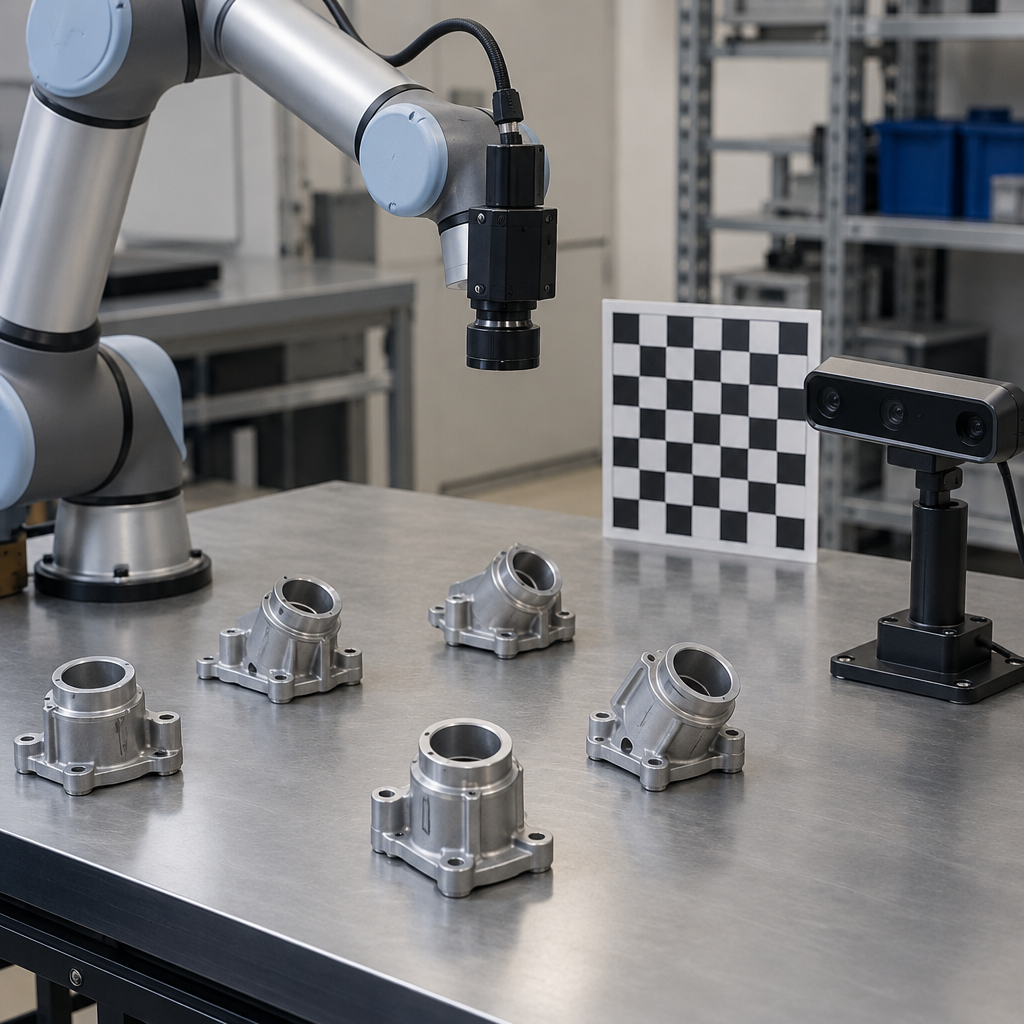
The supplied OpenCV calibration tutorial describes estimating camera intrinsics and distortion from chessboard observations, and using solvePnP to estimate the pose of known geometry. That establishes an important distinction: a 2D image is not necessarily limited to a two-dimensional positioning result.
It does not establish that your part, camera placement or operating conditions will produce acceptable results. Treat known-geometry pose estimation as a candidate method to test, not a reason to exclude depth sensing before evaluation.
For robotic vision systems, the useful comparison is therefore between two proposed ways of meeting a defined requirement—not between two camera labels.
What must “known geometry” mean in the evaluation?
Write down exactly which geometric information the proposed method will use. Do not accept “the software recognises the part” as an equivalent specification.
Ask the integrator to identify:
- The part geometry represented in the pose-estimation method.
- The image observations associated with that geometry.
- The permitted differences between the reference geometry and production parts.
- The task conditions in which those observations are expected to be available.
- The response when the required observations cannot be obtained.
For example, consider a proposed task involving a consistently presented part with a documented shape. The evaluation question is whether the actual observations support the required pose estimate throughout the permitted presentation range. It is not whether one favourable image produces a convincing overlay.
This is an illustrative test scenario, not a reported deployment or performance claim.
How should you compare 2D pose estimation with depth sensing?
Define the acceptance conditions before comparing outputs. Which position and orientation components matter to the task? What error limits will the integration team accept? Which part presentations must be included, and which may be rejected?
Then test the known-geometry approach on representative cases separate from those used to establish calibration. Compare its estimates against an independently established reference appropriate to the task. Record both errors and cases where no usable estimate is returned.
If the approach fails, describe the failure precisely. Was the geometry assumption unsuitable? Were the necessary observations unavailable? Was camera calibration inadequate? Or did the method fail to supply information the task requires?
Only then specify what a depth-camera candidate must demonstrate. A different sensor should be tested against the same task requirements, including the cases that exposed the original limitation. The supplied sources do not establish which depth technology or camera model would resolve those cases.
The trade-off is practical: a known-geometry approach commits you to maintaining and checking its geometric assumptions. A depth-based proposal needs its own evidence that the additional measurements resolve the identified problem. Neither deserves acceptance merely because its demonstration looks more sophisticated.
Which calibration checks remain necessary?
Keep camera calibration and camera-to-machine calibration distinct.
Camera intrinsics and distortion concern the imaging model. Extrinsic calibration relates the camera pose to a machine coordinate frame. The MoveIt calibration explanation describes that relationship and the camera-to-target and base-to-end-effector pose pairs used for eye-in-hand calibration.
For this camera-selection decision, request evidence for both relevant calibration stages. Detecting a calibration board is not, by itself, an evaluation of calibration quality. Likewise, an acceptable camera-relative pose estimate does not establish that the corresponding robot-frame target meets the task requirement.
Keep motion approval separate. A camera picture alone is not a validated safe motion command, and adding depth or AI does not remove that distinction.
What should the evaluation checklist contain?
Use this checklist when reviewing the comparison:
- Task requirement: Required pose components and acceptance limits are written down.
- Geometry assumptions: The reference shape and permitted production variation are explicit.
- Calibration evidence: Imaging calibration and the relevant camera-to-machine relationship have been evaluated.
- Independent checks: Test poses are compared with an appropriate reference, not judged only by visual overlays.
- Representative coverage: The trial includes permitted presentation variation and difficult observations.
- Failure records: Unavailable or rejected estimates remain visible in the results.
- Depth justification: Each proposed benefit addresses a documented limitation of the tested alternative.
- Decision boundary: Perception results are not treated as automatic authorisation for robot motion.
SMERT is an OEM and integrator. For a proposed SMERT Cobot application, a useful starting point for a robotics integration discussion is the part geometry, presentation range and acceptance checklist—not a preselected camera type.
What three questions should you ask next?
- Which geometric assumptions would invalidate our 2D pose estimate if production parts changed? Request a written boundary for acceptable variation.
- What did the held-out evaluation reveal that the calibration demonstration did not? Ask for errors, rejected cases and the reference used.
- Which specific failed requirement would depth sensing resolve, and how will we verify that? Require a comparable test before changing the specification.
Related: Cobot integration
Transform Your Business with SMERT Robotics
Ready to experience the benefits of hospitality automation? Our team is ready to help you get started.