Who Owns the Upkeep? A Household Maintenance Responsibility Checklist
Who Owns the Upkeep? A Household Maintenance Responsibility Checklist
Owner-approval draft · 21 November 2026
In a busy household, everyone can notice something while nobody owns the follow-up. One adult hears an unfamiliar sound. Another sees a mark near a moving part. Both assume someone else has checked the instructions. A useful maintenance plan begins by closing that responsibility gap—not by buying tools or inventing a cleaning schedule.
This checklist helps a family decide who will maintain the records, who can carry out explicitly permitted care, and what happens when a concern is unresolved. It is about household accountability, not repairability, floor cleaning or restarting an interrupted task.
What the available research can support
The 2012 review of ground mobile locomotion compares wheels, tracks, legs and hybrids across factors including complexity and readiness. It provides a reason to ask mechanism-specific questions. It does not provide a household maintenance schedule or prove that one design will need less upkeep in your home.
The 2014 domestic prototype study reports indoor movement, small-bump and small-item pickup testing. Those demonstrations do not establish long-term domestic reliability, service intervals or the work a household would need to perform.
The practical response to those limits is not to guess. It is to build a responsibility record that can later be populated from the actual product instructions. Until those instructions exist, leave unsupported requirements blank.
Choose a coordinator and a backup
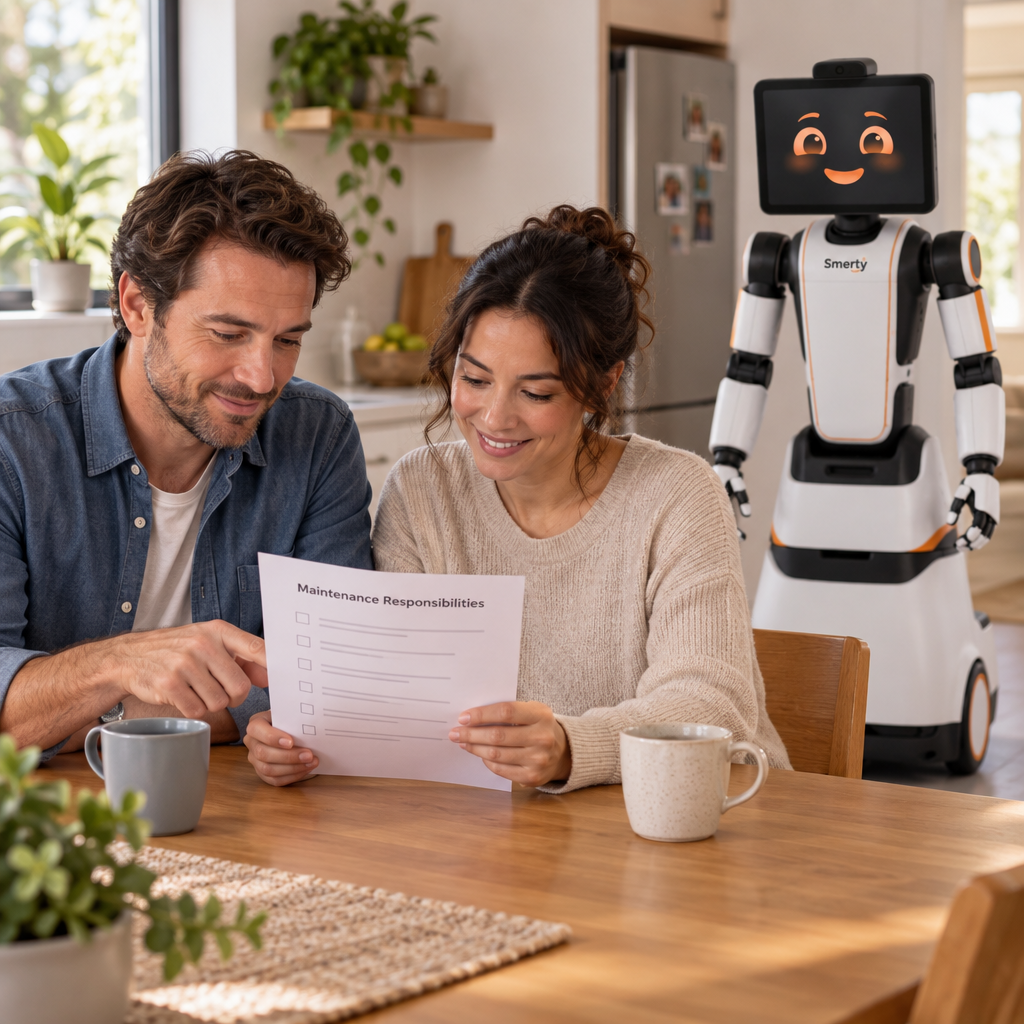
Name one willing adult to keep the current instructions and maintenance record together. The coordinator does not have to perform every permitted task. Their role is to make sure questions are assigned and outcomes are recorded.
Choose a backup for times when the coordinator is unavailable. If nobody wants either role, that is useful information about household fit. A future assistant should not create an invisible job that defaults to the busiest family member.
Agree on three boundaries:
- Who may carry out care explicitly permitted by the instructions?
- Who may contact the supplier or arrange authorized assistance?
- Who records whether an unresolved concern has been addressed?
Children can tell an adult what they notice, but should not be assigned inspection or maintenance around moving components. Keep participation friendly and age-appropriate rather than turning upkeep into a family policing exercise.
Build the record around instructions, not assumptions
Create a single reference page with space for the product identification, applicable instruction version, official support route and any documented maintenance requirements. Keep access practical for the adults who need it.
For each permitted care task, record:
- The instruction or official guidance that authorizes it.
- Who is responsible for carrying it out.
- The specified timing or condition that triggers it, if provided.
- Any required preparation stated in the instructions.
- The date it was completed and any unresolved observation.
Do not fill gaps with routines borrowed from vacuum cleaners, toys or other products. Similar-looking components do not establish equivalent care requirements. Likewise, this article supplies no approved cleaning agent, lubrication method, disassembly procedure or maintenance interval.
Make observations easy to report
Use neutral descriptions rather than home diagnoses. “A sound occurred during this movement” is more useful than “the drive is failing” when the cause is unknown. Record what happened, when it was noticed and whether it recurred, without deliberately repeating a concerning action to gather more evidence.
Keep notes relevant to equipment care. There is no need to document family movements, photograph children or create a household surveillance record. If support requests an image, focus it on the relevant equipment detail and avoid unnecessary personal information.
A short, factual entry is enough. The aim is continuity between adults and support personnel, not a perfect diary.
Define what an unresolved concern means
Agree that uncertainty will not be silently treated as permission to continue. If an observation raises a safety concern, stop the activity and consult the applicable instructions or official support. Do not open assemblies, improvise a fix or ask a family member to reproduce a fault outside authorized guidance.
Assign a named person to follow up. Record the guidance received and any conditions attached to it. “Someone looked at it” is not a useful closure note; the record should distinguish an observation, advice and completed authorized action.
This approach cannot guarantee safe operation. It simply makes responsibility and unresolved questions visible.
Check whether the workload fits the household
Before accepting a future maintenance commitment, ask whether the documented tasks fit the family’s time, confidence and access to support. Do not assume wheels mean negligible upkeep or legs mean an unacceptable burden.
Where essential activities involve steps or uneven ground, a verified legged or hybrid design may be a better functional fit despite different care requirements. Maintenance convenience should not override task suitability. Equally, a more complex mechanism is not justified merely because it looks capable; its relevant abilities and care requirements need documentation.
For product context, see Smerty’s development page. Smerty is in development; market verification and certification must precede sale. This checklist establishes no maintenance schedule or reliability claim for Smerty.
A good ownership plan is modest: clear instructions, willing adults, concise records and no hidden assumptions. That leaves the household free to focus on the joyful reasons it wanted assistance in the first place.
Transform Your Business with SMERT Robotics
Ready to experience the benefits of hospitality automation? Our team is ready to help you get started.