Say Hi to ™
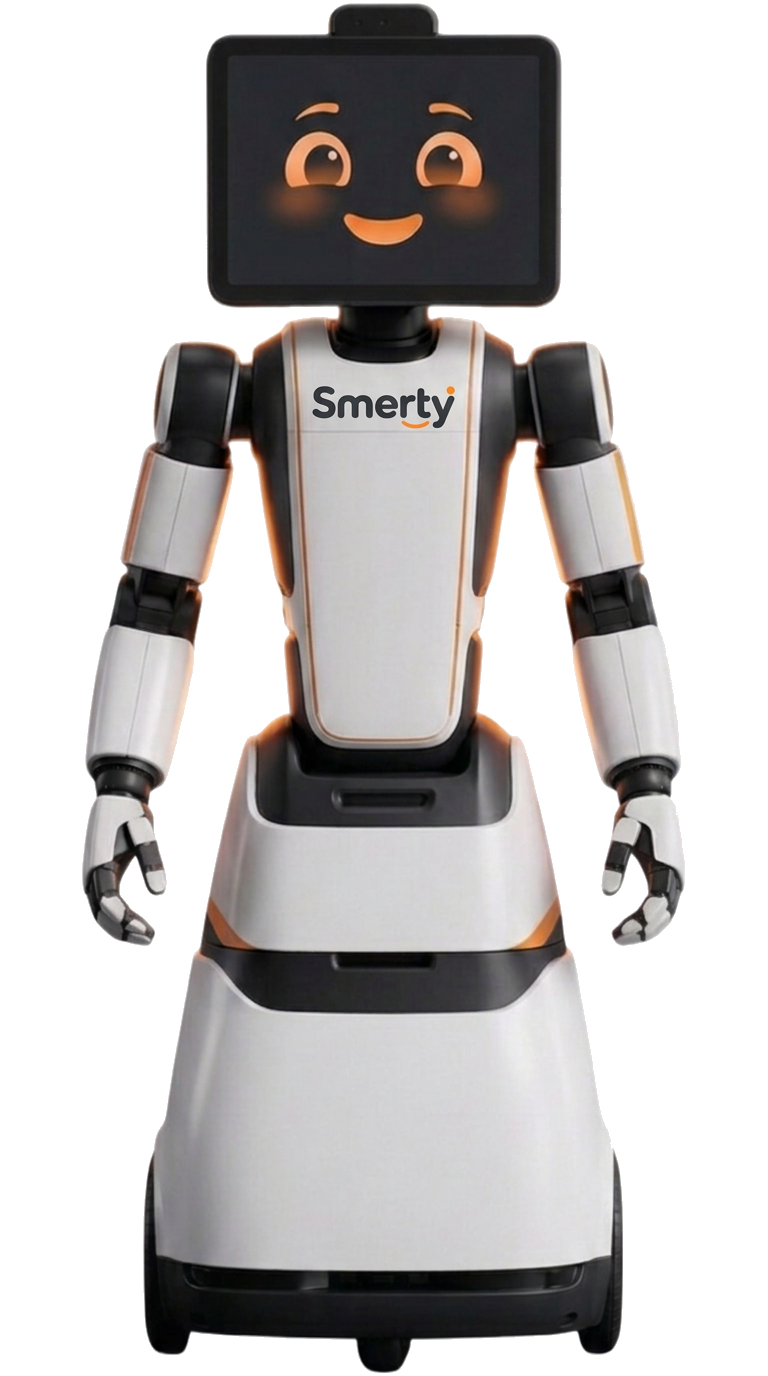
Home assistance for your family's care.
Meet: the home helper that brings your family into the room
Smerty is SMERT's wheeled home companion with a 14-inch screen, two arms with five-finger dexterous hands, a distance camera, a camera on each wrist and a microphone array. Family and carers video-call straight onto its screen, talk with the person at home and guide gentle, approved actions in real time.
When nobody is connected, Smerty works through all 24 hours of your family's day: morning stretches with the kids, reading and replying to emails over breakfast, pill reminders, receiving the food delivery at the time you chose, folding laundry, homework help, cooking alongside you, music and games in the evening, and quiet checks at night. When you order, tell us what you want Smerty to do and what it should look out for, and we set it up for your home.
Why ™, and not a walking humanoid?
Two-legged humanoids are impressive in a demo. A home needs something different: steady, quiet, useful every day, and affordable. Here is why Smerty is built on wheels.
A base built for real weight
Smerty stands on a mobile base rated to 400 kg and we load it with 100 kg of ballast — a quarter of what the chassis is built for. The two versions handle up to 25 kg and 50 kg respectively. A two-legged robot has to balance every kilo it carries.
Moves around silently
No more than 60 decibels while moving — about the level of a quiet conversation. Soft-tyre wheels roll with no footsteps, no heel-click and no motor whine from leg joints, so it can pass a bedroom at night.
More stable than two legs
Low centre of mass on a wide wheeled base. It does not trip over a rug, a toy or a pet, and it does not fall over when switched off.
A screen, not a blank face
Its face is a screen: the carer's live video, lyrics for karaoke, homework, photos, reminders. A humanoid head has a face that shows nothing useful.
Runs longer, charges by itself
Rolling uses far less energy than walking, so the battery lasts through the day and it docks to charge in the storeroom on its own.
Your home stays private
Video is processed on the computer inside its base. Nothing is sold or shared.
Made by SMERT, serviced by people
We build and support Smerty ourselves, with a global technician network, not a remote factory you can't reach.
Two versions for every home
Smerty from US$9,999 + taxes (up to 25 kg) or Smerty+ at US$19,999 + taxes (up to 50 kg). Fully refundable 10% deposit; first deliveries March 2027.
Weight, battery and price figures are design targets for the pilot, to be confirmed by testing.
Manufacturer, not a reseller
SMERT builds Smerty, the AI and the computer vision in-house.
Hong Kong R&D lab
Designed, built and tested at our own lab in Tsim Sha Tsui.
AI runs on Smerty
One enclosed AI computer per unit. Video is read on Smerty itself, not in a data centre.
Support in three regions
24/7 online assistance and a technician network across APAC, Europe and the Americas.
Three things ™ does for your home
Safety, entertainment and routine tasks, all from one Smerty. Each item further down the page is marked as lab-tested or still in development.
Safety
Watches for trouble and brings a person in the moment it matters.
- Infant check-ins with parent alerts
- Fall and "not feeling well" events
- Dog leaving its allowed area
- Carer call on the screen; ambulance only after a human confirms
- Stable 100 kg base, quiet floor-safe wheels, video read locally
Entertainment
A companion that sings, plays and makes the evening lighter.
- Karaoke with lyrics on the screen
- Music with dance gestures from the arms
- Party and quiz games for all ages
- Play time with children and pets
Routine tasks
Gets the everyday chores done, then parks itself out of the way.
- Tidying and light dry wipe-down
- Medicine reminders, brought over
- Homework time with the children
- Back to the storeroom to charge by itself
Everything else ™ is learning
More functions for each pillar, all in development for the pilot. Smerty never lifts or moves a person, never does wet cleaning and never gives medicine itself. It brings the box and reminds.
Safety
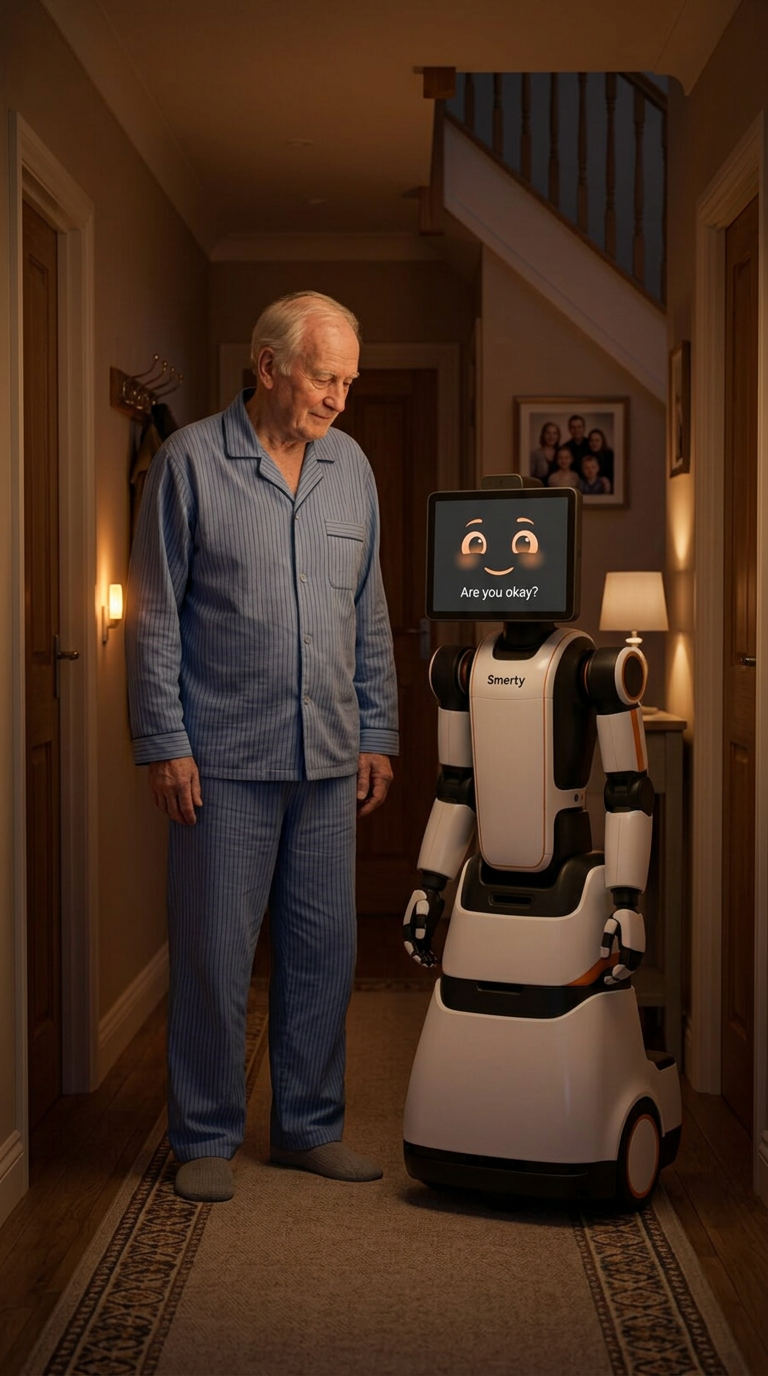
Night watch
Soft light and a check-in if someone is up too long at night.
Front-door alert
A message to the household when an unknown face is at the door.
Stove and tap check
Alerts if the hob, iron or a tap is left on in an empty room.
Alarm heard
Calls the family when it hears a smoke alarm going off.
Wandering alert
For a relative with memory loss heading for the door at night.
Child-safe zones
Alerts when a toddler goes near stairs, the balcony or the kitchen.
Entertainment
Storytelling
Bedtime stories with pictures on the screen, in the voice you chose.
Gentle exercise coach
Chair exercises for grandparents, with Smerty showing the moves.
Language tutor
Practise English, Cantonese, Mandarin or Italian with the children.
Memory lane
Family photos on the screen and a chat about each one.
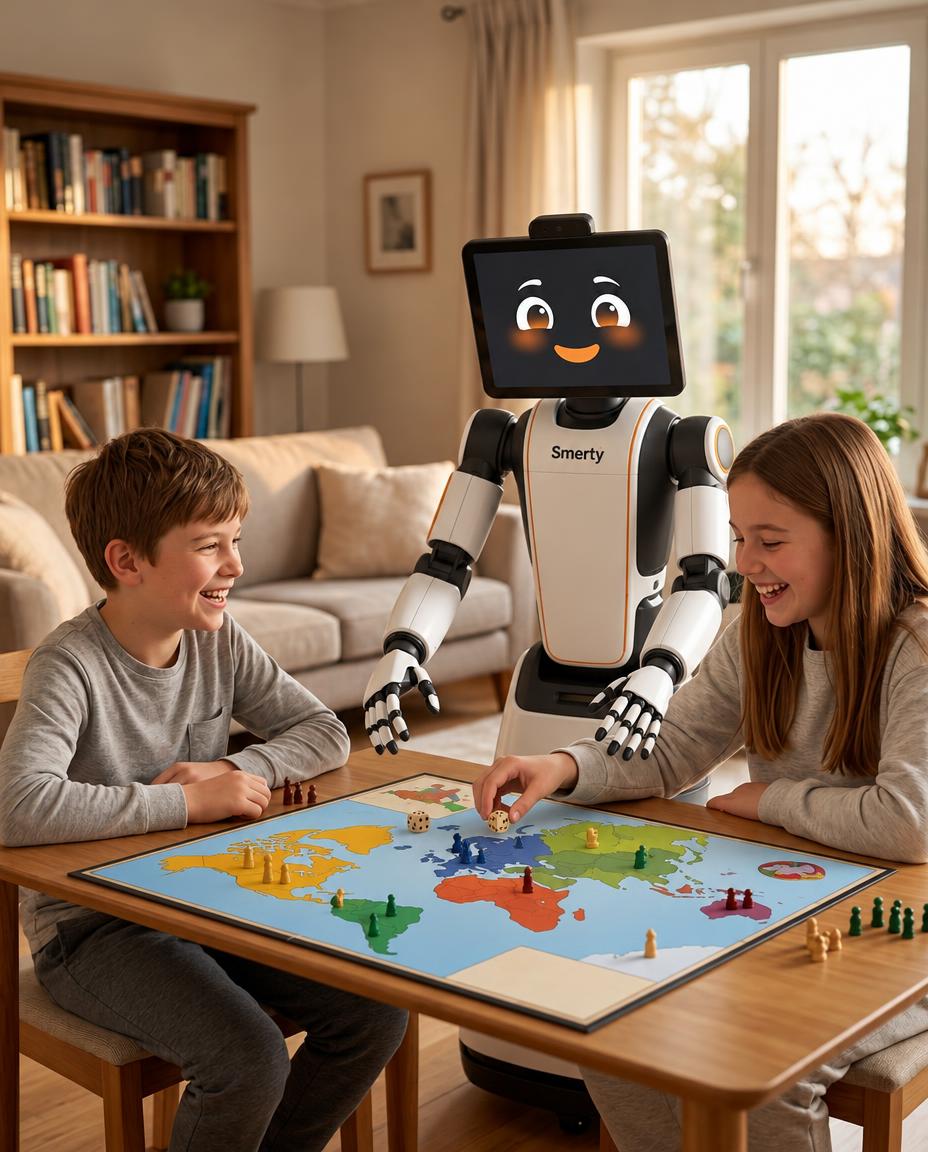
Board-game partner
Moves the pieces with its hands for chess, draughts or memory cards.
Party mode
Birthday songs, a dance-off and photo moments.
Routine tasks
Fetch and carry
Brings the remote, glasses, a bottle of water or the post.
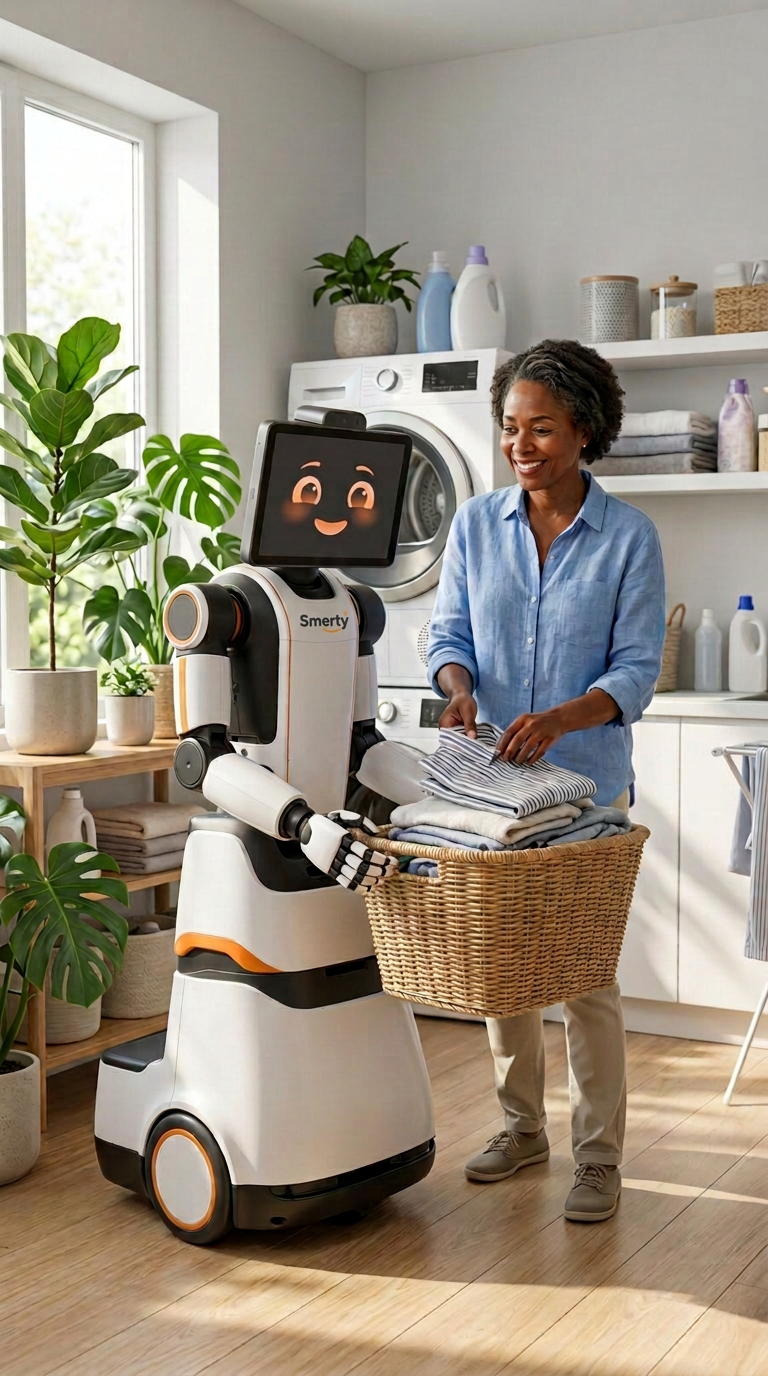
Laundry helper
Carries the basket and sorts socks and small items.
Plant care
Watering reminders and a camera check that plants look healthy.
Shopping list
Notices what is running low and adds it to the list.
Calendar and reminders
Appointments, birthdays and bin day, spoken out loud.
Pet routine
Feeding times, the treat box and food in the bowl.
Welcome home
Greets people at the door and takes coats and bags.
The technology behind ™
This is SMERT's own work, built in our lab: the voice pipeline, the vision events, the motion library and the safety layer. We show what has been tested here and what is still being built.
Voice to action
A spoken request is matched to a task, proposed back for a yes, then carried out inside speed and force limits. Smerty reports what happened.
Computer vision with event assistance
The cameras watch for named events — a person on the floor, a break in routine, a pet out of bounds — and raise an alert with a snapshot for a person to judge.
Approved-motion library
Smerty only performs motions that have been written, tested and signed off. There is no free joystick control of the arms.
Remote carer takeover
An authorised carer's face appears on the screen, they speak and act in real time, and control returns automatically when they leave.
On-device edge compute
One enclosed NVIDIA Jetson Orin computer per unit runs perception and motion. Nothing streams out unless an event is sent to a carer.
Safety envelope
Motions run under a speed cap, stop on contact, and are cut by STOP at any moment — from the screen, Smerty itself or the carer's phone.
Voice to action
Lab-testedSpeaking to Smerty is not a remote control in disguise. A request becomes a task, the task is proposed back for a yes, and only then does anything move.
Hear
A microphone array with hardware echo cancellation hears the room over the TV and over Smerty's own voice.
Understand
The words are matched to a task and a target object, not to a fixed list of keywords.
Propose
Smerty says what it intends to do and asks for a yes. Anything that moves the arms waits for that yes.
Confirm
A spoken yes, or a code on the carer's screen, releases the action. No confirmation, no movement.
Act and report
The motion runs inside speed and force caps, stops on contact, and Smerty says what it did.
Anything that moves the arms waits for a clear yes. If the room is unsure, Smerty does not move.
Event assistance: what the cameras watch for
Tell us what matters in your home when ordering. We configure supported event checks around your household, with an agreed response: ask, alert and bring a person in. Each new check is validated before use.
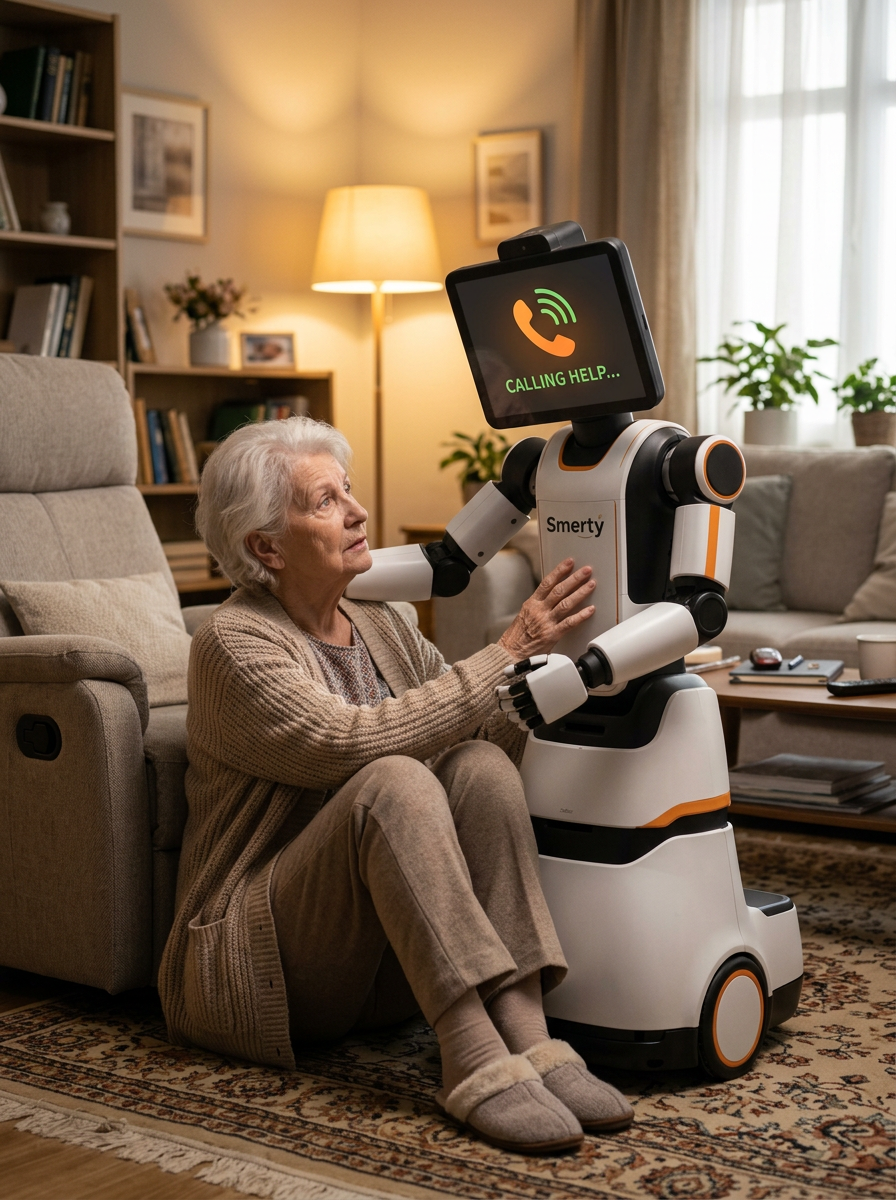
Fall on the floor
What it sees: A person is down and not moving.
What Smerty does: Smerty rolls closer, asks if they are OK, and calls the carer's phone. If nobody answers, a person decides whether emergency services are contacted.
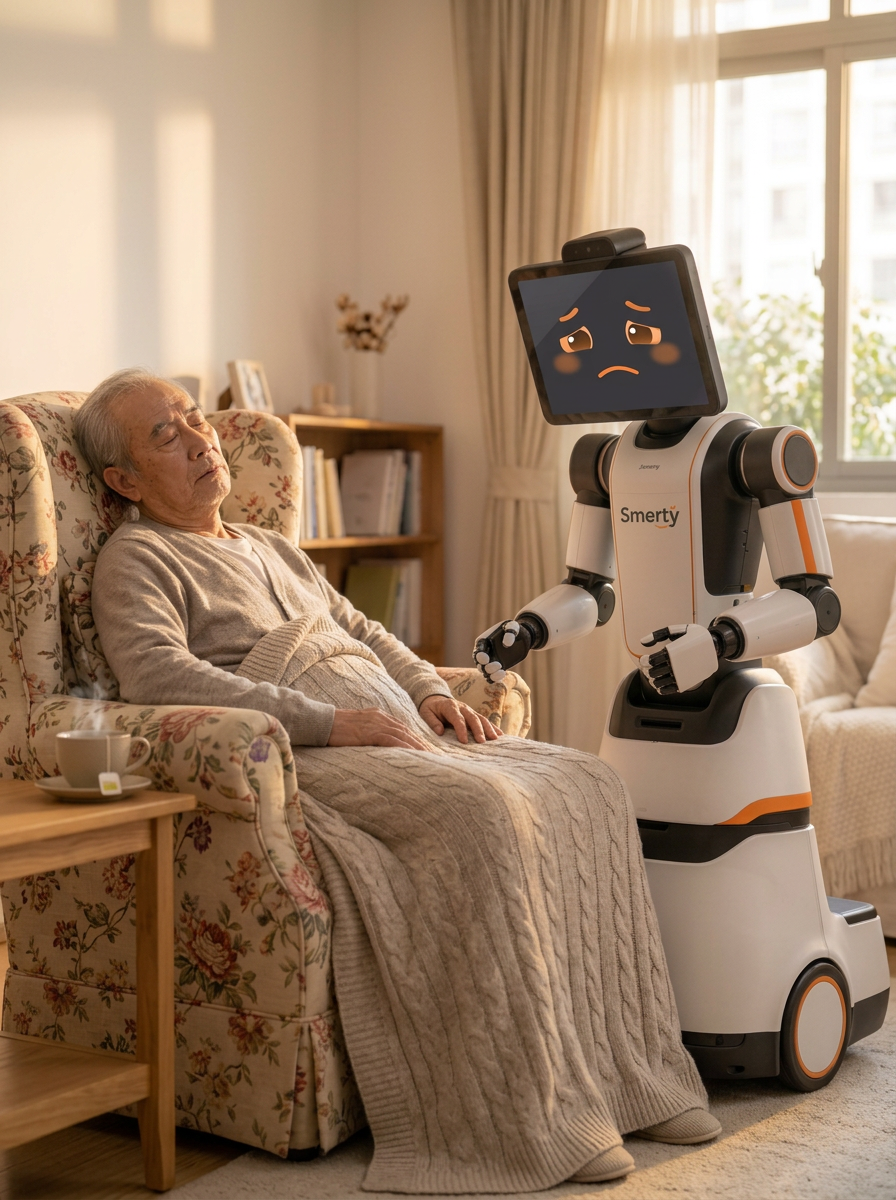
Not feeling well
What it sees: A change in routine: nobody up at the usual time, a long stay in one chair, a meal missed.
What Smerty does: Smerty tells the carer what changed. It does not diagnose illness and never claims to know what is wrong.
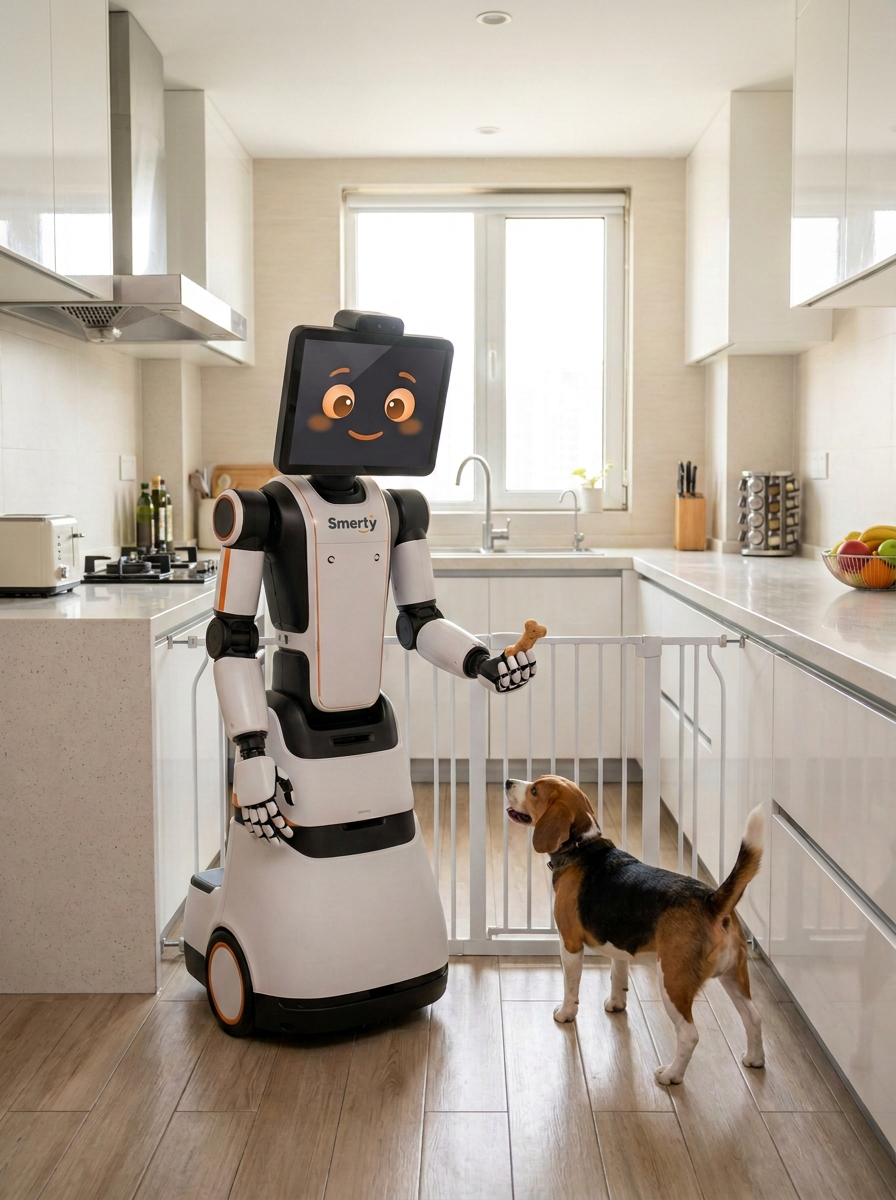
Dog where it shouldn't be
What it sees: The dog in the kitchen, on the stairs, or through a gate it should not pass.
What Smerty does: Smerty moves toward the dog, calls the carer, and can hand out a treat to bring the dog back to where it belongs.
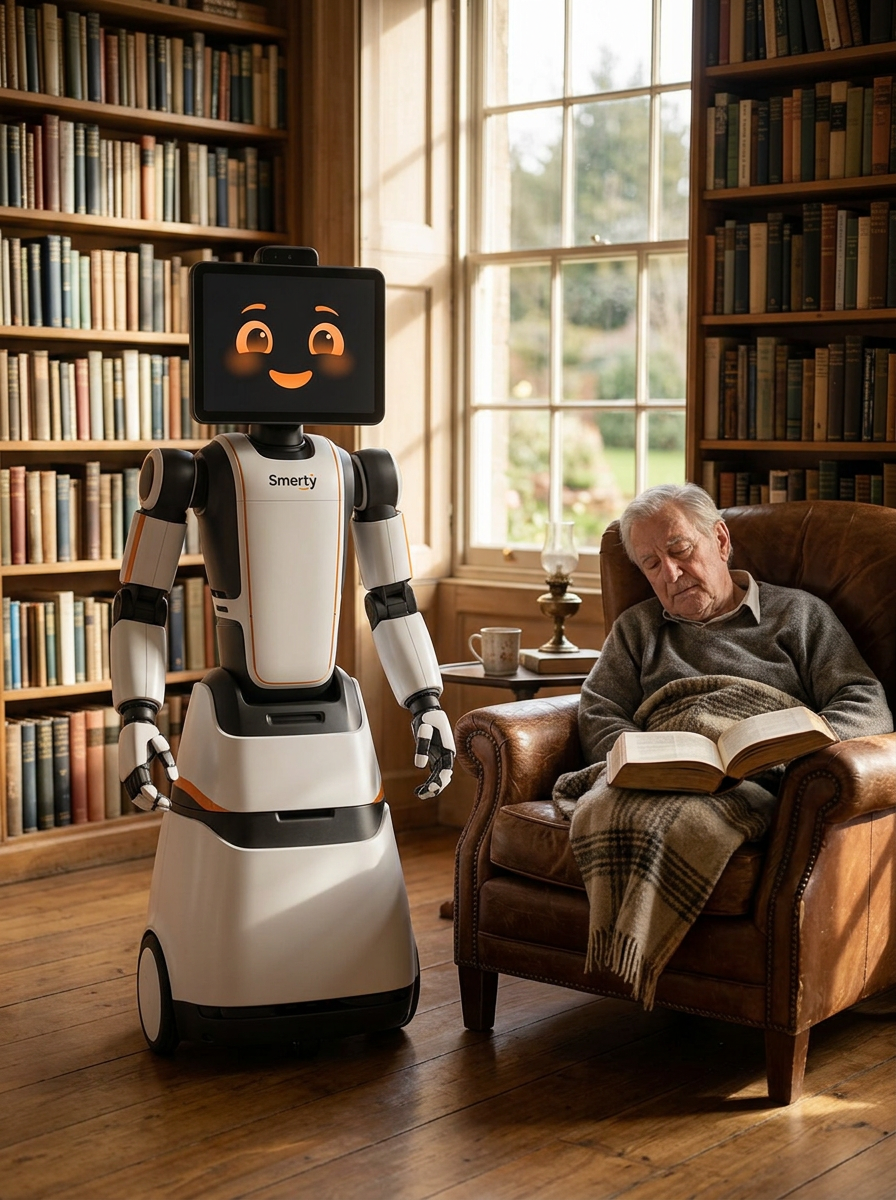
No movement for hours
What it sees: No movement in a room where the person is usually active.
What Smerty does: Smerty checks in by voice, then rings the carer if there is no reply.
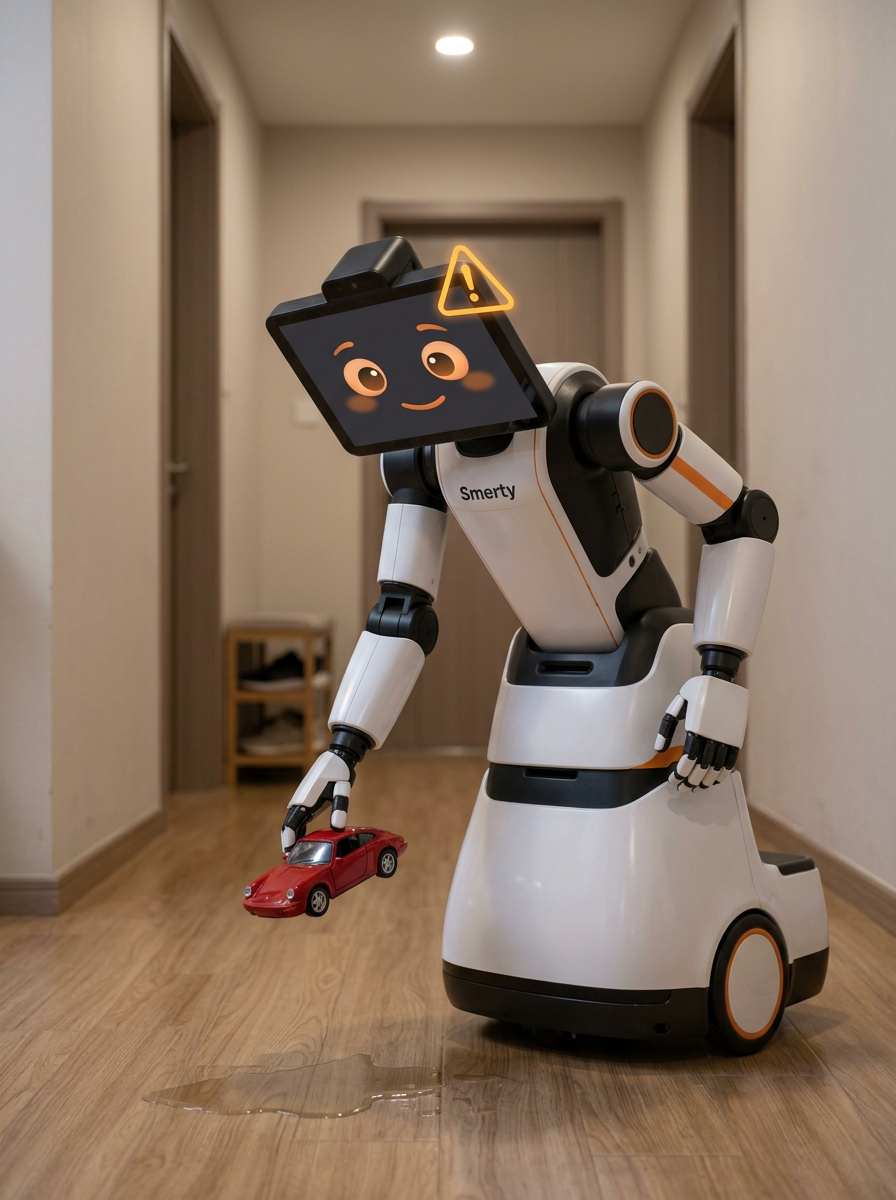
Something on the floor
What it sees: A spill, an object or a tripping hazard where the person walks.
What Smerty does: Smerty warns, and can clear it where the motion has been approved for that object.
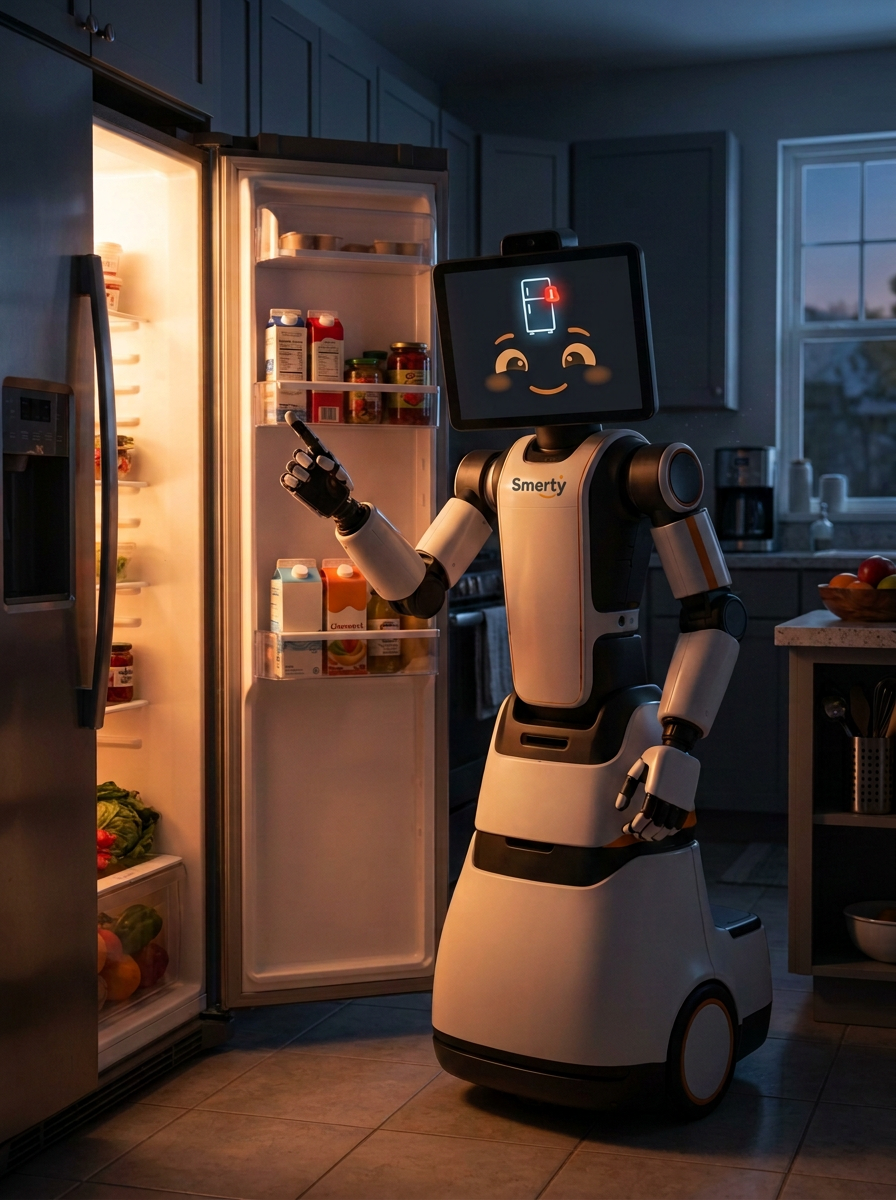
A door or gate left open
What it sees: A front door, a fridge or a pet gate left open.
What Smerty does: Smerty alerts the household and the carer. It never closes a door on its own.
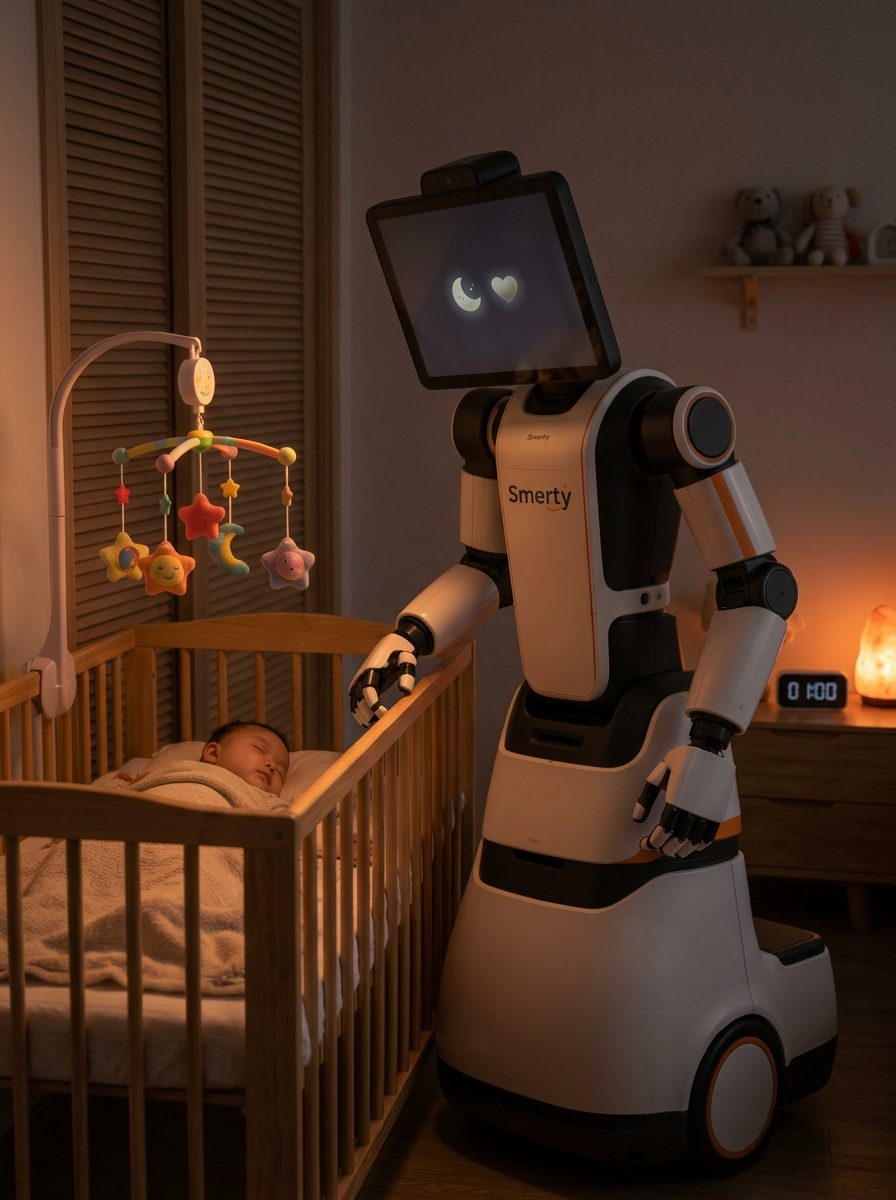
Infant check-in
What it sees: A baby stirring or crying during a household-approved check.
What Smerty does: Alerts a parent and offers a live view. Not a breathing monitor or a substitute for adult supervision.
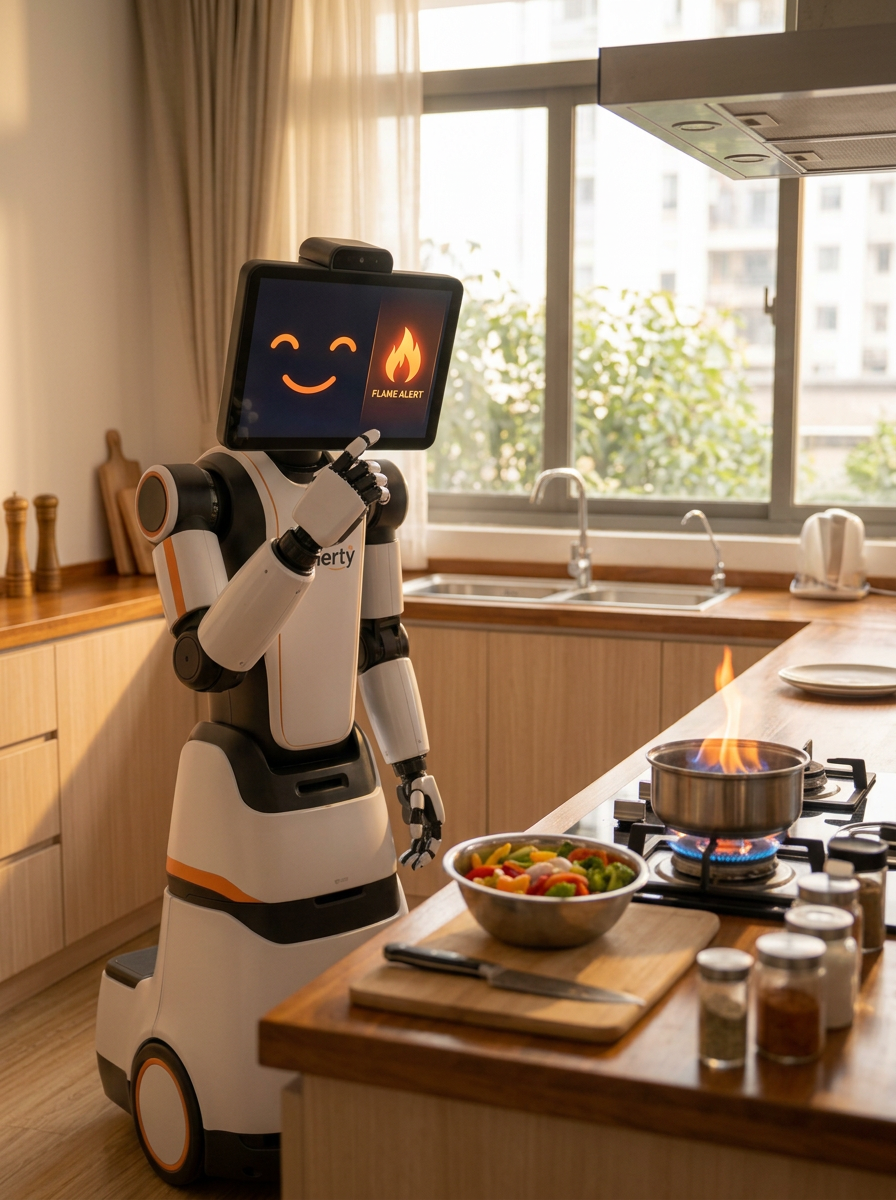
Hob left on
What it sees: A visible flame or cooking activity after the kitchen is empty.
What Smerty does: Asks the household to check and sends an alert. Never replaces a smoke or gas alarm.
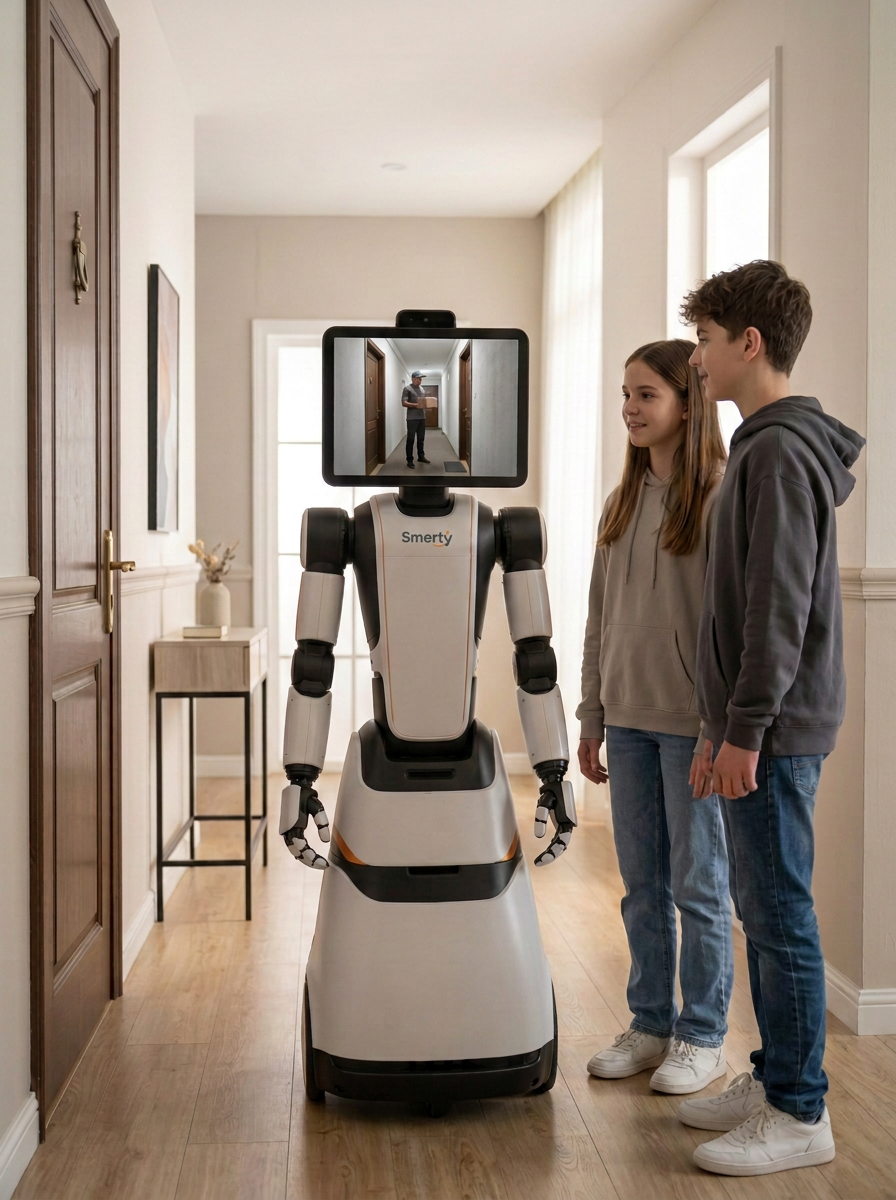
Someone at the door
What it sees: A visitor arriving at the entrance.
What Smerty does: Lets the household know and offers a view before anyone opens the door.
Every event is advisory. A person decides what happens next, and no emergency call is ever placed by Smerty.
Working today in our Hong Kong lab
Tested on our lab prototype. Not yet deployed in homes.
Computer vision
Camera-based object and scene understanding, with event checks and advisory visual verification.
Voice control
Live spoken requests and replies, with confirmed actions inside approved limits.
Natural interaction
Two-way conversation, task explanations and feedback through voice and screen.
Entertainment
Music generation and spoken song requests demonstrated in the lab. Family games and integrated home routines remain subject to testing.
Human takeover
An authorised carer takes over from Smerty's own voice in one tap, and speaks and acts in real time.
Approved movements only
The carer picks from a short list of named, speed-capped motions. No free joystick control.
Automatic handback
If the carer's connection drops, Smerty stops and its own voice takes the room again.
STOP always available
Stop works at every moment, from the carer's screen and on Smerty itself.
24 hours with ™
One moment for every hour of a family's day, from the morning stretch to lights off.
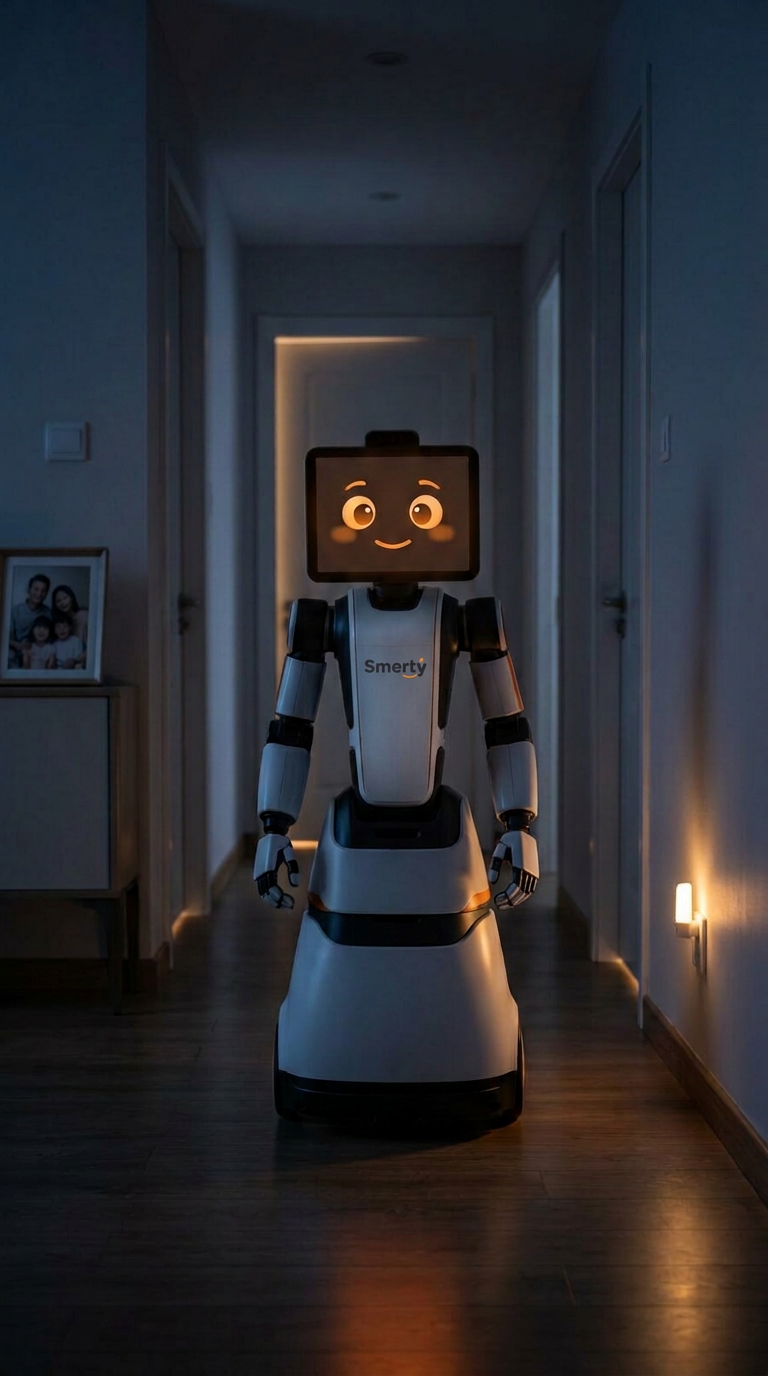
A quiet lap down the hall
A soft-lit check of the house while everyone sleeps.
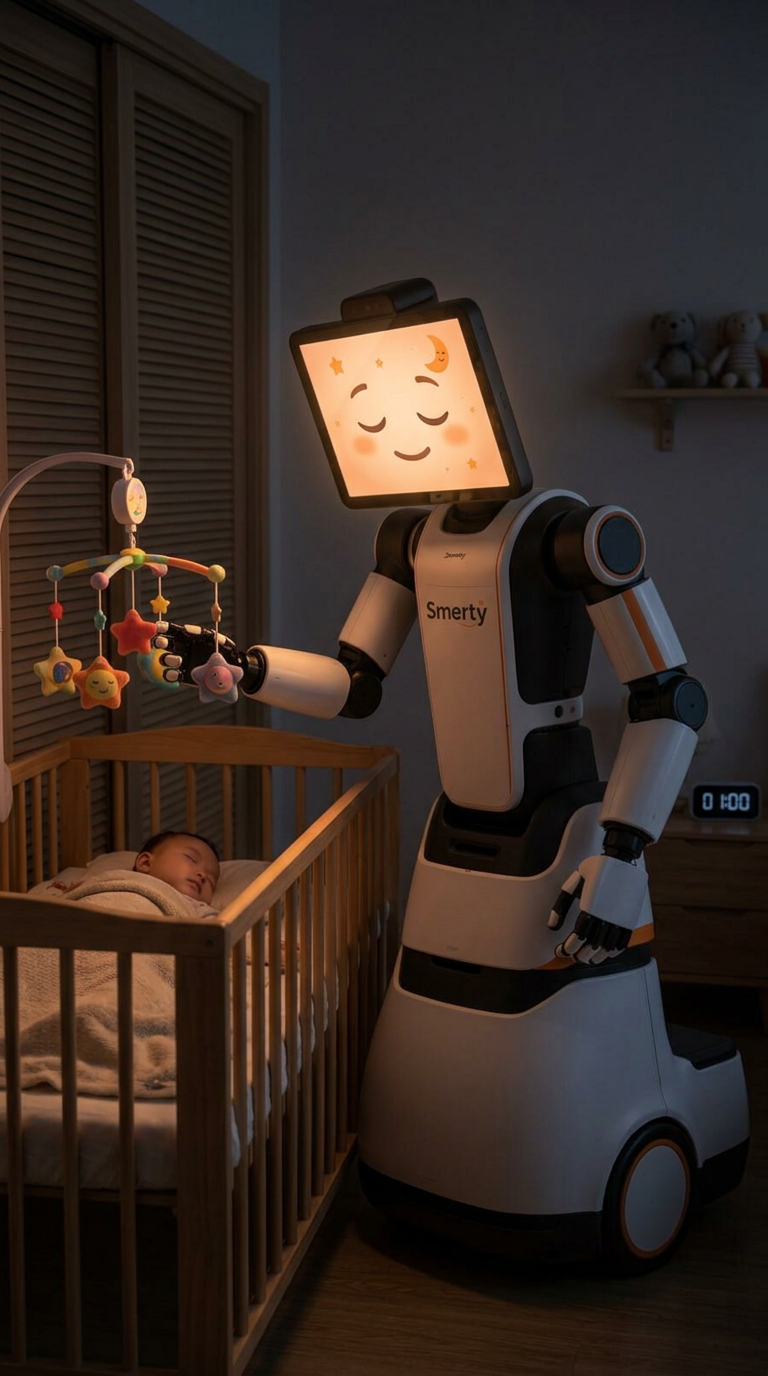
A soft lullaby for the little one
Gentle music and a calm face on the screen when the baby stirs.
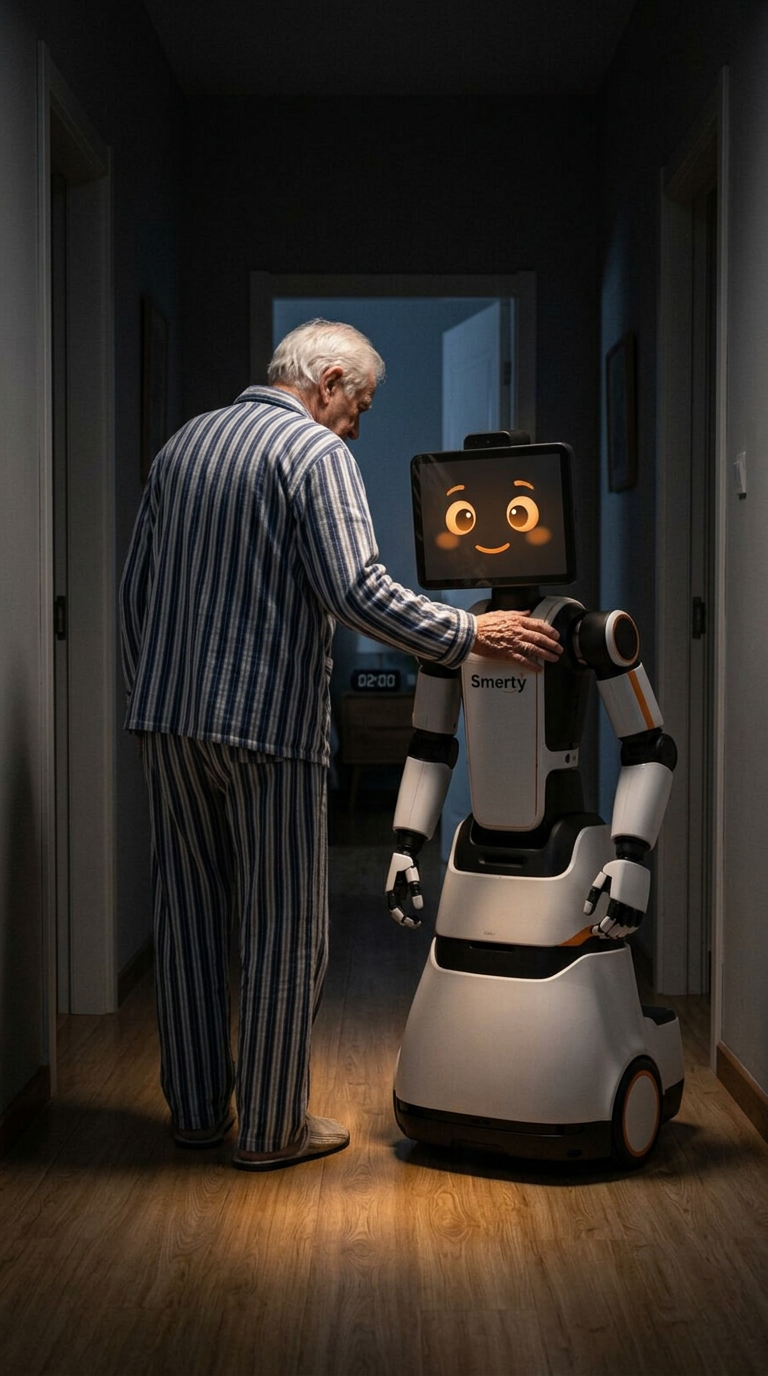
Company for Grandpa's late-night stroll
Rolls beside him with a steady shoulder to lean on.
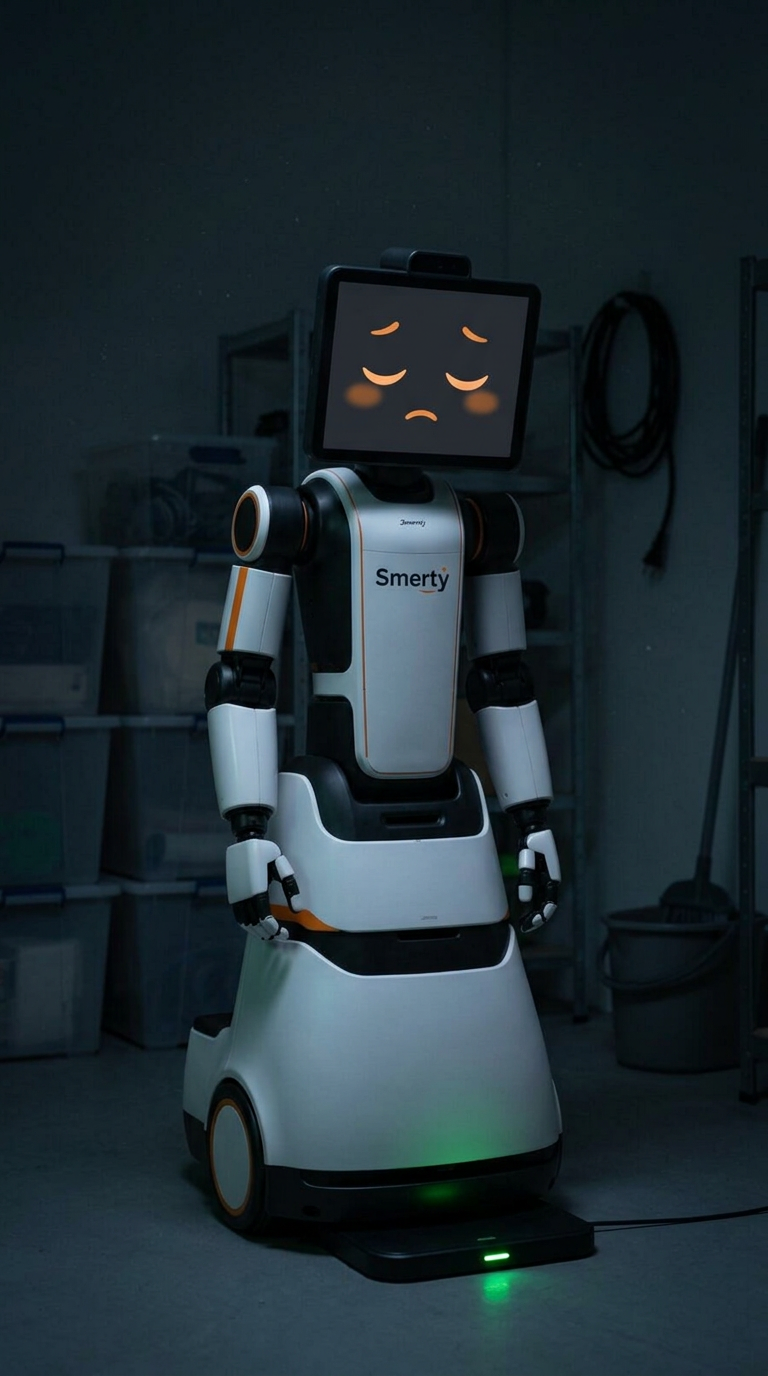
A quick recharge
Docks by itself so it's ready for the day.
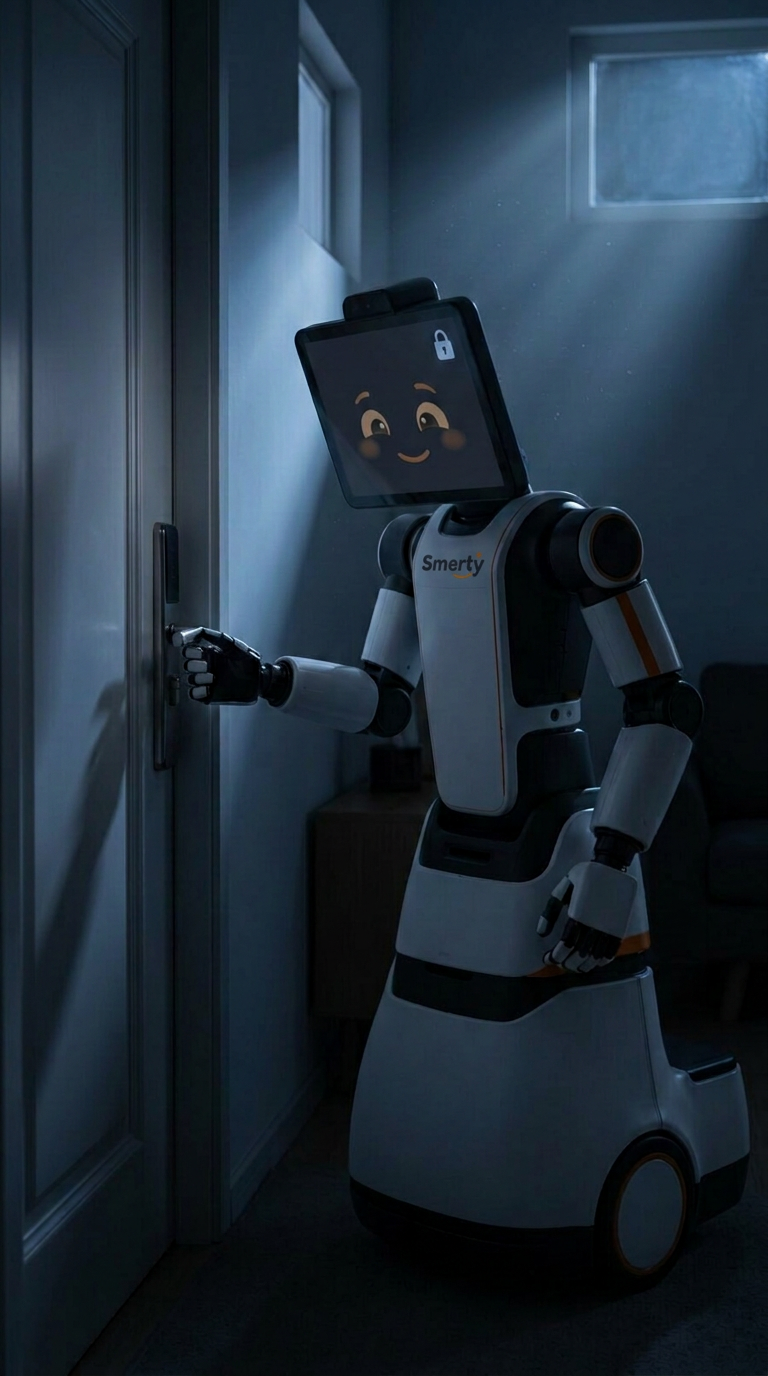
Double-checking the front door
Confirms the door is locked and lets you know.
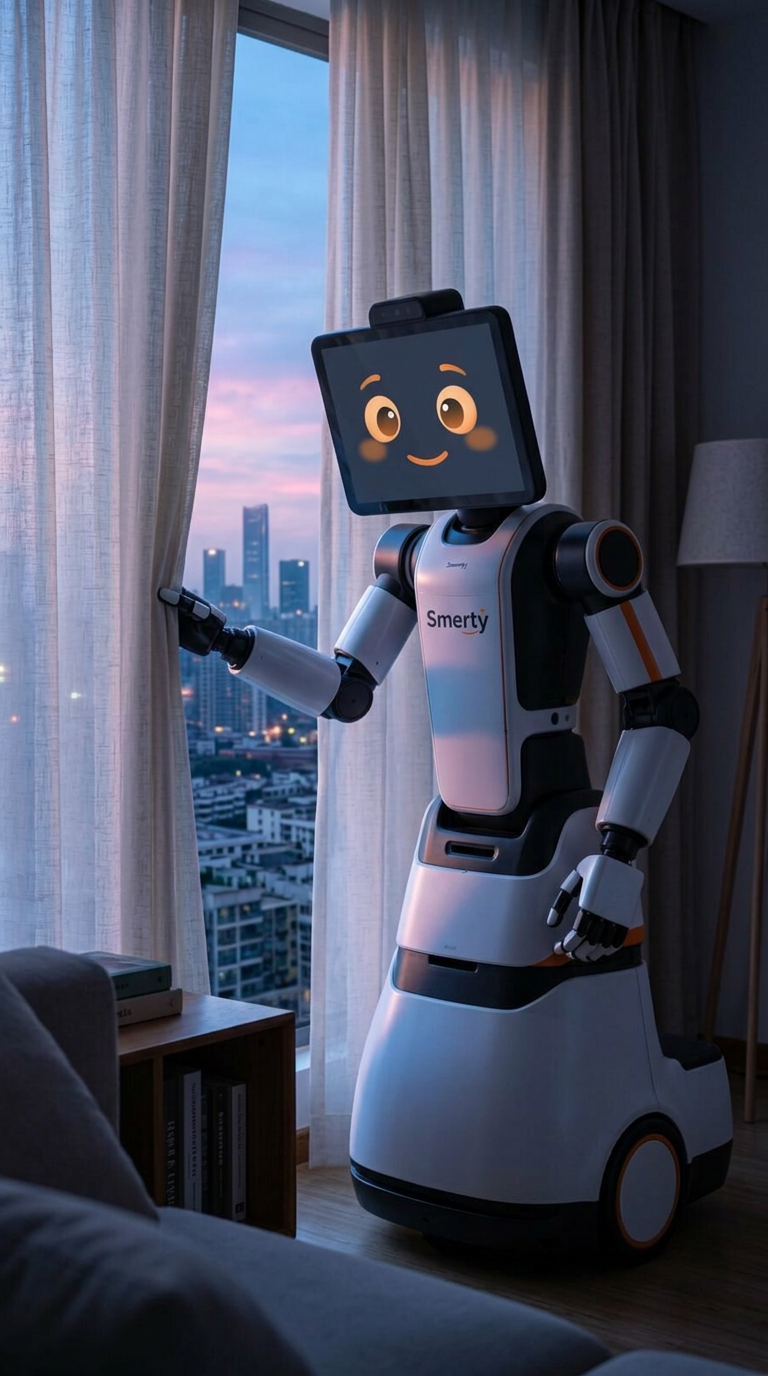
Curtains open for the sunrise
Lets the light in and starts the morning gently.
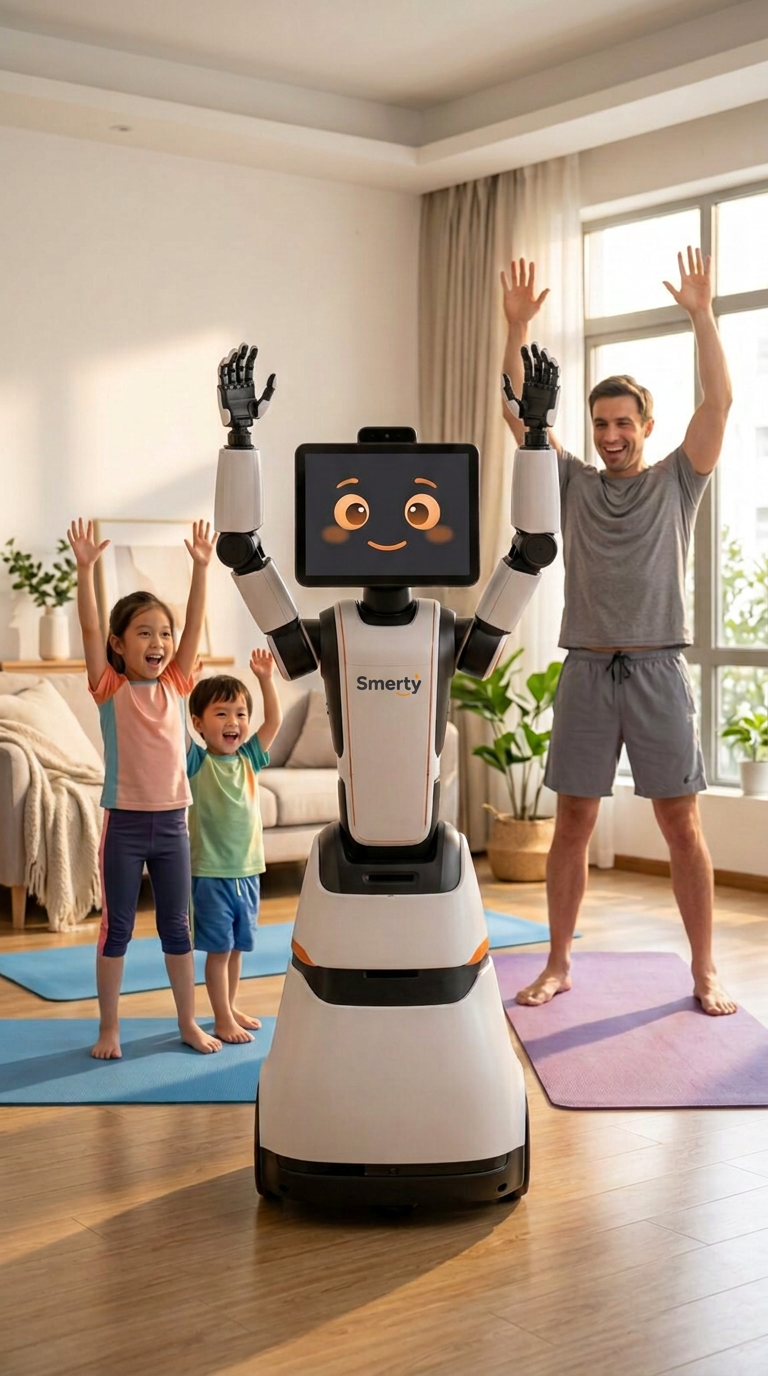
Morning stretches with Dad and the kids
Leads the moves on its screen and joins in with its arms.
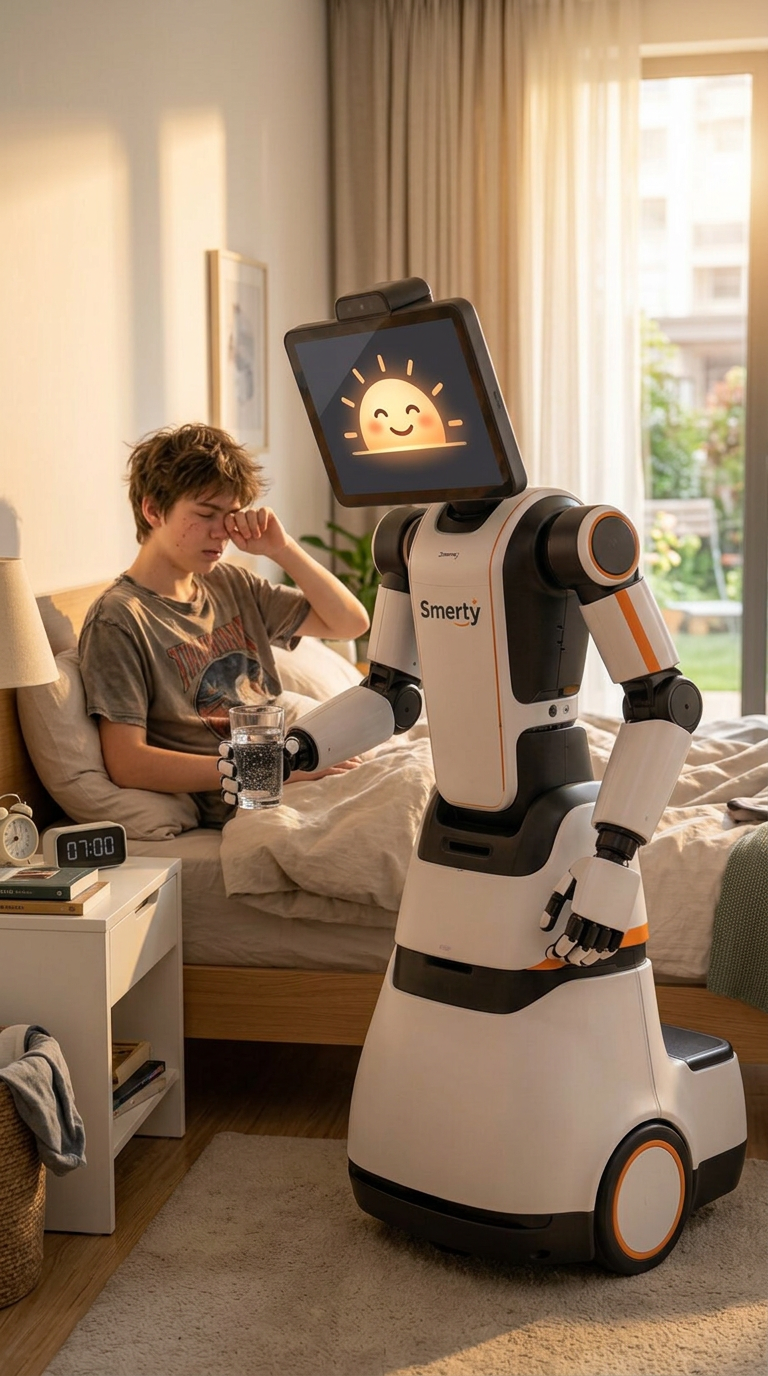
A glass of water for a sleepy teen
Brings it over with a cheerful wake-up.
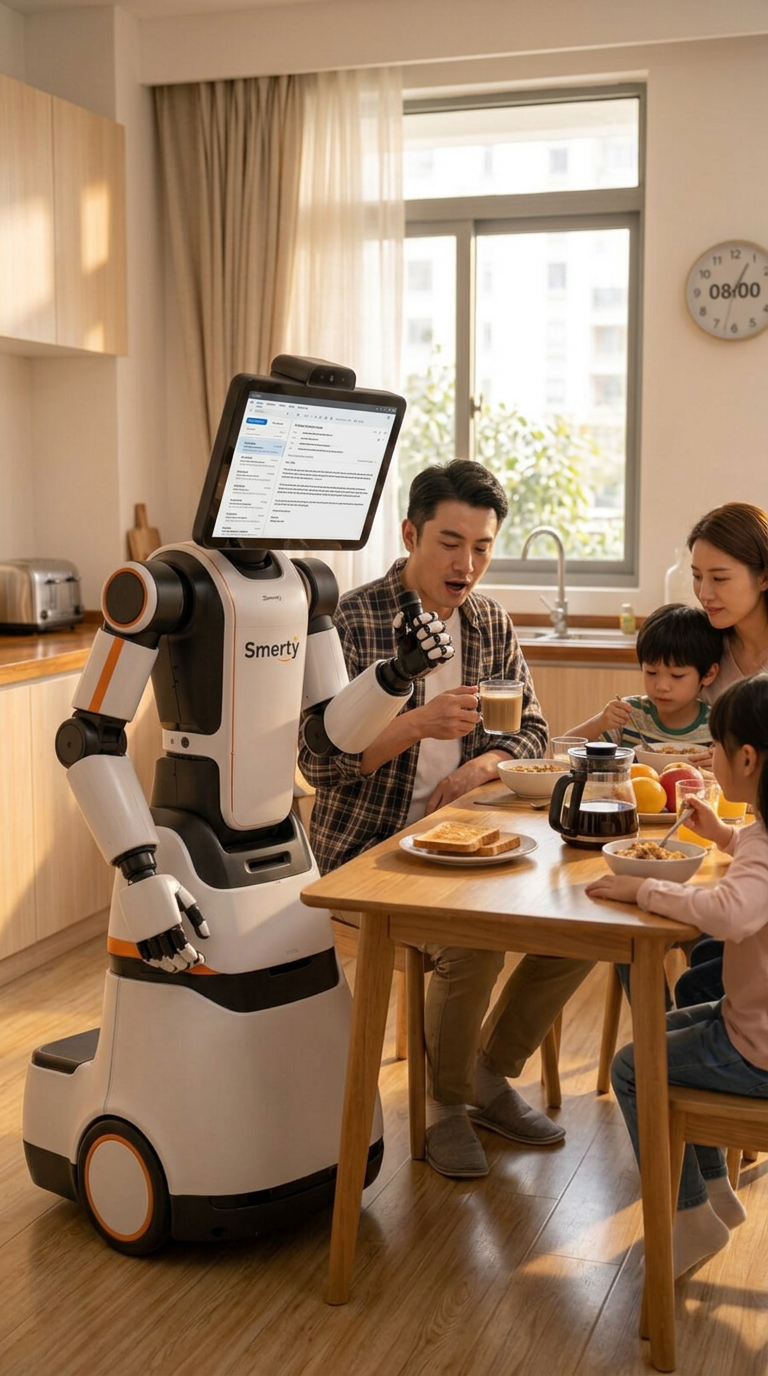
Breakfast and emails
Reads Dad's emails aloud and sends his spoken replies.
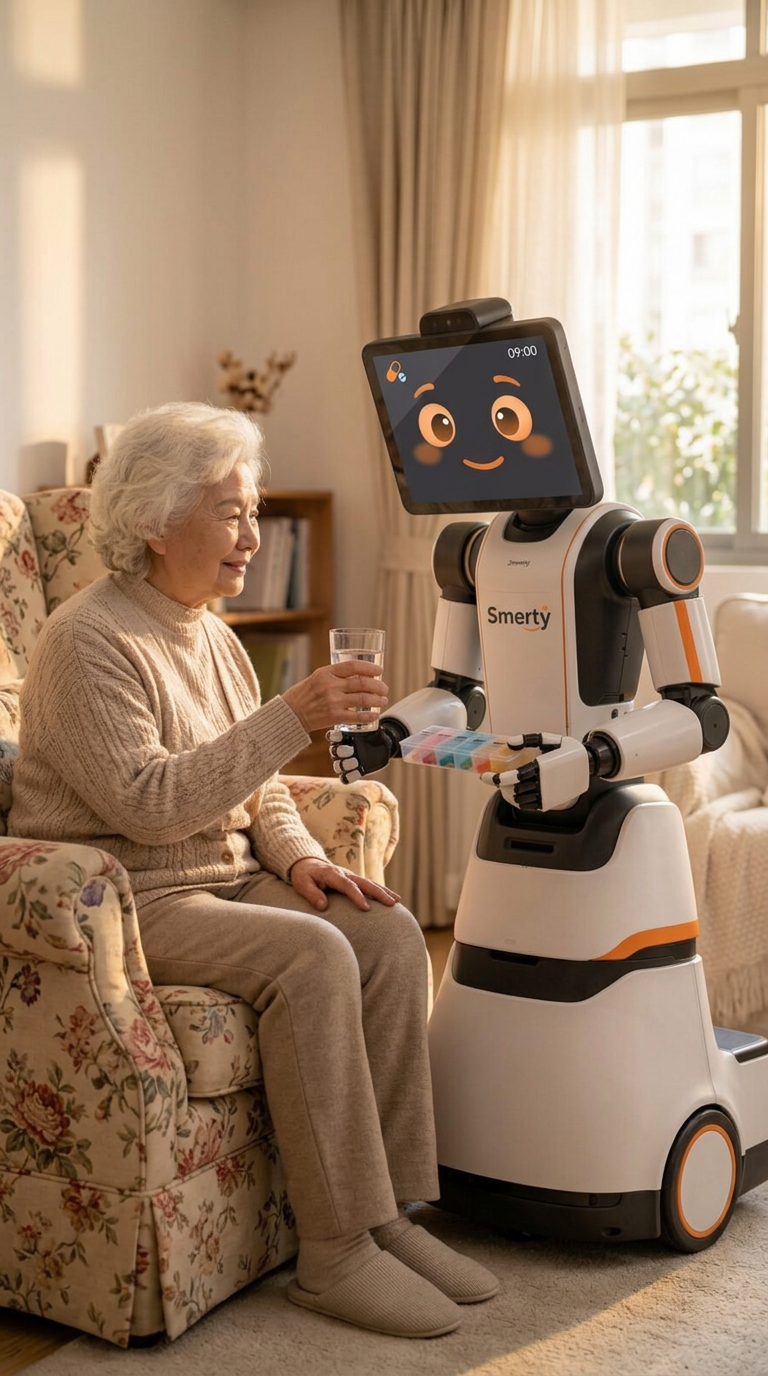
A friendly reminder for Grandma's pills
Brings the box and tea, right on time.
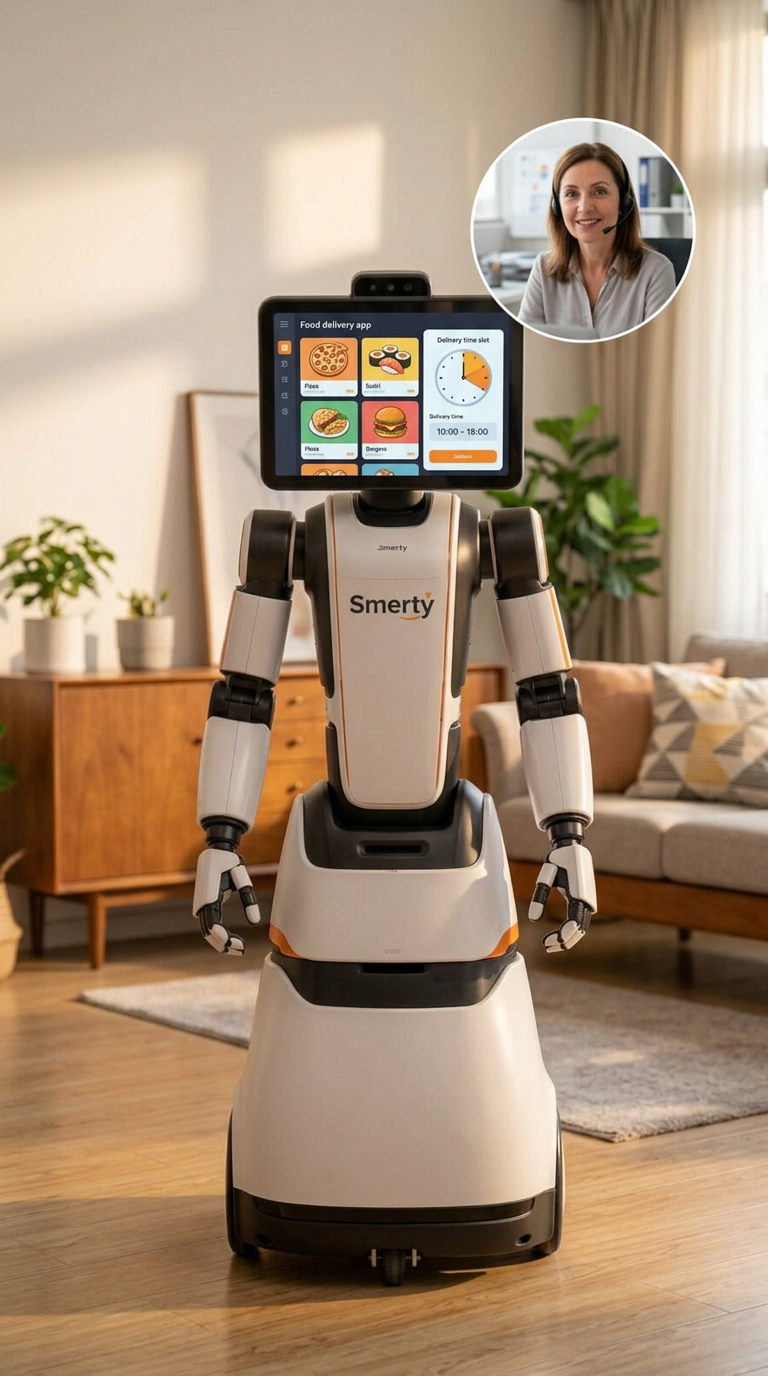
Lunch, ordered from its screen
Pick the meal and the delivery time together.
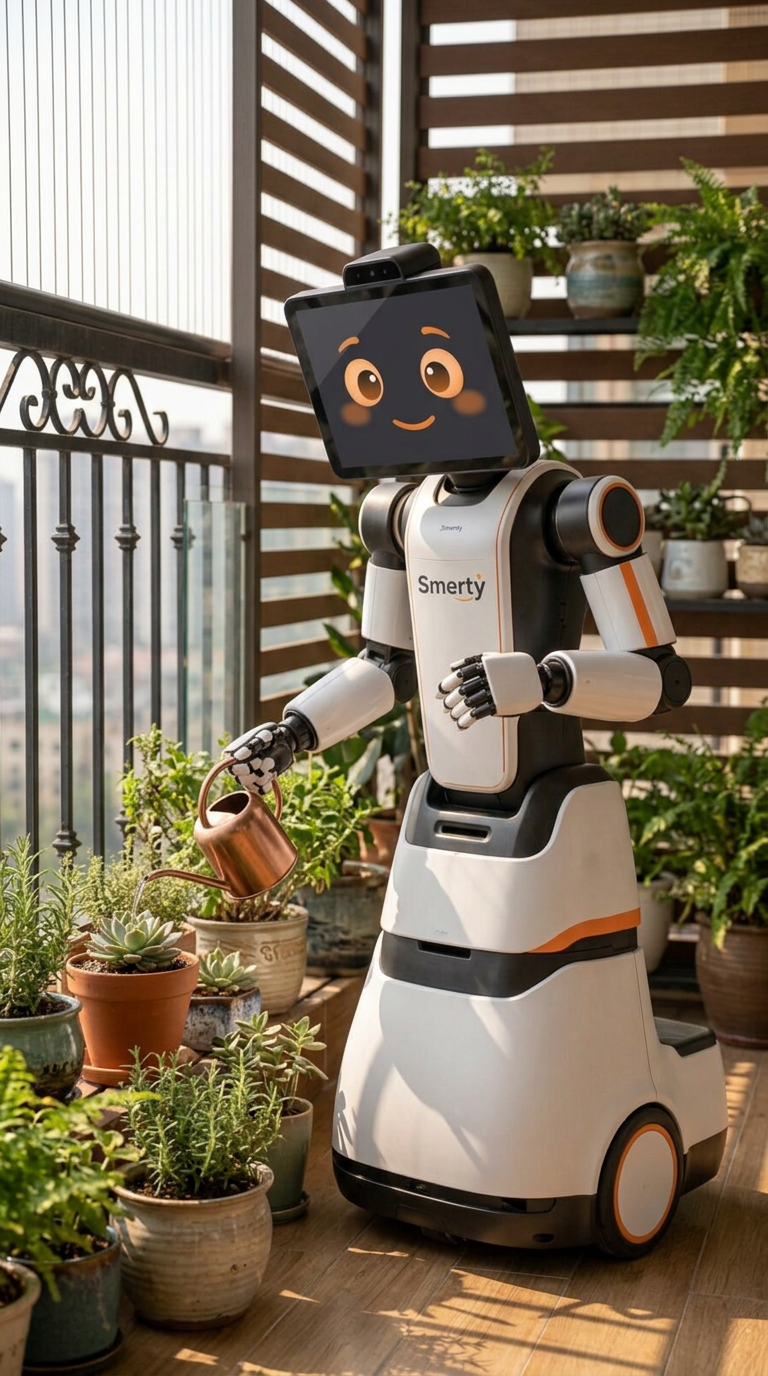
The balcony plants get a drink
Waters the plants on the schedule you set.
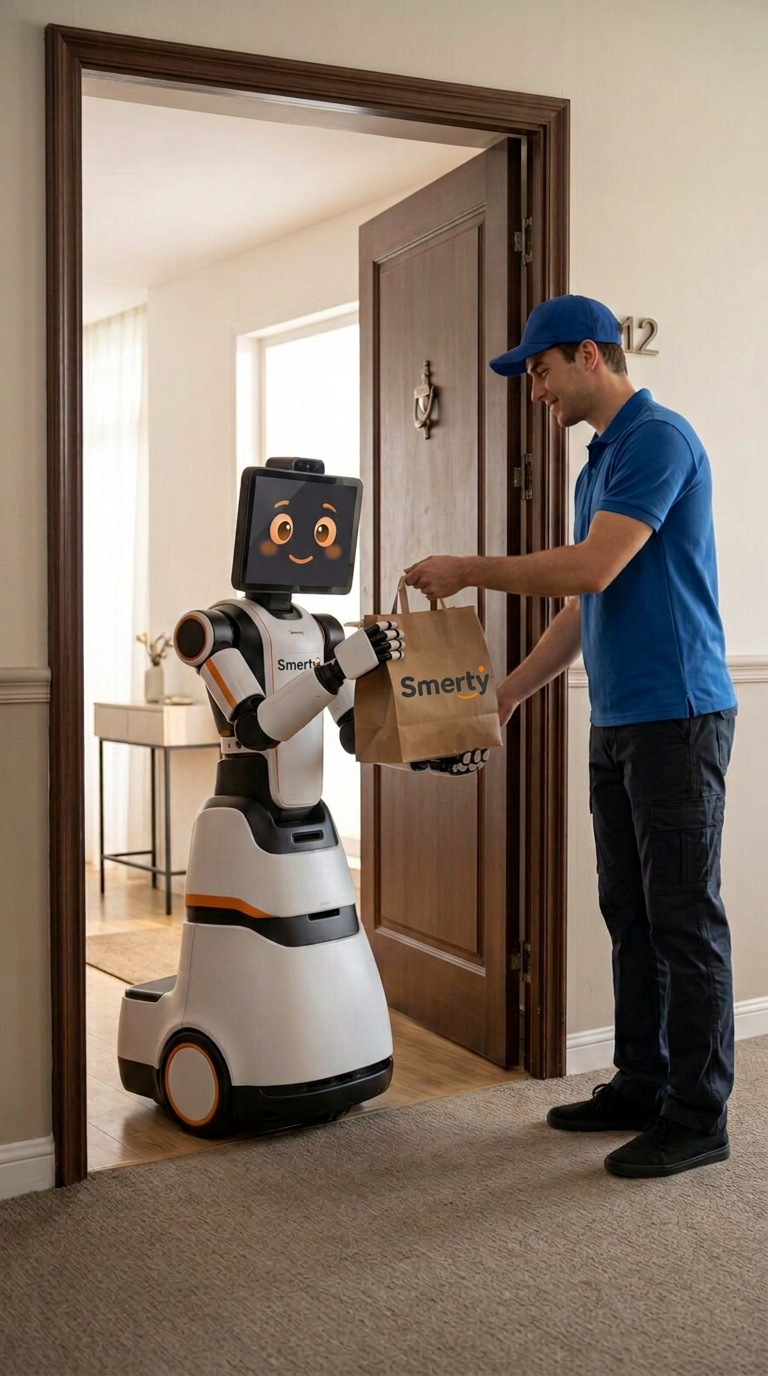
The delivery arrives on time
Receives the food at the door at the time you chose.
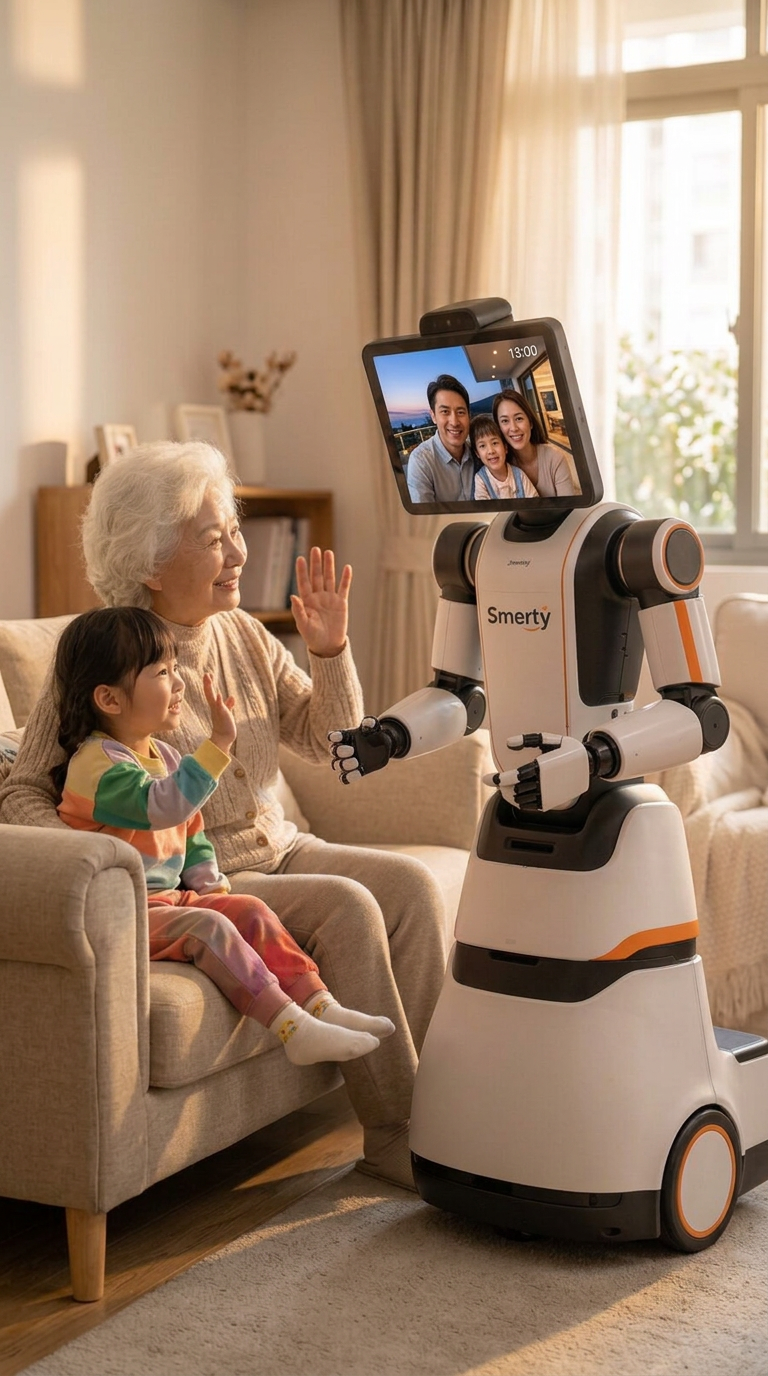
A video call with family far away
Grandkids and relatives appear right on its screen.
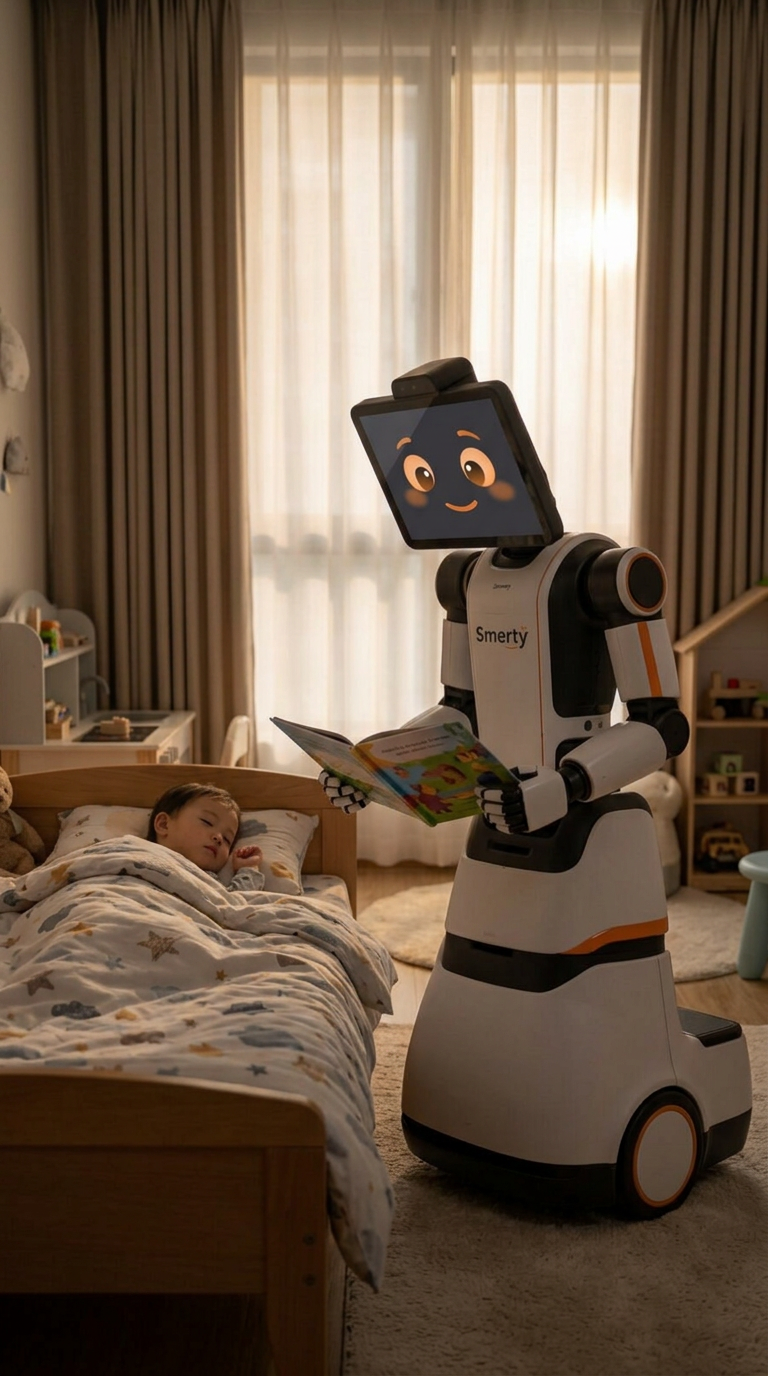
A storybook for nap time
Reads aloud with pictures on the screen.
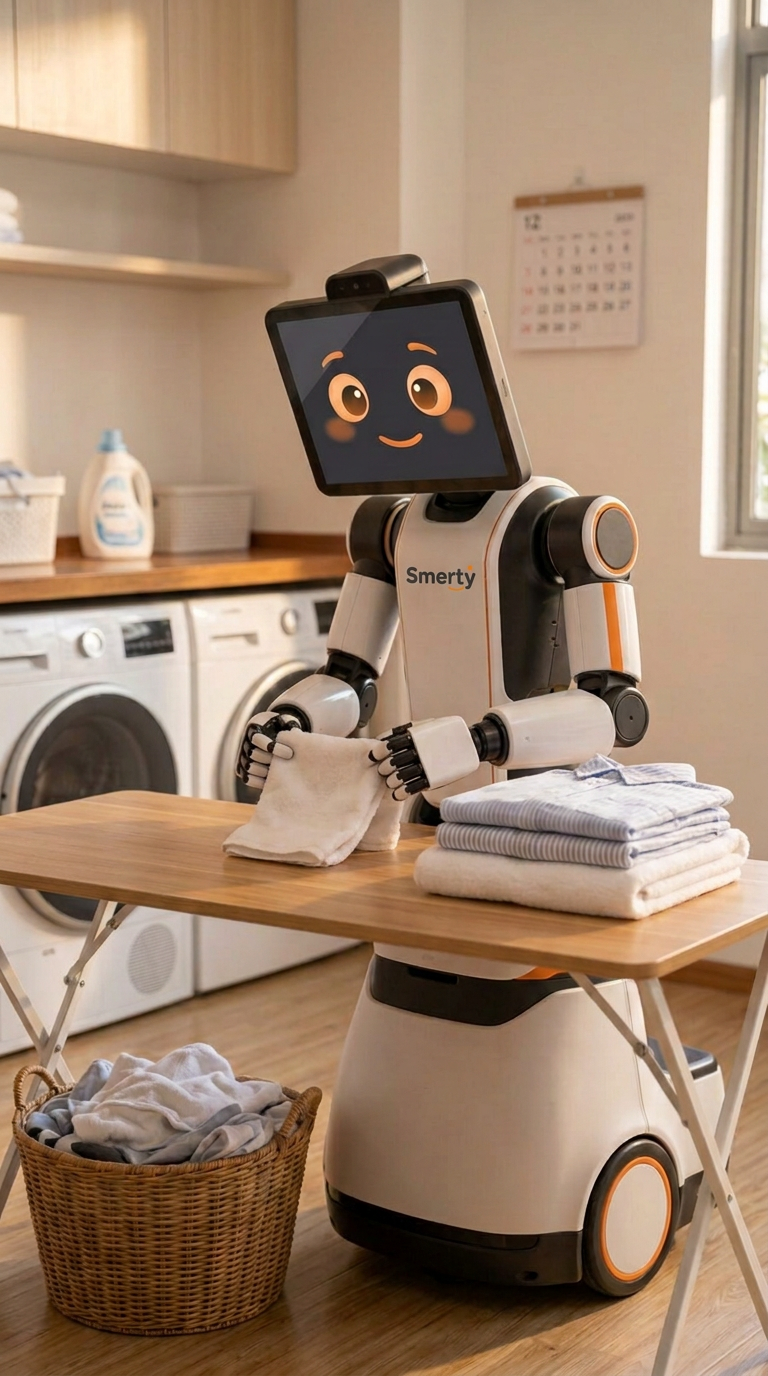
Laundry, folded
Folds and carries the basket with its two hands.
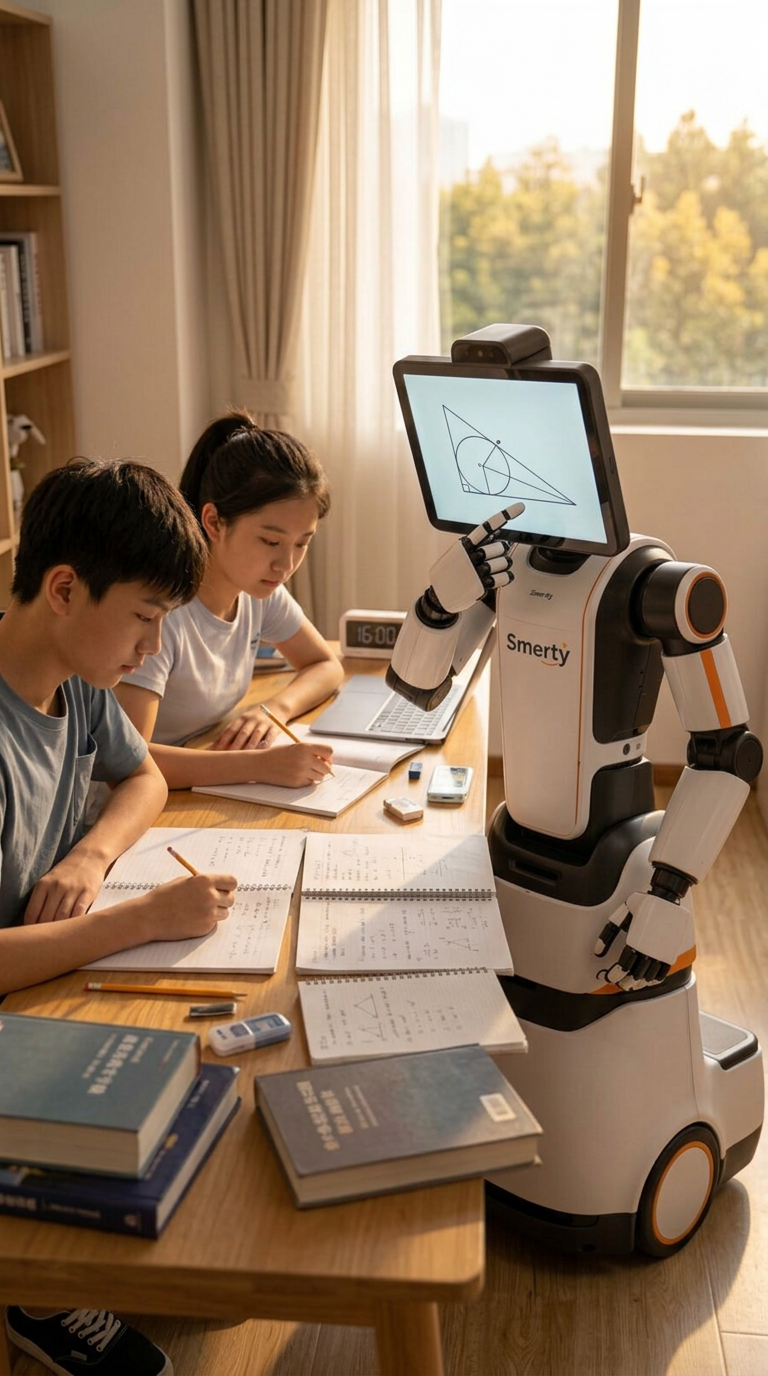
Homework help
Geometry, reading and spelling, step by step on its screen.
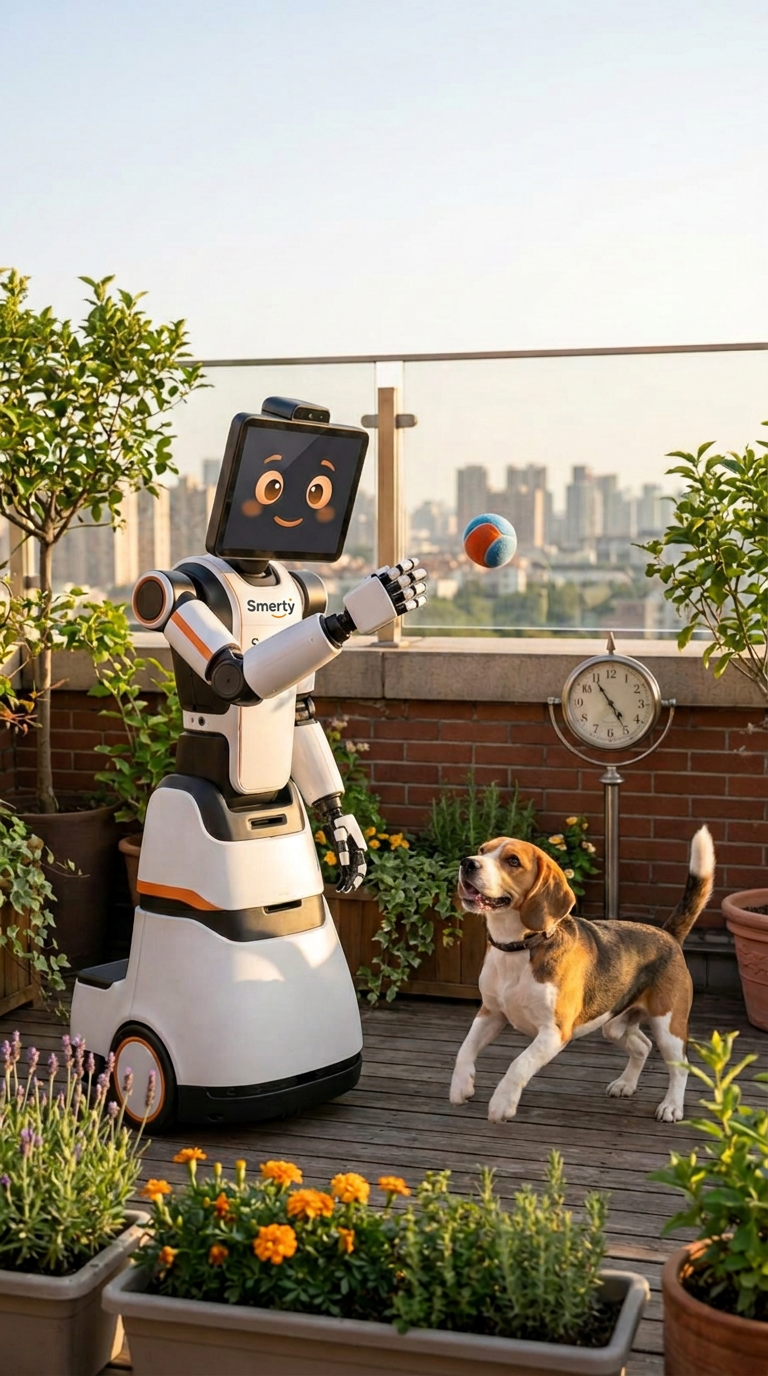
Playtime with the dog
Plays and keeps the dog inside the areas you allow.
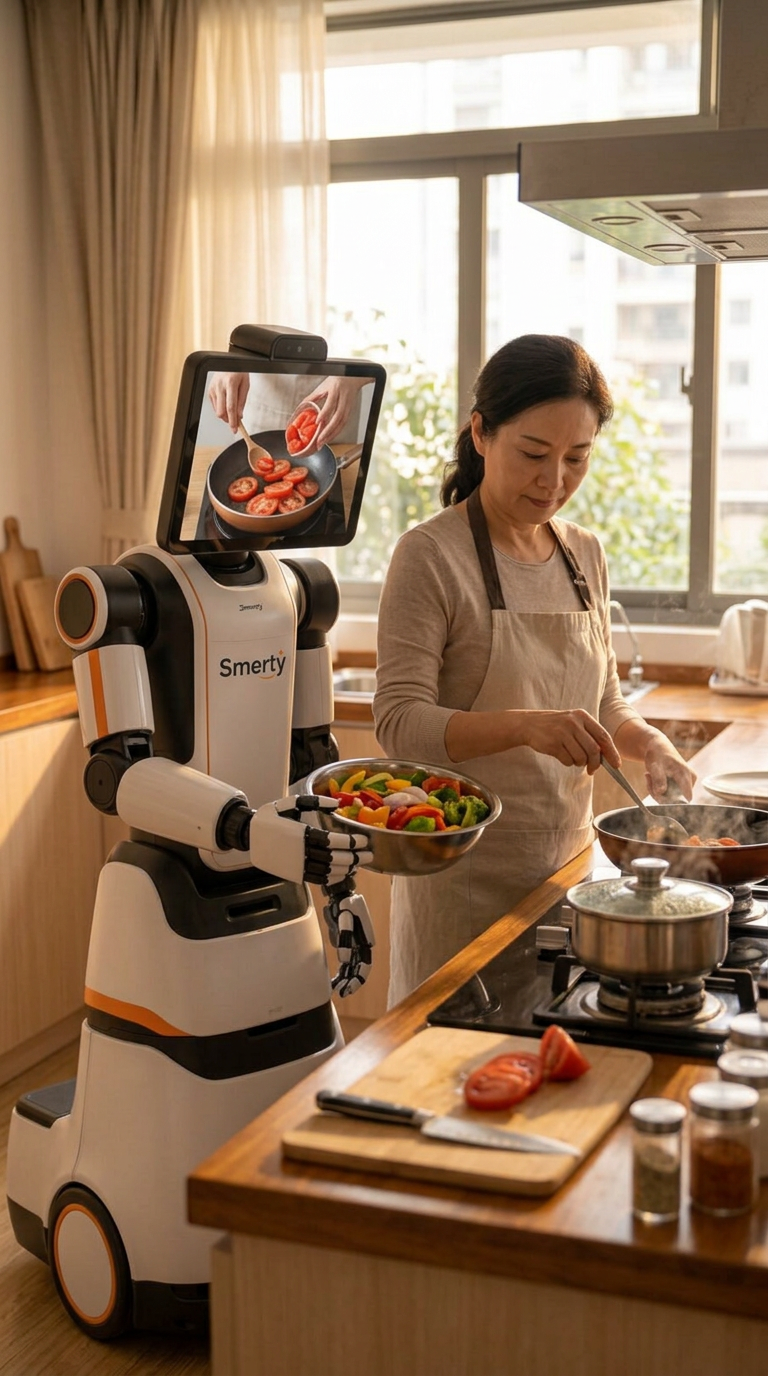
An extra pair of hands in the kitchen
Shows the recipe and passes what you need.
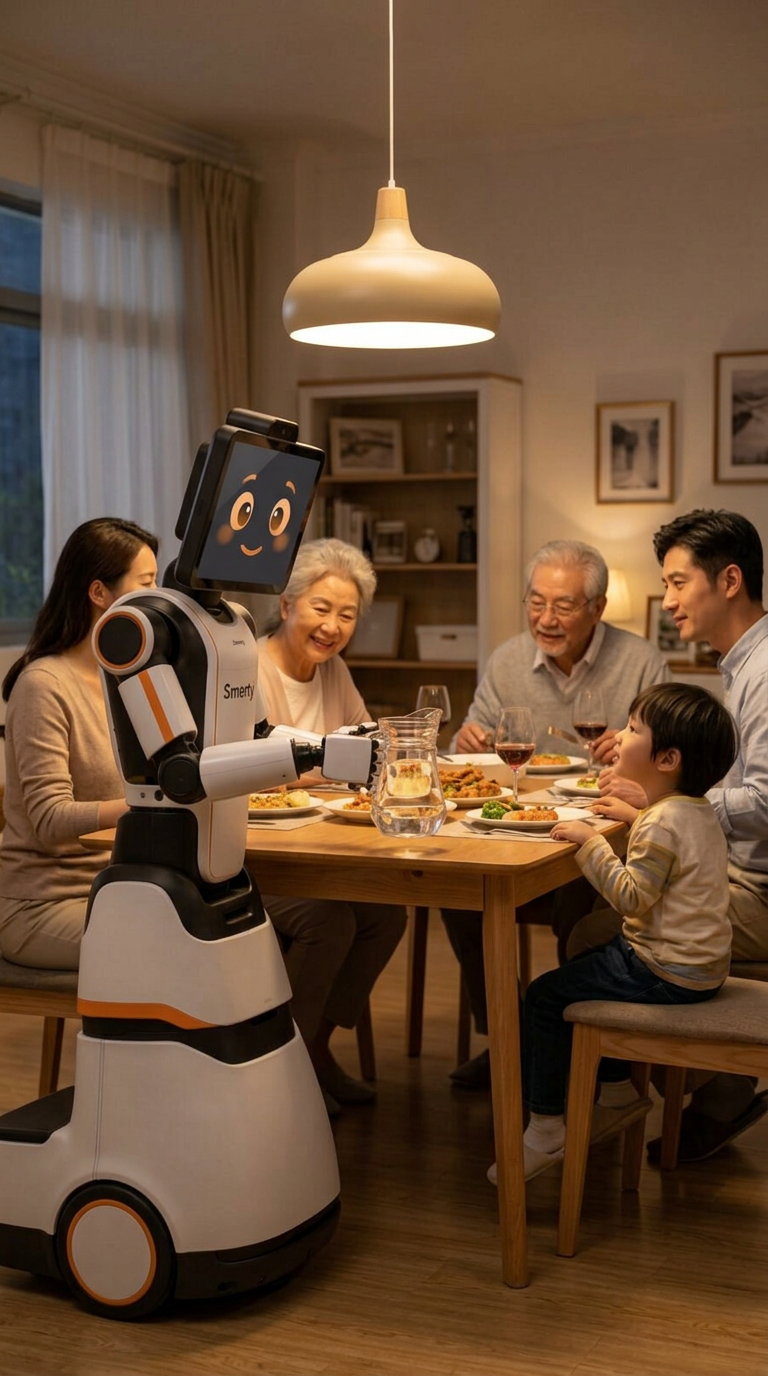
Everyone around the table
Family dinner, with music and conversation.
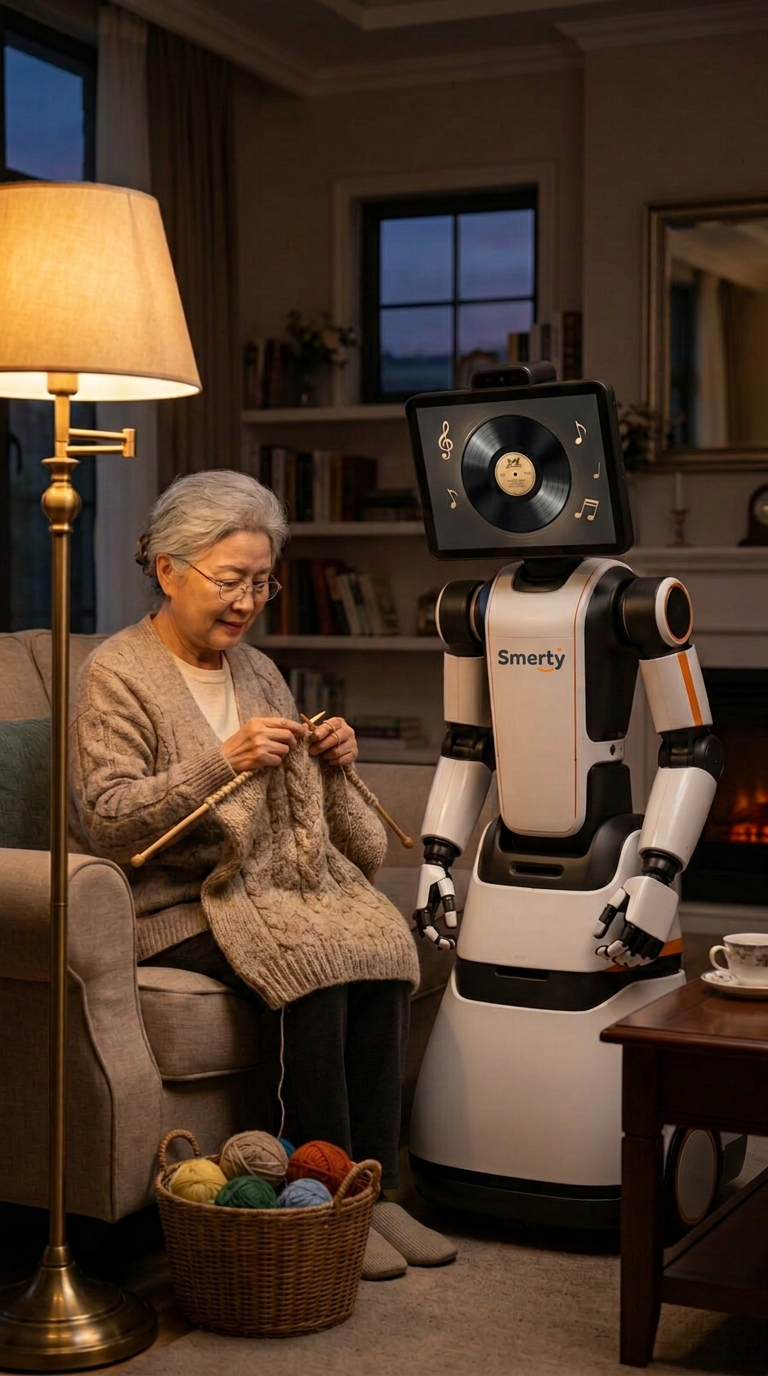
Grandma's favourite old songs
Plays her music while she knits on the sofa.
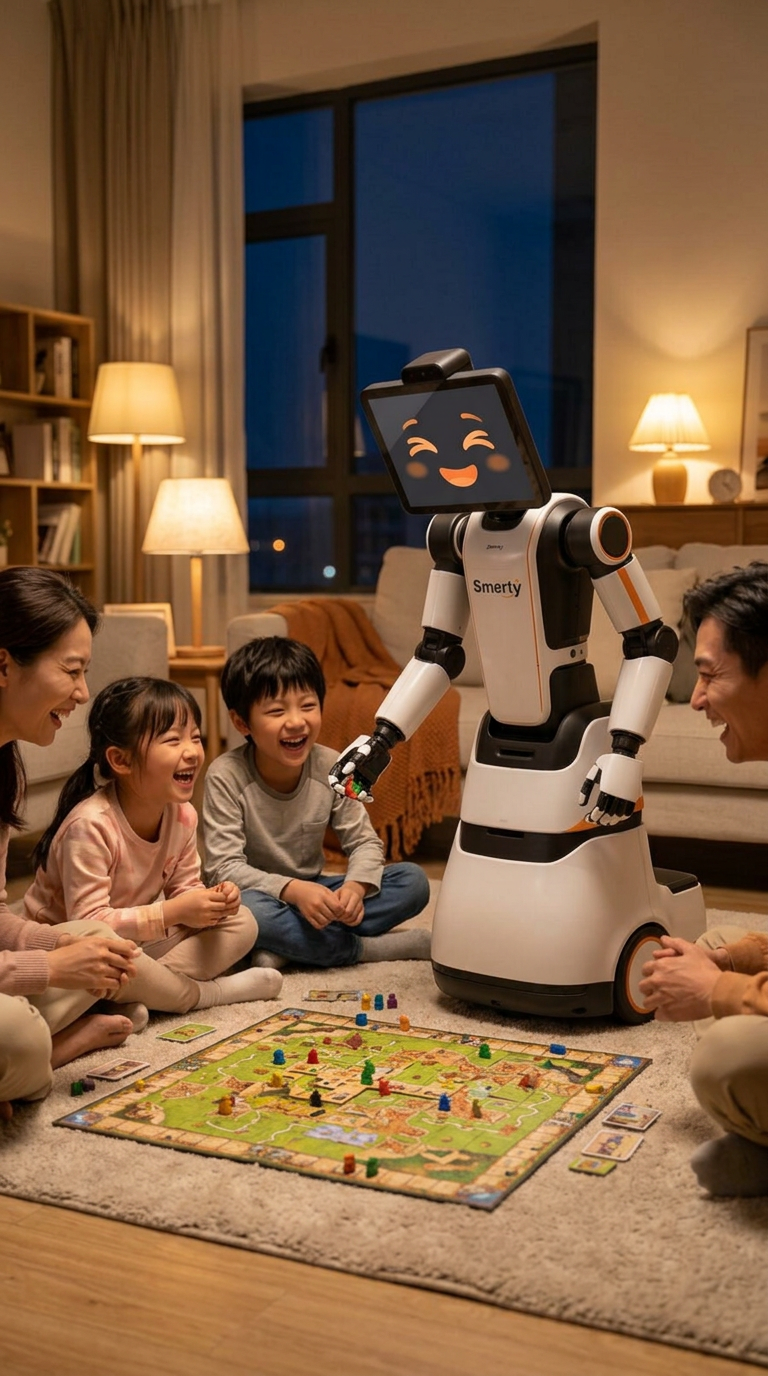
Game night
Board games and quizzes for every age.
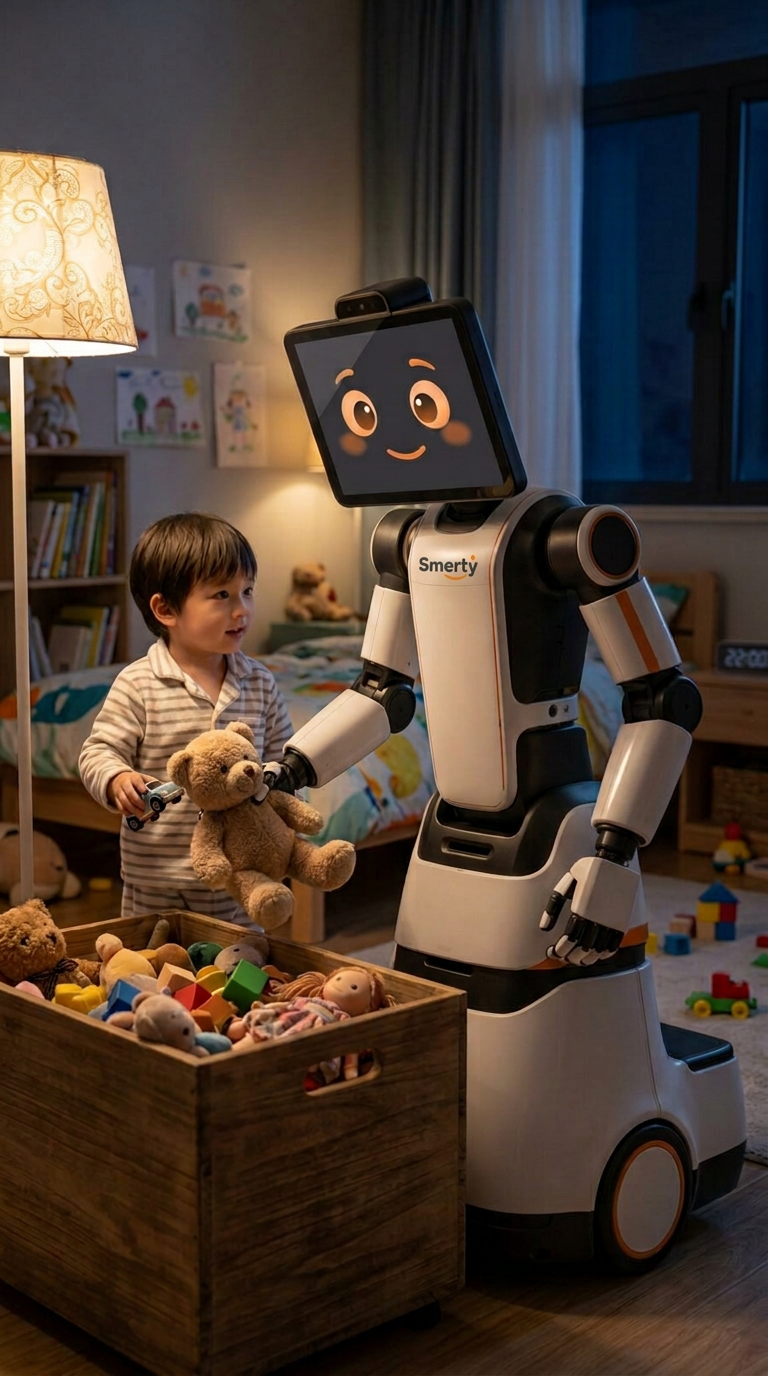
Toys back in the box
Tidies up the playroom before bed.
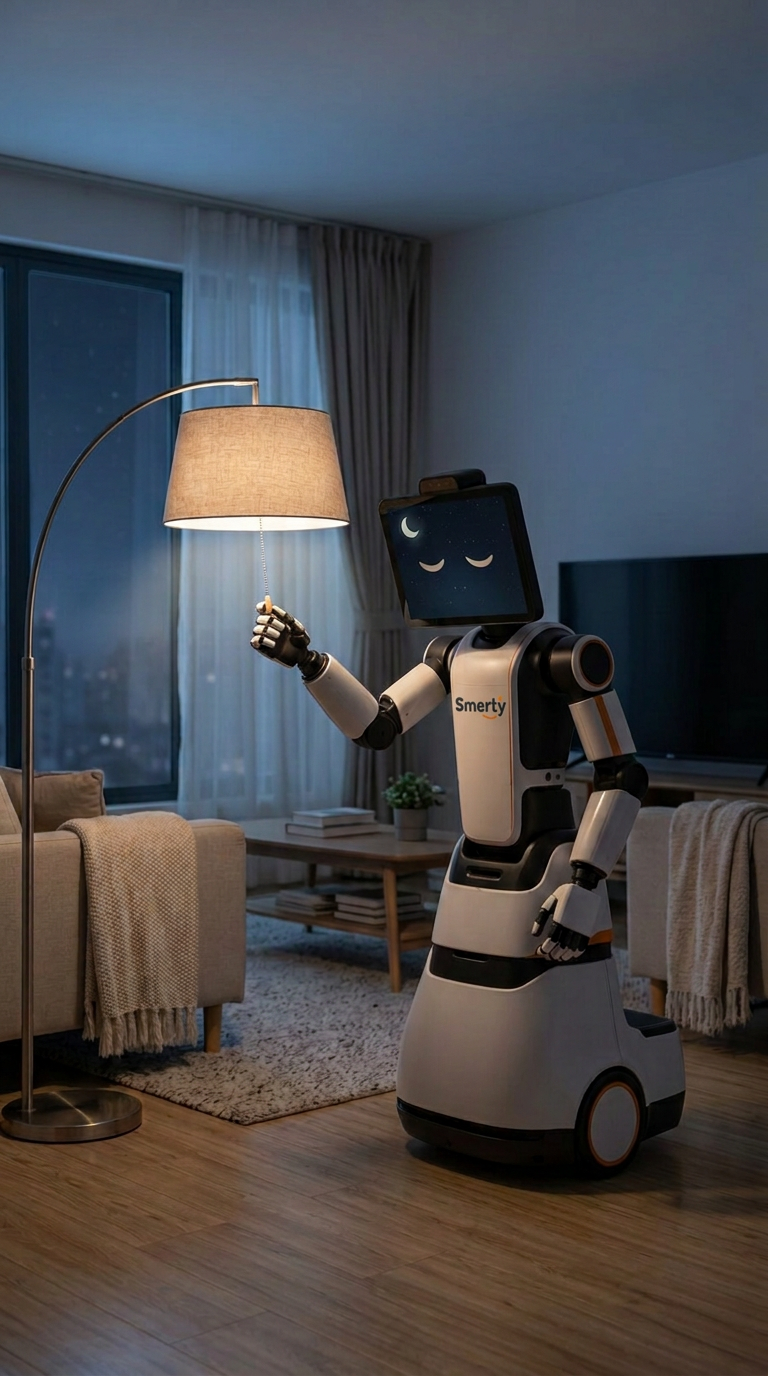
Lights off. Goodnight.
Dims the lights and settles in for the night.
™'s own voice — the one you choose
Smerty speaks with a voice of its own, and the household picks the one they like best from the ones we ship: calm and quiet, warm and chatty, or a plain, clear voice for someone who finds a busy tone hard to follow. It speaks and listens through Smerty's own microphone and speaker, answers everyday questions only from information the family has approved, and goes quiet the moment a person joins.
Weight, materials and your floor
Smerty is heavy on purpose. Almost all of that weight sits at the bottom, and that is what keeps it upright through normal use — one adult leaning on it, a dog walking into it, a nudge from a child. It is stable, not immovable: a load it was not designed for can still take it past its tipping point, so the limits below are stated plainly.
100 kg
of that is the base
Steel ballast set low and wide. It takes a shove, a dog walking into it or one adult leaning — it does not take a load it was not designed for.
400 kg
what the base is rated to
The chassis underneath is built to move up to 400 kg. We ask it to carry a quarter of that, so Smerty is never near its limit.
25–50 kg
the hands can handle
Smerty handles up to 25 kg; Smerty+ handles up to 50 kg with both hands together. Enough for a full kettle, a stack of plates or a basket of laundry.
160 kg
total weight
160 cm tall on a 60 × 60 cm footprint — most of the mass sits in the base, below the elbows.
Below the elbows
centre of mass
Kept inside the wheel footprint, so reaching forward never lifts a wheel.
Why your floor is safe
A heavy machine only marks a floor when its weight is pushed through a small, hard, dragging contact point. Smerty is designed to avoid all three at once.
Large wheels, soft tyres
Big-diameter wheels with non-marking polyurethane tyres spread the load over a wider patch, so the weight never sits on a narrow point that dents or bruises the floor.
Weight spread, not concentrated
The mass is carried across the whole wheel track rather than through four small contact points — which is what normally leaves permanent marks in wood and vinyl.
Nothing drags
Smerty steers and stops on its wheels. The base shell never touches the ground, so there is no scraping edge and no black scuff marks when it turns.
Clears thresholds and carpet pile
Wheel diameter and ground clearance are set to roll over door thresholds and low-pile carpet without catching or dragging debris underneath.
Rolls, never shoves
It moves at walking pace with a soft start and stop, so it does not push a rug, a chair leg or a shoe across the room.
60 decibels maximum — quiet as a conversation
Smerty moving generates no more than 60 dB, about the level of a quiet conversation. There are no heels, no hard castors and no footsteps on the floor. The soft tread absorbs the click and rattle a hard wheel makes on tile or wood, so at night Smerty passing the bedroom door is a faint hum rather than someone walking past it.
Proved on real samples
Before any home is asked to take a unit, the wheels are run on the floor types we support: hardwood, laminate, tile, vinyl and low-pile carpet.
What Smerty is made of
Frame
Aluminium extrusion skeleton — stiff, does not rust, and individual parts are replaced rather than the whole unit scrapped.
Shell
ASA panels: wipe-clean, and they keep their colour next to a sunlit window instead of yellowing.
Ballast
Steel plate set at the very bottom of the base. That is what makes Smerty stable.
Surfaces
Powder-coated and anodised finishes that take a normal household cleaner.
Screen
Toughened glass over the display, so a knock from a child or a dog bowl does not crack it.
Wheels
Large-diameter wheels with soft, non-marking polyurethane tyres.
Design targets, not measured results. Weight, materials and floor compatibility are confirmed on the pilot units.
How far that stability goes
A base that holds one adult leaning is not a base that holds any load. Here is the difference, stated plainly, so nobody finds out by being under it.
Normal use — it stays put
One adult leaning on it for support, a dog walking into it, a child bumping it, a nudge from a wheelchair as someone stands up. The 100 kg of ballast sits below the elbows, inside the 60 × 60 cm footprint, and Smerty simply takes it.
Programmed tasks — inside its ratings
Smerty handles up to 25 kg and Smerty+ up to 50 kg with both hands together, the base carries its own 100 kg of ballast, and motions are speed-capped with stops on contact. Reaching forward for a shelf or carrying a laundry basket never lifts a wheel, because the load stays over the base.
Past the limits — it will tip
Three adults of 100 kg hanging off Smerty is 300 kg of load on a machine that weighs 160 kg with a base half a metre square. It tips over. That is not a fault or a weakness of the design — nothing on wheels of this size would stay up, and Smerty does not pretend otherwise.
What you must not ask Smerty to do
These are not covered by what Smerty is built for. They are outside its ratings, and doing them puts a person under a 160 kg machine that is about to move.
Two or more people leaning, hanging or sitting on Smerty at once. One adult at a time, and only leaning.
Climbing on it — a child using the mast or the arms as a ladder, or anyone standing on the base.
Pulling it along, or using an arm as a handle to steady yourself while you stand up.
Lifting, carrying or moving a person. Smerty has no person-lift rating and never will; the base only supports someone leaning.
Hanging a bag, a plant or any load on an outstretched arm — weight away from the base is exactly what tips a machine like this.
Stepping on the cables or wedging the wheels; a blocked wheel while Smerty is moving can throw its own weight sideways.
The tip-over alarm
Because the limits exist, Smerty watches its own angle and says so out loud — in development for the pilot, and part of what a pilot home is asked to test.
Tilt sensor on the base
An inclinometer watches the angle of the base. Past a small, set tilt — the angle at which a wheel is about to leave the floor — it triggers before Smerty has gone far.
Loud local alarm
A siren on the unit sounds so everyone in the room stops and steps back, and every motion halts at once.
Alert to the carer's phone
The same event is pushed to whoever is on call with a snapshot, so a person — not the machine — decides what to do next.
Locked out until a person resets it
After a tip warning Smerty stays still until someone checks the room and clears it by hand. It does not quietly carry on as if nothing happened.
What a pilot home is agreeing to
- Smerty is a prototype in a pilot programme. It is not a medical device, not a lift, and not a substitute for a carer, a rails in the bathroom, or someone who answers when a person needs help.
- Stability, floor safety and the tip alarm are design targets being measured on these units. Until they are measured, they are described as targets, not as certificates.
- Damage or injury from anything in the list above — more than one person on Smerty, climbing, hanging loads on an arm — sits outside what Smerty is built for and outside the pilot agreement.
- Anything fitted to Smerty by someone other than SMERT, or any change to its software or structure, becomes the responsibility of whoever fitted or changed it. The same applies to a site that runs Smerty under its own insurance: the cover, the risk assessment and the local sign-off stay with that site and its insurer, not with us.
It takes the smallest space in the house
Smerty does not need a corner of the living room or a charger left in the hallway. Its home is the storeroom you already have — the one under the stairs, at the end of the kitchen, off the landing.
Parks and charges out of sight
The dock is a charging strip on the floor of a small storeroom. Smerty rolls in, backs onto it and charges behind a closed door.
Opens the door itself
A lever handle is one of the approved motions, so Smerty can pull the storeroom door open and close it behind it on the way out.
Goes back when it is not needed
When the day's tasks are done and nobody needs support, Smerty returns to the dock on its own instead of idling in the room.
Comes the moment it is called
A spoken call, a touch on the screen, or a carer's phone brings it straight out of the storeroom and into the room that asked for it.
Out of the way, not out of service
No charger in the hallway, no cable across the floor, and nothing standing in the room you are using. It is there when called and gone when it is not.
A storeroom, not a garage
The dock takes the floor space of a doormat, and the doorway of an ordinary cupboard is wide enough for Smerty to pass through.
Self-return, docking and opening a door are among the motions we are building for the pilot. The exact footprint, height and dock size are fixed with the pilot homes.
Your home stays inside your home
Smerty does its seeing and its thinking on the unit itself. There is no camera feed to stream out and no recording to hand over.
Video is read on Smerty
The cameras are processed by the computer inside Smerty's own base. No continuous video or audio stream leaves the home.
Nothing is sold or shared
No advertising networks, no data brokers and no third-party analytics on the camera feed, and your footage is never used to train models.
Only what you send, goes
The only things that leave the home are the ones you or your carer start: a call you place, or an event alert you switched on.
EU and US rules by design
Built to GDPR in Europe and CCPA/CPRA in the United States: your data stays in the region you choose, and a data-processing agreement covers care organisations.
Where the data lives
Europe (GDPR): processing stays in EU-region services under smert.ai B.V., with a record of processing and a data-processing agreement for care organisations.
United States (CCPA/CPRA): no sale or sharing of personal information, no data brokerage, and deletion when you ask for it.
Smerty is not a medical device and we do not claim HIPAA certification. Care-organisation contracts are covered by our data-processing agreement.
Coming with the first deliveries
These parts are being finished for the first units delivered in March 2027.
Live two-way video
The carer's face on Smerty's screen; the carer sees and hears the room.
Fall alert
Camera-based fall spotting that asks the person if they are OK and alerts their carer. Being built and tested in our lab.
Human-confirmed emergency call
Smerty never calls an ambulance on its own. A carer or the person confirms first.
Carer and family accounts
Invited carers and relatives with their own secure sign-in.
Consent and privacy
Consent from the person cared for before any session, with a session log.
The ™ design
A large wheeled base for stability, no legs, two articulated arms with hands, and a screen for its face and video calls.
Drag to turn · scroll or pinch to zoom · tap a number to see each part
Drag to turn Smerty around, scroll to zoom. Concept model, not final dimensions.
Every part, explained
The final design may vary. Small details — panel shapes, finishes, sensor and hand housings — can change as parts are validated for production. We are sticking to the design shown on this page, and everyone who reserves receives development updates by email.
Ask ™ anything
Size, weight, safety, price, what it can and cannot do — answered from our approved facts.
Talk to Smerty
Demo answers come from our approved product facts only.
What is inside the unit
The planned configuration. Final parts, dimensions and battery life are set during the pilot.
Base
60 × 60 cm wheeled base — fits through a standard doorway and parks in a storeroom. No legs.
Height
160 cm tall — the screen sits at eye height for a seated or standing adult.
Arm reach
Each arm extends 60 cm, like a human arm, so shelves, counters and tables are all in reach.
Base rating
The mobile base is rated to 400 kg. Smerty loads it with 100 kg of ballast — a quarter of its rating.
Arms and hands
Two articulated arms with dexterous multi-finger hands, handling up to 25 kg (Smerty) or 50 kg with both hands together (Smerty+).
Screen
Landscape screen at eye height for video calls and faces.
Cameras
Room camera on the mast plus wrist cameras for close work.
Voice
Microphone array with hardware echo cancellation, plus a speaker.
Compute
One enclosed NVIDIA Jetson Orin computer per unit.
Privacy
Video is read on Smerty. Nothing leaves the home unless an event is sent.
Safety
Speed-capped motions, stops on contact, STOP at any moment.
Weight
160 kg in total — 100 kg of that is the ballasted base. Stable for one adult leaning on it; not a hoist, and it can be tipped if overloaded.
Floors
Large soft-tyred wheels. Built to be safe on wood, laminate, tile, vinyl and low-pile carpet.
Who builds ™
SMERT is the manufacturer. We design and assemble Smerty, and we write the software that runs on it.
We build it
SMERT is the manufacturer. Our own team writes the AI, the computer vision and the motion software, and assembles Smerty in Hong Kong.
One lab, one standard
Every unit is brought up and tested at our R&D lab: 14/F Foo Hoo Centre, 3 Austin Ave, TST, Hong Kong.
Care without overclaiming
We do not sell Smerty as a medical device and we do not promise what the cameras cannot see.
Installed and supported
Deployment, training and a technician network in APAC, Europe and the Americas, with 24/7 online assistance.
More skills coming up
Smerty's skills will grow through software updates. These are planned additions, subject to testing, compatible hardware and your approval—not functions available today.
Personalised household routines
New voice-guided schedules, room-by-room tasks and configurable reminders.
Family learning and entertainment
More homework activities, language practice, accessible games and karaoke experiences.
Pet-friendly routines
Configurable indoor boundaries, pet-event alerts and supervised play routines.
Everyday tidying
New tested object-handling and dry-cleaning routines within approved motion limits.
Event assistance
Additional locally processed event cues, human check-ins and human-confirmed escalation workflows.
Remote support tools
Improved family and carer calling, troubleshooting and configurable accessibility options.
Remote assistance & software updates
Smerty
US$99 per month or US$999 per year
Smerty+
US$199 per month or US$1,999 per year
Includes remote assistance and software updates with new skills and solutions as they are released. Hardware purchase is separate; new skills may require compatible accessories and safety validation.
Release dates are not yet announced. This plan is not an emergency-response service or a guarantee of continuous human care. Subscription checkout is not open yet.
Our support commitments
24/7 remote assistance & alarm overview
Round-the-clock remote support and an overview of configured alerts, included with your assistance plan. Emergency decisions stay with a person.
Replacement hands dispatched within 24 hours
If a hand malfunctions, we dispatch a replacement within 24 hours. Dispatch is not arrival; transit and customs depend on your location.
Technician intervention when needed
Remote troubleshooting first, with technician intervention when required through our global network. Visit timing and coverage are confirmed for your location.
Choose your ™
Same body, cameras, safety and AI in both. Only the best in safety, computer vision and artificial intelligence. First deliveries March 2027.
Smerty
US$9,999 + taxes
- Dexterous hands
- Handles up to 25 kg with both hands
- Fully refundable deposit US$999 (10%)
- Support plan US$99/month or US$999/year
Smerty+
US$19,999 + taxes
- Dexterous hands
- Handles up to 50 kg with both hands
- Fully refundable deposit US$1,999 (10%)
- Support plan US$199/month or US$1,999/year
Buy now, pay later
Split your purchase into instalments at checkout instead of paying in one go. Reserve with the 10% deposit today and choose instalments when your Smerty is ready to ship.
™ as a Service
US$999/month · Smerty
US$1,999/month · Smerty+
All-inclusive contract — 24 months for Smerty, 36 months for Smerty+: your Smerty, the assistance and software plan, new skills and support in one monthly fee. Ask us when you reserve.
Secure payment by Stripe. Deposit fully refundable on request. We'll email you development updates and your estimated shipping time. The final design may vary; we are building to the design shown on this page.
Questions people ask us
What ™ is not
Smerty is not a medical device, does not provide diagnosis or treatment, and does not replace emergency services or in-person care. Physical tasks are limited to approved, gentle motions, and Smerty does not lift or move people.
Care homes, care agencies & franchise partners
Offer Smerty to your residents or region. Ask about pilots, volumes and SMERT franchise territories.
Contact Our Team
Fill out the form below and we'll get back to you within 24 hours.
Invest in Smerty
Discuss investment in Smerty with the SMERT team. This is an expression of interest only—not a payment, an investment commitment or an offer of securities.
Contact Our Team
Fill out the form below and we'll get back to you within 24 hours.