After Pickup: Should an Item Travel With a Home Assistant?
After Pickup: Should an Item Travel With a Home Assistant?
Owner-approval draft · 21 November 2026
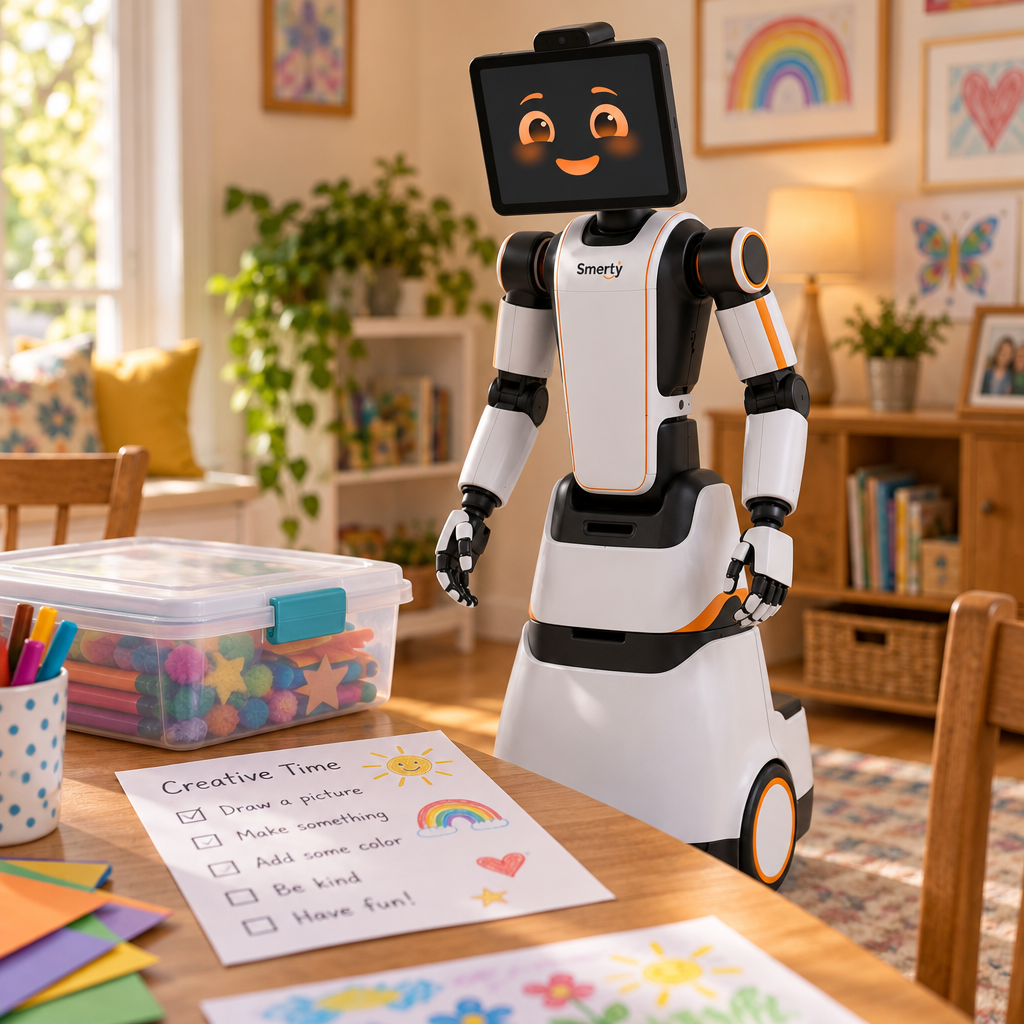
Imagine a small craft supply moving from a cupboard area to the family table. The object may be easy for a person to carry, and a pickup demonstration may look encouraging. Yet pickup answers only one part of the question. What happens to the object during travel, and where does it go when the journey ends?
This checklist focuses on the decision to include movement in an object task. It is not a pickup evaluation, a handoff protocol or permission to test an unsupported activity. Its purpose is to distinguish a potentially useful carrying task from one that should remain stationary or stay with a person.
Write the transport task as a complete sentence
Avoid descriptions such as “carries household items.” They hide the details that matter. Instead, describe one object, its condition, its proposed containment, the start location and the intended destination.
For example, a household planning note might say: “Move a closed container of lightweight craft materials between these two work areas.” That is a candidate task, not a claim that a particular system can perform it.
Now ask what makes travel valuable. Does it remove a meaningful inconvenience, or merely add movement to an activity that could happen in one place? If the family can comfortably bring the activity to a shared table, transport may not be necessary at all.
Keep the evidence boundary visible
The 2014 domestic humanoid prototype study reports testing for indoor movement, small bumps and small-item pickup. Those reported tests do not establish broad domestic competence. In particular, the supplied evidence does not establish loaded travel for an arbitrary object, container or destination.
The 2012 locomotion review compares mobility approaches across obstacles, energy, complexity and other factors. It is not a validation of carrying tasks in a family home. Treat mobility evidence and object-handling evidence as separate until documentation explicitly supports the combined activity.
That distinction prevents a common reasoning shortcut: adding two demonstrated abilities together and assuming the combined task has also been demonstrated.
Screen the object before discussing movement
Make a simple object record. Describe the intended contents, whether they can move within the container, whether anything can spill, and what the consequences of a dropped or misplaced item would be.
For an initial planning shortlist, leave out hot contents, sharp objects, fragile valuables, hazardous substances and anything whose loss could create a serious household problem. This is a conservative editorial screening rule, not a product operating specification.
Ask:
- Is the object’s condition predictable from one occasion to the next?
- Could loose contents change position?
- Does the task depend on keeping the object upright?
- Could a lid open or an unsecured part separate?
- Would a child or pet be likely to reach for it during movement?
- Is an adult better placed to carry it directly?
A familiar household object is not automatically a suitable transport object.
Do not assume that adding a tray solves the problem
A tray, basket or closed box may make a task easier to describe, but it also changes the configuration being evaluated. Do not invent an accessory or assume an improvised attachment is supported.
Ask the supplier what carrying arrangements are documented, how the intended object is retained, and whether the guidance applies during movement rather than only while stationary. Seek stated restrictions on the object and the configuration. If those details are unavailable, mark the proposal as unresolved.
The same discipline applies to photographs. An image of an item resting on a platform is not evidence that it can travel there under the conditions you intend.
Review movement and destination together
Without conducting a live trial, list the movement events the task would require: starting, turning, stopping and approaching the destination. Then ask whether the available documentation covers the proposed loaded configuration through those events.
Check whether the destination is a supported placement location rather than merely a convenient surface. If successful completion depends on an undocumented reach, release or placement action, the transport task is not yet fully specified.
Where the essential journey includes steps or uneven transitions, a verified legged or hybrid platform may be better suited to the mobility requirement. That does not establish its carrying capability. Obstacle crossing and object retention still need evidence together; no mechanism earns an automatic pass.
Give the candidate a clear outcome
End the review with one of three decisions:
- Keep the activity stationary: travel adds little value or creates unnecessary uncertainty.
- Request task-specific evidence: the activity matters, but the combined movement and object configuration remain unsupported.
- Keep it with a person: the object, consequences or destination make human handling the appropriate choice.
These are planning outcomes, not operational authorization. A later product assessment would still need applicable instructions and verified capabilities.
For future product context, visit Smerty. Smerty is in development; market verification and certification must precede sale. No carrying, retention or loaded-travel performance is established here. The family-first goal is simple: useful help with clear boundaries, leaving more room for enjoyable time together.
Transform Your Business with SMERT Robotics
Ready to experience the benefits of hospitality automation? Our team is ready to help you get started.