When Plans Change: Write an Interrupted-Task Plan for Home Assistance
When Plans Change: Write an Interrupted-Task Plan for Home Assistance
Owner-approval draft · 20 November 2026
Family routines rarely unfold exactly as planned. Lunch moves to another room, a visitor arrives early, or someone needs the hallway just as a task is due to begin. Useful home assistance must be considered alongside that ordinary unpredictability—not only the tidy beginning and successful ending shown in a demonstration.
This article focuses on a distinct decision: is there a documented, understandable way to leave a proposed task unfinished? It is not an introduction plan, an emergency-response procedure or a claim that a particular interruption feature exists.
Before relying on any future assistance, write down what the household should do when the original request no longer makes sense.
A successful demonstration leaves questions unanswered
A domestic humanoid design study reports tests involving indoor movement, small bumps and small-item pickup on a particular wheeled prototype. Those results do not establish broad domestic competence, including how another product would handle changed plans.
A wheel-legged indoor-service study demonstrated stair climbing and differential-wheeled operation on flat ground with a specific prototype. That is evidence about the reported platform, not conventional wheels, Smerty or a general ability to recover from interruptions.
Neither capsule supplies a household cancellation protocol. The checklist below is a planning framework for identifying missing documentation, not a source-backed claim that any product already meets its requirements.
1. Define the unfinished state before approving the task
For each proposed task, describe what “unfinished” could mean in plain language. A journey might not reach its destination. An object-related action might not reach its intended final state. Access to a room might change after the task begins.
Then ask:
- What could remain in a different place from where it started?
- Could a doorway or shared area be affected?
- Would a person need to complete any part manually?
- Is there a documented way to identify the task’s current state?
- Can the household simply leave the task incomplete?
If the last answer is no, the task needs particular scrutiny. Do not make an essential family routine depend on an unverified completion or recovery capability.
2. Distinguish a changed request from a safety concern
“Please do something else” and “something appears wrong” are not interchangeable situations. Obtain the product’s documented procedures for routine cancellation, pausing and safety-related concerns. Do not assume that the same command or control handles them all.
Ask how a user knows that an instruction has been received and what confirmation actually means. An acknowledgement should not be interpreted as proof of a completed physical action unless the documentation says so.
If a relevant procedure is absent, mark the proposed task as unresolved. Do not invent a voice phrase, button sequence or physical intervention and present it to the family as an approved method.
3. Agree who handles the next step
Household clarity matters more than an elaborate chart. Identify an adult who can consult the instructions and decide whether the task should remain paused, be abandoned or follow a documented recovery process.
Children should not be assigned responsibility for troubleshooting, moving equipment or retrieving an item from an uncertain situation. Nor should anyone be expected to lift, push, restrain or otherwise physically manage a product without explicit instructions permitting that action.
The friendly household message can be simple: changed plans are normal, and leaving a task unfinished is acceptable. Nobody needs to rescue the schedule by improvising.
4. Keep an ordinary manual alternative available
Choose the fallback before considering assistance essential. If a proposed task cannot proceed, can an adult complete the household activity in the usual way without interacting with an uncertain product state?
A fallback might be postponing the activity, using another available room or completing an unaffected part manually. It should not depend on undocumented access to a held object or on moving the product out of the way.
This is a dependency decision, not a performance criticism. A task can be promising while still being unsuitable as the only way a household meets an important need.
5. Match the fallback to the mobility boundary
Where a required activity spans stairs or substantial discontinuities, legs or a suitable hybrid may offer a better mobility fit than a conventional wheeled approach. The wheel-legged study illustrates one specific implementation, not a universal solution.
A stair-climbing mechanisms review also covers multiple approaches, including legged, tracked and hybrid mechanisms. Choosing among them still does not establish what happens when a task is interrupted.
For household planning, do not improvise a carry-between-floors workaround. Keep any relocation, stair use or recovery proposal within the specific product’s documented permissions.
6. Review the plan without manufacturing a test
Start with a paper walkthrough: name a changed circumstance, locate the applicable instruction, and identify the manual alternative. This can reveal missing answers without creating a physical fault or obstruction.
Do not deliberately block movement, provoke loss of balance, disconnect power or surprise a product to see how it reacts. Any later hands-on evaluation should follow approved procedures and the permissions applicable to that development stage.
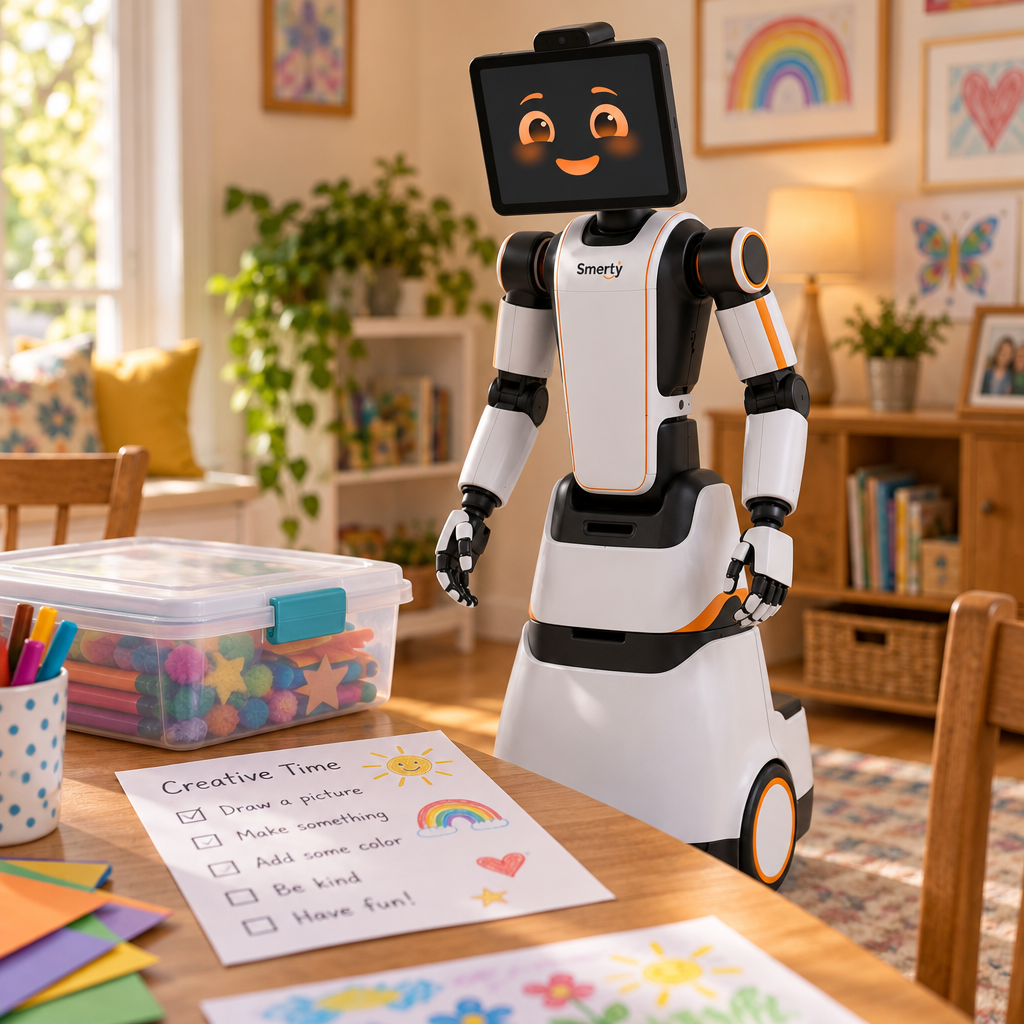
For Smerty, these are questions for future evaluation rather than descriptions of confirmed features. Smerty is in development; market verification and certification must precede sale. The aim is joyful, low-pressure family assistance: useful when appropriate, and never a reason for the household to feel trapped by an unfinished task.
Transform Your Business with SMERT Robotics
Ready to experience the benefits of hospitality automation? Our team is ready to help you get started.