What Does a Battery Claim Actually Tell You? Audit the Evidence Before Comparing
19 November 2026 · Editorial draft for owner approval
A battery headline can sound wonderfully simple: charge a mobile assistant, then enjoy some help around the house. But the useful question is not just how long something stays switched on. It is what happened during that time, under which conditions, and whether those conditions resemble the help your family wants.
This article is an evidence-audit checklist, not a charging schedule or product comparison. Its purpose is to help you decide whether a runtime claim is sufficiently explained to be useful—or whether you should ask for more information before comparing it with another claim.
Separate three kinds of evidence
Start by identifying what the source actually studies.
The review of energy-efficient locomotion principles discusses general energy-efficiency principles. It does not prove a particular home-task battery runtime or establish a universal wheel-to-leg efficiency ratio. A design principle can explain a research direction without predicting how long a finished product will help in a kitchen.
The review of ground locomotion systems compares wheels, tracks, legs and hybrids across factors including energy, obstacles and complexity. It is not a home-assistance trial. Treat it as background for asking questions, not as a substitute for product-specific evidence.
Finally, a task-level evaluation would need to describe the actual system, task and conditions. When that information is missing, label the result “not established,” rather than filling the gap with a category assumption.
Ask what the clock includes
Two runtime descriptions are not meaningfully comparable if one counts waiting and the other counts active work. Before looking at the headline duration, request a plain-language account of the test.
Use this checklist:
- What activity started and stopped the clock?
- Was the system moving, waiting, manipulating objects or alternating between activities?
- Were computing, sensing and communication functions operating normally?
- Did the reported period include pauses, charging or human intervention?
- What battery state marked the beginning and the end?
- Were unsuccessful attempts included in the account?
These are questions to ask, not claims that any particular test followed these practices. If the answers are unavailable, keep the headline separate from your household expectations.
Look for the task behind the number
“Indoor operation” is too broad to describe a family’s experience. A demonstration of travelling across an open floor says something different from repeated approaches to a table, waiting for a person and handling an object.
Ask the provider to name the task in ordinary language. Then ask whether the published result covers that whole task or only one part. A useful evidence record might have headings for the starting position, requested action, completion condition and assistance required. Leave unknown fields blank.
Do not calculate a household runtime by combining unrelated research papers. A locomotion review and a separate manipulation demonstration do not jointly establish the endurance of a third system.
Keep terrain suitability ahead of an efficiency slogan
Energy is not the only reason to choose a mobility architecture. If a necessary journey includes stairs or difficult changes in level, terrain capability may matter more than an attractive flat-ground efficiency statement.
Legged or hybrid approaches can be better candidates where obstacle negotiation is central, provided the specific design has relevant evidence. The stair-climbing mechanisms review covers legged, tracked, wheel-legged and wheel-linkage approaches. It supports considering multiple mechanisms, not declaring one universally best.
Conversely, choosing a complicated mechanism simply because it can address a different environment does not establish better energy performance in yours. Keep “can complete the necessary route” and “has useful runtime evidence” as separate decisions.
Create a claim card instead of a ranking
For each runtime statement you encounter, write a short card:
- Exact claim: Copy the wording without strengthening it.
- Evidence type: General review, prototype demonstration or product-specific evaluation.
- Included activity: Record only what is explicitly described.
- Conditions: Note the stated environment and operating setup.
- Missing information: List unanswered questions.
- Decision: Comparable, informative but not comparable, or insufficiently described.
This prevents an impressive number from becoming the default winner before you know what it measures. It also gives a provider a focused opportunity to answer your questions.
What this means for Smerty
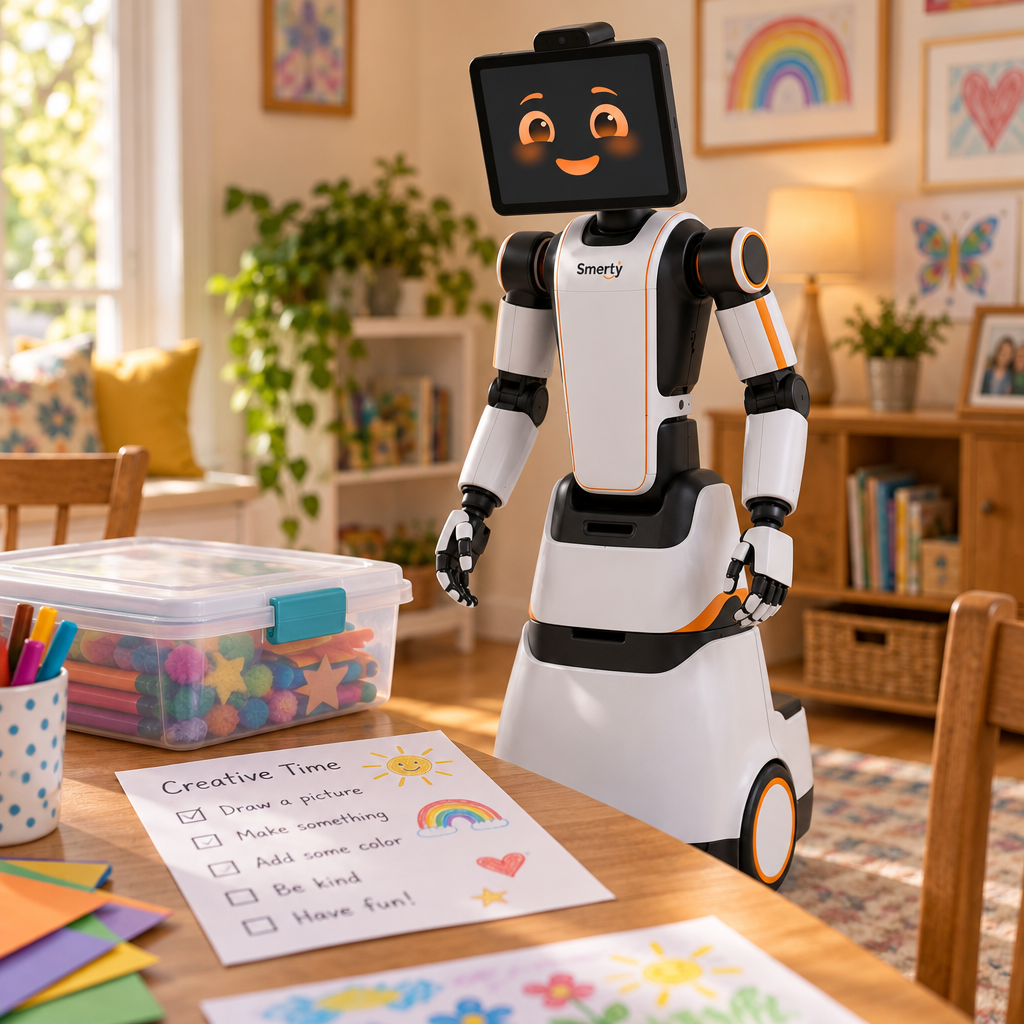
Smerty is in development. The supplied research does not establish measured Smerty energy performance, runtime or charging behaviour. Market verification and applicable certification must precede sale; this draft is not a statement of certified readiness.
For now, the useful family decision is whether the evidence supports an expectation—not whether a headline sounds reassuring. Keep the goal warm and practical: help that fits shared life, with clear limits and no need to turn family routines into a monitoring exercise. An honest unanswered question is more valuable than a confident battery promise built from the wrong source.
Transform Your Business with SMERT Robotics
Ready to experience the benefits of hospitality automation? Our team is ready to help you get started.