Can It Pick Up the Item? A Home Manipulation Evaluation Checklist
Draft for owner approval · 25 October 2026
Picking up one object can be a delightful demonstration. It is also a narrow piece of evidence. A family deciding whether a home assistant could help with everyday items needs to understand the entire task: reaching the location, approaching the object, handling it, placing it somewhere useful and responding when something does not go as expected.
This article offers a practical way to define that evaluation. It does not establish Smerty’s lifting, reaching or manipulation capabilities. Smerty remains in development, and market verification and applicable certification must precede sale.
Decide what a successful task actually means
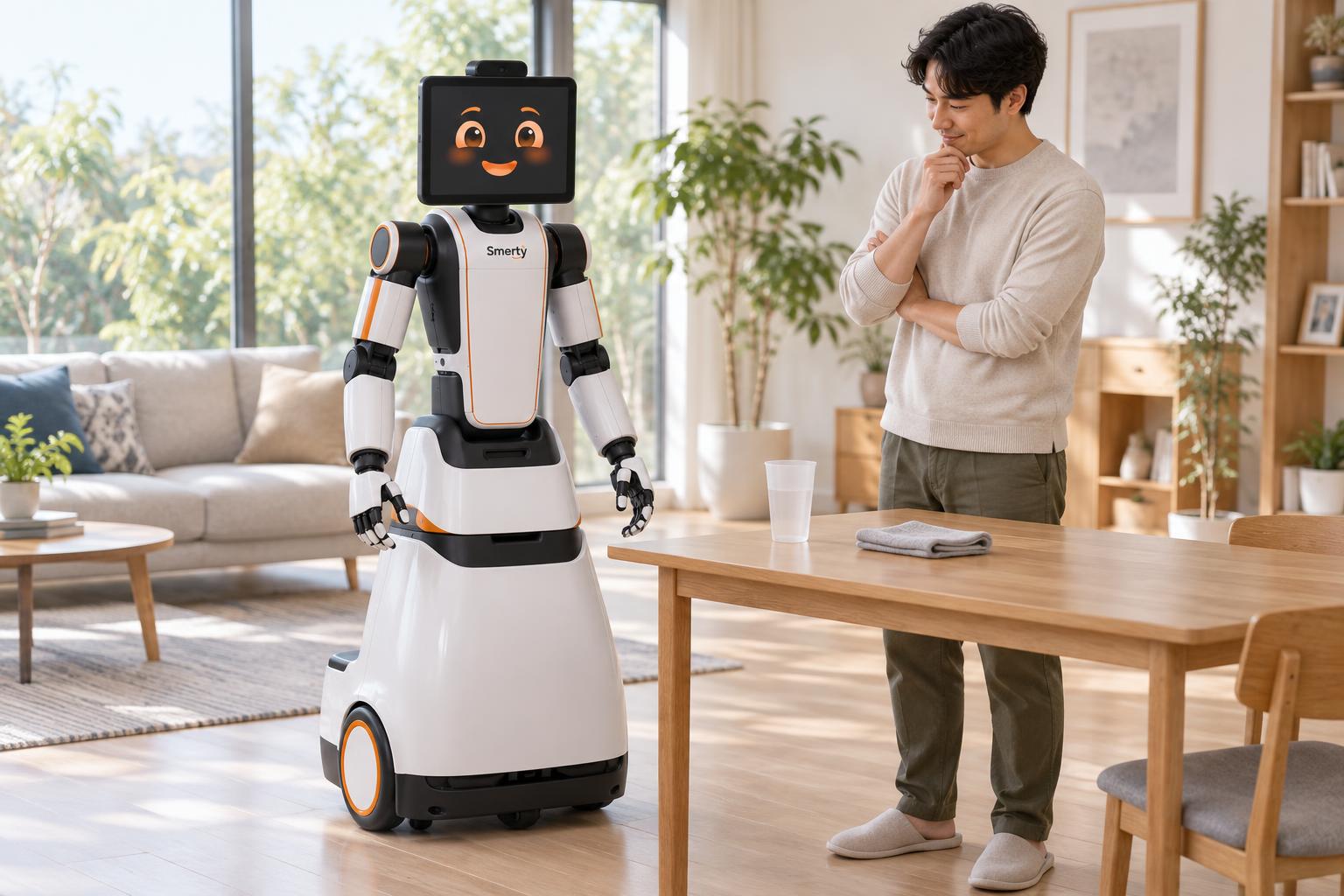
Start with one proposed activity rather than “help with household objects.” For example, you might want to evaluate moving a particular lightweight, non-fragile item between two accessible surfaces. This is a task specification, not a statement that Smerty supports that activity.
Describe the object’s dimensions, material, shape and expected condition. State where it begins and where it should end. Specify whether someone will place it in a predictable position or whether the system is expected to find it among other objects.
Those are different requests. A carefully positioned demonstration should not be presented as evidence for an untidy tabletop, an unfamiliar object or an unsupervised family routine.
Keep research claims at their original scale
A 2014 domestic humanoid design study reports a wheeled domestic prototype tested for indoor movement, small bumps and small-item pickup. That supports a narrow statement about that prototype’s tests. It does not establish broad domestic competence, and it supplies no measured Smerty performance.
Likewise, the 2012 ground locomotion review compares mobility approaches across several engineering considerations. It is not evidence that one base design is universally more stable during household manipulation.
Together, these sources support a disciplined distinction: movement evidence and pickup evidence need to be examined at the task level. Neither should be stretched into a promise that a product can handle whatever a family leaves within reach.
Evaluate the approach before the grasp
Ask how the device gets into the working position. A pickup demonstration may conceal important preparation if the base was manually placed, the furniture moved or the object carefully aligned.
Your evaluation checklist should include:
- The floor and available approach space.
- The starting position relative to the object.
- Furniture edges and nearby obstructions.
- Whether repositioning is required before reaching.
- Any manual setup or remote intervention.
- The conditions under which the task should be declined.
Ask the evaluator to identify preparation explicitly. Preparation is not automatically a flaw; it simply belongs in the description of what the system can do and what the household must provide.
Examine stability without assuming a winning architecture
For any proposed manipulation task, request documented limits for the relevant configuration. Ask whether evaluation covers the intended reach, object and placement position together, rather than relying on separate headline specifications.
Useful questions include whether the base remains stationary, whether any support arrangement changes during the task, and how nearby people should stay clear. Ask what happens after an unsuccessful grasp and whether recovery requires a person.
Do not try to establish limits by adding weight, pulling on the device or asking a child to interact during a reach. A family checklist should guide requests for appropriate evidence, not become an improvised stress test. No manipulation demonstration should be interpreted as permission to lean on Smerty or use it for weight-bearing support.
Know when legs or hybrids deserve consideration
A route to the work location can matter as much as the handling task. Where reaching the destination requires stairs or discontinuous terrain, a purpose-built legged or hybrid approach may be better suited than a conventional wheeled arrangement.
The 2023 stair-climbing mechanisms review includes several architectures, not only bipedal designs. However, suitability for reaching a location does not establish stability while handling an object there. Evaluate access and manipulation separately, then ask for evidence of the combined task.
For a same-floor activity, avoid choosing on visual resemblance to a person. Start with the working position and the task’s documented boundaries.
Include placement, failure and family comfort
A successful grasp is not the finish line. Define where the item should be released and what counts as acceptable placement. Ask what occurs if the target area is occupied, the item slips or the task cannot be completed.
Consider the household experience too. Can everyone understand when the activity is underway? Does the working area conflict with play, conversation or a pet’s usual resting spot? Would the required preparation outweigh the usefulness of the task?
These questions keep the focus on welcoming assistance rather than a spectacle. A modest, clearly bounded activity may be more valuable than an ambitious demonstration with hidden setup.
Write the evidence request before the promise
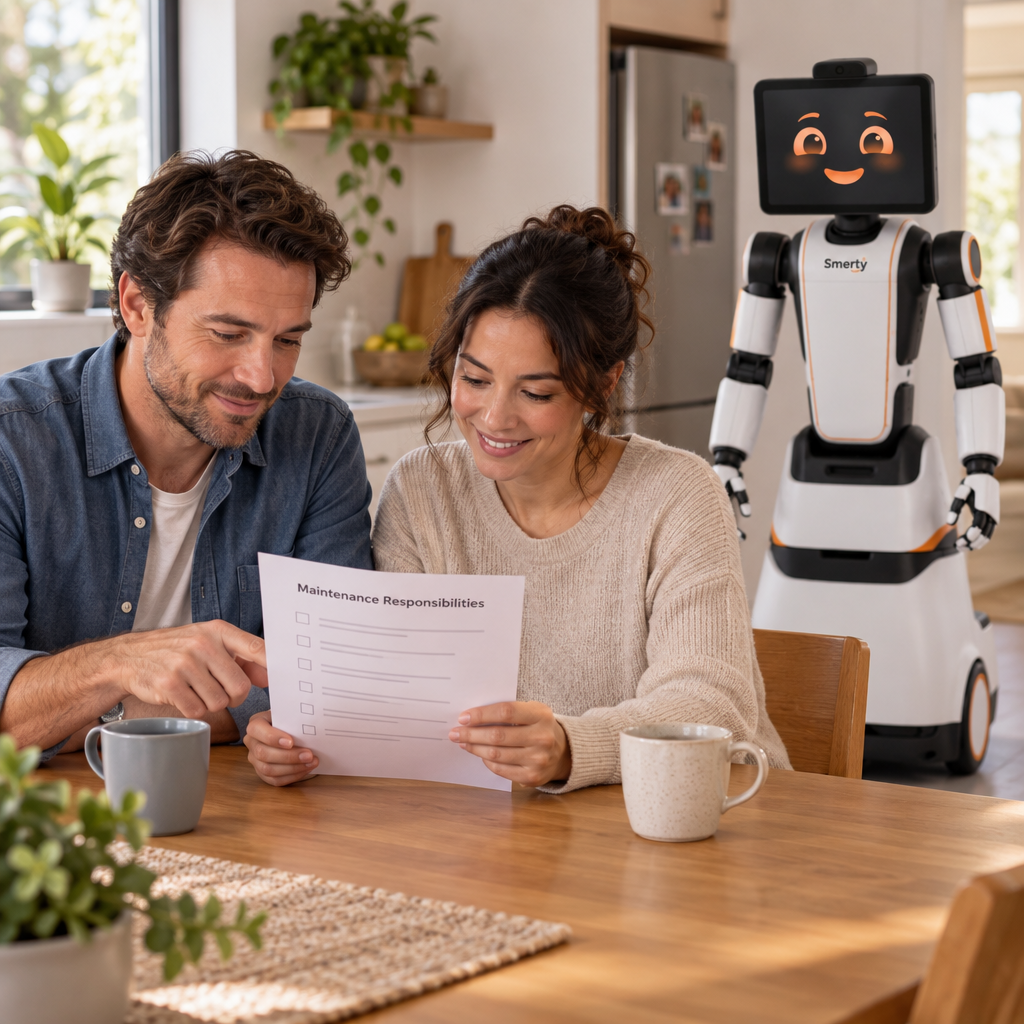
Finish with a short task sheet: named object, start and finish locations, approach conditions, required human involvement, stopping conditions and evidence still needed. Record unanswered questions rather than filling them with assumptions.
Visit Smerty for the development context. Any future claim should match the evaluated task and configuration. Until then, a precise checklist is more useful than a broad promise about household competence.
Transform Your Business with SMERT Robotics
Ready to experience the benefits of hospitality automation? Our team is ready to help you get started.