A Family-First Introduction Plan for Mobile Home Assistance
A Family-First Introduction Plan for Mobile Home Assistance
18 November 2026 · Editorial draft for owner approval
The most enthusiastic person in a household is not always the person most affected by a new product. A child may be curious, an adult may prefer quiet routines, and a visiting relative may want familiar access through shared rooms. A thoughtful introduction starts with those differences, not with a performance demonstration.
This plan supports a distinct decision: does the household want to proceed with an appropriately authorised introduction, and under what shared boundaries? It is not a buyer guide, a navigation test or evidence that a developing product is suitable for family use.
The goal is a warm addition to everyday life. It should leave room for curiosity, delight and an uncomplicated “not now.”
Keep the evidence in its proper place
A domestic humanoid design study reports tests of a specific wheeled prototype involving indoor movement, small bumps and small-item pickup. Those activities do not establish broad household competence, suitability around children or dependable operation during busy family routines.
A wheel-legged indoor-service prototype study demonstrated stair climbing and differential-wheeled operation on flat ground. Those are findings about that prototype. They are not capabilities of conventional wheels or Smerty.
Neither capsule establishes that a household will feel comfortable sharing space with a mobile product. Family acceptance needs its own conversation, while safety and permitted operation require product-specific documentation and appropriate verification.
1. Agree on the purpose before discussing features
Ask every affected household member what would make the proposed introduction worthwhile. Keep the answers modest and specific. Someone may welcome learning about the developing technology; someone else may only want assurance that a favourite activity will remain undisturbed.
Separate three things in your notes:
- The benefit the family hopes for.
- The capability actually documented for the product.
- The capability that remains an aspiration or open question.
Do not let a hoped-for benefit quietly become a promise. If the introduction is educational rather than practical, say so. There is nothing wrong with curiosity, provided it is not presented as proven assistance.
2. Give everyone an easy way to decline
Agree that a person can opt out of participation without having to defend their preference. Choose a time and setting that do not prevent others from using essential shared areas.
For children, use language suited to their understanding and follow the supplier's age-related restrictions and supervision instructions. Do not turn uncertainty into a game of daring someone to approach, touch or interrupt the product.
If an adult cannot supervise under the required conditions, postpone. A successful introduction is not one that happens on schedule at any cost. It is one in which the agreed conditions can actually be maintained.
3. Establish boundaries before any operation
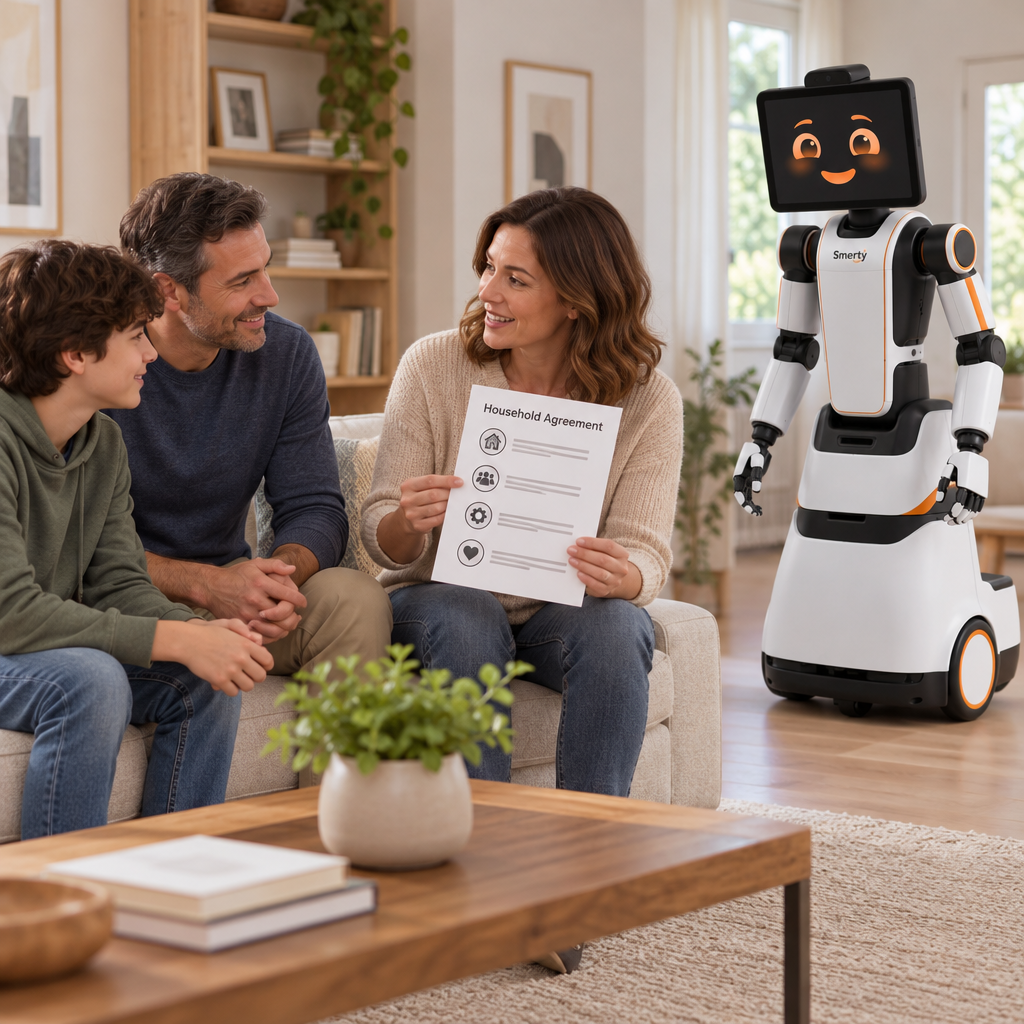
For any future verified product or properly authorised demonstration, obtain the applicable instructions first. The household agreement should sit alongside those instructions, never replace them.
Clarify:
- Who is responsible for supervision and communication with the demonstrator.
- Which area and activity are authorised.
- How participants request a pause.
- Who uses the documented stopping control or procedure.
- Where non-participants can comfortably remain.
- What happens if the agreed conditions change.
Do not assign children responsibility for safe operation. Do not assume any product is fall-proof, suitable for climbing on or able to provide weight-bearing support. Never test a safety boundary by deliberately creating a collision, obstruction or unstable situation.
4. Explain what is known about information handling
Family comfort also includes understanding what information, if any, a product processes. Ask for the actual documentation rather than inferring functions from appearance or from generic expectations about the category.
Questions may include whether data is collected, what the stated purpose is, where the relevant controls are and whom to contact with concerns. Record unknowns honestly. Do not claim that Smerty has particular recording, recognition or privacy features without approved supporting information.
Keep this discussion proportionate and human: everyone deserves to understand the proposed arrangement. The product's place in the home should be framed around welcome participation, not watching family members.
5. Start with the least demanding authorised encounter
Where an introduction is permitted, begin within the documented scope and under the required supervision. A stationary explanation may be sufficient before any authorised movement demonstration. There is no need to combine movement, object handling and several people's participation merely to make the occasion exciting.
Do not improvise challenges involving pets, children, stairs or carried objects. If a household member asks for a demonstration outside the approved scope, write down the question for later rather than attempting it.
The same principle applies to personal assistance: no one should lean on the product, expect it to catch them or treat an unverified function as a substitute for care.
6. Debrief without turning enjoyment into performance evidence
Afterwards, ask simple questions: Was the purpose clear? Did anyone feel crowded or pressured? Were the boundaries easy to understand? Would the household welcome another appropriately authorised session?
Keep subjective responses separate from technical findings. “We enjoyed meeting it” is meaningful family feedback, but it does not demonstrate navigation reliability or broad domestic competence. An uneventful session is not certification.
Choose to continue, revise the arrangement or pause. All three are legitimate outcomes.
Where legs or hybrids may fit better
If the household's actual need depends on stairs or substantial obstacle negotiation, a legged or hybrid approach may be a better candidate for investigation than conventional wheeled movement. The wheel-legged study illustrates one specific stair-capable mechanism, not a general guarantee. Resolve that capability question separately from whether the family enjoys an introduction.
Smerty's place in this conversation
Learn about Smerty, SMERT's developing product. Smerty is in development; market verification and certification must precede sale. This article is an owner-approval editorial draft, not an invitation to operate a prototype or a claim of certified readiness. A joyful family relationship begins with honest expectations, shared choice and respect for the limits of the evidence.
Transform Your Business with SMERT Robotics
Ready to experience the benefits of hospitality automation? Our team is ready to help you get started.