AI Consulting for SMEs: Is Hiring an AI Consultant Worth It?
Is hiring an AI consultant worth it for an SME?
Hiring an AI consultant can be worthwhile when your business has a measurable operational problem, usable data, and someone who can own the new workflow. It is less worthwhile when the brief is simply “we need AI” or when an existing software feature would solve the problem more cheaply.
Good ai consulting for small business starts with business processes, not model demos. The consultant should identify where AI might help, compare it with simpler alternatives, and test the strongest option before recommending a larger investment.
For Hong Kong SMEs, the practical questions often include language support, compatibility with existing systems, staff training, and where sensitive information will be processed. This guide explains what to buy, how to evaluate proposals, and when to walk away.
What does an AI consultant actually do?
An AI consultant connects business needs with technical implementation. That should mean more than recommending a chatbot subscription.
A useful engagement typically covers:
- Workflow discovery: Map the current process, exceptions, bottlenecks, and handoffs.
- Feasibility review: Check data availability, system access, privacy constraints, and technical limitations.
- Solution selection: Compare existing software, conventional automation, and AI-assisted approaches.
- Pilot delivery: Test a narrow workflow with agreed success criteria and human oversight.
- Operational handover: Document ownership, monitoring, training, maintenance, and fallback procedures.
At smert.ai, the context is AI consulting and cobot integration, with a Hong Kong base, a lab in Tsim Sha Tsui, and a US branch in Delaware. Explore AI consulting services when your first need is deciding what to prioritise rather than purchasing a particular tool.
Where small businesses can find practical value
Customer enquiries and internal knowledge
An AI assistant can draft answers using approved product information, policies, and operating documents. Staff review uncertain or sensitive responses before they reach customers.
A sensible pilot might cover one shared inbox and a small set of common enquiries. Measure handling time, corrections, escalation volume, and whether answers refer to the right source material. Check performance separately across the languages your customers actually use.
Document-heavy administration
Purchase orders, supplier forms, and service reports often involve repetitive reading and data entry. AI can help extract fields, categorise documents, and prepare entries for staff approval.
Start with one document type. Include incomplete forms, poor scans, and unusual layouts in testing. A workflow that handles tidy examples but creates extra correction work elsewhere may not be worth deploying.
Sales preparation and follow-up
AI can help organise incoming enquiries, summarise account notes, and draft follow-up messages. Keep people responsible for factual claims, commercial terms, and decisions about contacting prospects.
If sales administration is the bottleneck, review the sales generator as one option to assess against your workflow. The business case should be about useful staff support, not promises of guaranteed revenue.
Visual checks and physical workflows
Computer vision can detect and flag apparent packaging issues, missing items, or process exceptions for human review. Lighting, camera placement, product variation, and the consequences of missed issues must shape the evaluation.
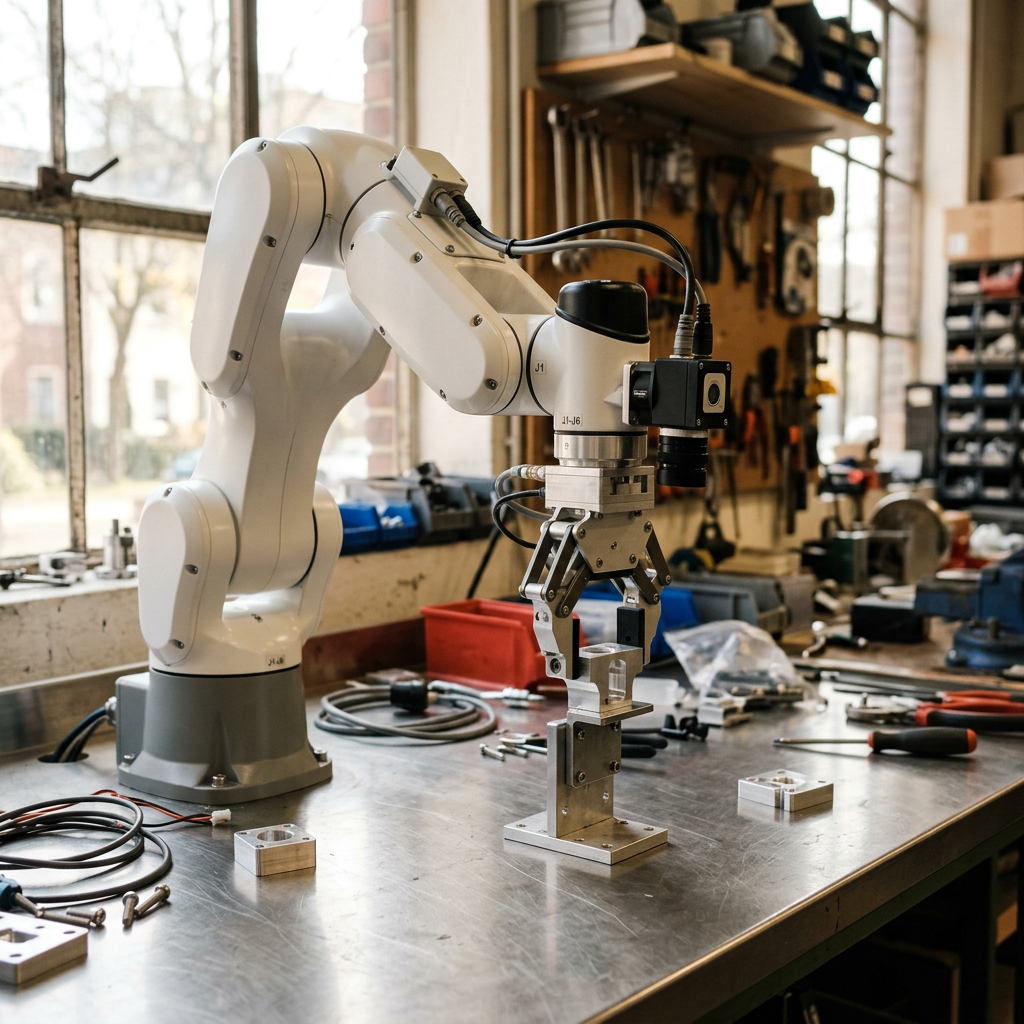
For physical tasks, a cobot may be relevant, but software consulting alone cannot establish suitability. smert.ai integrates cobot arms from established makers; it does not manufacture arms. Safety depends on a per-site risk assessment. ISO 10218 and ISO/TS 15066 are standards integrators assess against, not guarantees of safety.
Healthcare applications require particular care: support should be assistive, supervised, and not positioned as a medical device. No clinical outcome should be promised.
Build the business case before requesting a proposal
Establish the current cost
Choose one workflow and record its weekly volume, average handling time, correction effort, and delays. Use an observed baseline rather than a best-case estimate from memory.
For example, suppose staff process 240 requests weekly at six minutes each. That represents 24 hours of work. If a pilot reduces net handling time to four minutes per request, including review and correction, it releases eight hours weekly.
At an illustrative loaded labour cost of HK$180 per hour, that is HK$1,440 of weekly capacity value. These are hypothetical figures, not a performance forecast or a smert.ai quotation.
Separate capacity from cash savings
Released time is not automatically money saved. It becomes valuable when staff use it to reduce overtime, clear backlogs, improve service, or handle additional work.
A basic calculation is:
Monthly net value = realised operational benefit − monthly operating costs.
Include subscriptions, usage charges, hosting, support, maintenance, and internal administration. Compare the remaining value with the upfront implementation cost. If benefits depend on demand that may never arrive, treat them as uncertain rather than bankable savings.
What should an AI consulting proposal cost and include?
There is no honest universal price for SME AI consulting. A limited workflow assessment differs substantially from connecting several legacy systems or installing a cobot application.
Ask suppliers to price discovery, pilot delivery, production deployment, and ongoing support separately. This makes it easier to stop after an unconvincing pilot without committing to the entire project.
The proposal should specify:
- Deliverables, exclusions, and required access to your systems.
- Your team's responsibilities and expected time commitment.
- Third-party fees, usage assumptions, and potential cost increases.
- Acceptance tests, review requirements, and failure handling.
- Ownership of accounts, configurations, documentation, and data.
- Handover, support terms, and an exit procedure.
Compare proposals by scope and operating burden, not headline price alone. Review broader AI services only after identifying which capabilities your selected workflow requires.
Security and oversight are part of the purchase
Before sharing business information, document what data enters the system, where it goes, who can access it, and how long it remains available. Ask whether providers may use submitted data for model training and what contractual controls apply.
For Hong Kong businesses, assess applicable privacy obligations, including the Personal Data (Privacy) Ordinance where personal data is involved. Cross-border processing deserves explicit review rather than assumptions based on a supplier's office location.
Useful controls include role-based access, logging, retention rules, restricted integrations, and a tested manual fallback. Systems that can send messages or change records need clear approval boundaries. Uploaded documents and incoming messages should also be treated as potentially untrusted instructions.
Consider a cybersecurity consulting review before connecting AI to sensitive records or business-critical systems.
When should you hire, use existing tools, or wait?
Hire a consultant when the workflow crosses several systems, mistakes carry meaningful consequences, or your team lacks the capacity to evaluate and implement alternatives.
Use an existing tool first when the task is common, low-risk, and already supported by software you pay for. A short configuration or training engagement may be enough.
Wait and fix the foundations when records are inaccessible, procedures change constantly, or nobody owns the process. AI can amplify inconsistent inputs rather than resolve them.
For a pilot, agree on a representative test set, review responsibilities, spending limits, and stop conditions. Proceed only if the observed benefit survives ordinary exceptions and the ongoing support burden is acceptable.
Frequently asked questions
Is AI consulting worthwhile for a very small business?
Sometimes. One repetitive, time-consuming workflow can justify a focused engagement. If the work is infrequent or easily handled by existing software, consulting may cost more than it returns.
Do we need clean historical data before starting?
Not always. Some projects can begin with a small set of approved documents. Others need structured records. Discovery should establish the minimum required data and the cost of preparing it.
How quickly can we know whether a pilot is useful?
That depends on access, integration complexity, and transaction volume. Set a review date, but also require enough representative cases to assess normal work, exceptions, and correction effort.
Can AI operate without staff review?
That depends on the task and its risks. Start with defined human review and escalation. Any reduction in review should follow evidence from testing and monitoring, not a general claim that AI is reliable.
Ready to assess one practical opportunity? Contact smert.ai with your workflow, approximate weekly volume, existing tools, and main constraints.
Related: AI consulting services
Transform Your Business with SMERT Robotics
Ready to experience the benefits of hospitality automation? Our team is ready to help you get started.