What Must an AI Robotics Pilot Revalidate After a Camera or Setup Change?
What must an AI robotics pilot revalidate after a camera or setup change?
An ai robotics pilot should revalidate the assumptions affected by the change: camera geometry, the camera-to-machine relationship, task conditions and the evidence supporting its operating limits. Previous results should not automatically carry over to a changed setup. This review does not establish machine safety; it identifies which technical results need renewing before a separately assessed return-to-task decision.
The narrow question is not whether the pilot once completed a task. It is whether the evidence still describes the configuration now in front of you. A moved camera, changed target or revised calibration file deserves an explicit review rather than an assumption that yesterday’s demonstration remains representative.
Which changes affect which evidence?
Start by recording exactly what changed. “Vision updated” is too vague to support a useful decision. Distinguish a camera mounting change from a lens adjustment, a new calibration file or a change to the known geometry used for pose estimation.
Two different calibration questions matter:
- Intrinsics and distortion: how does the camera form its image?
- Extrinsics: how is the camera positioned relative to the machine’s coordinate frame?
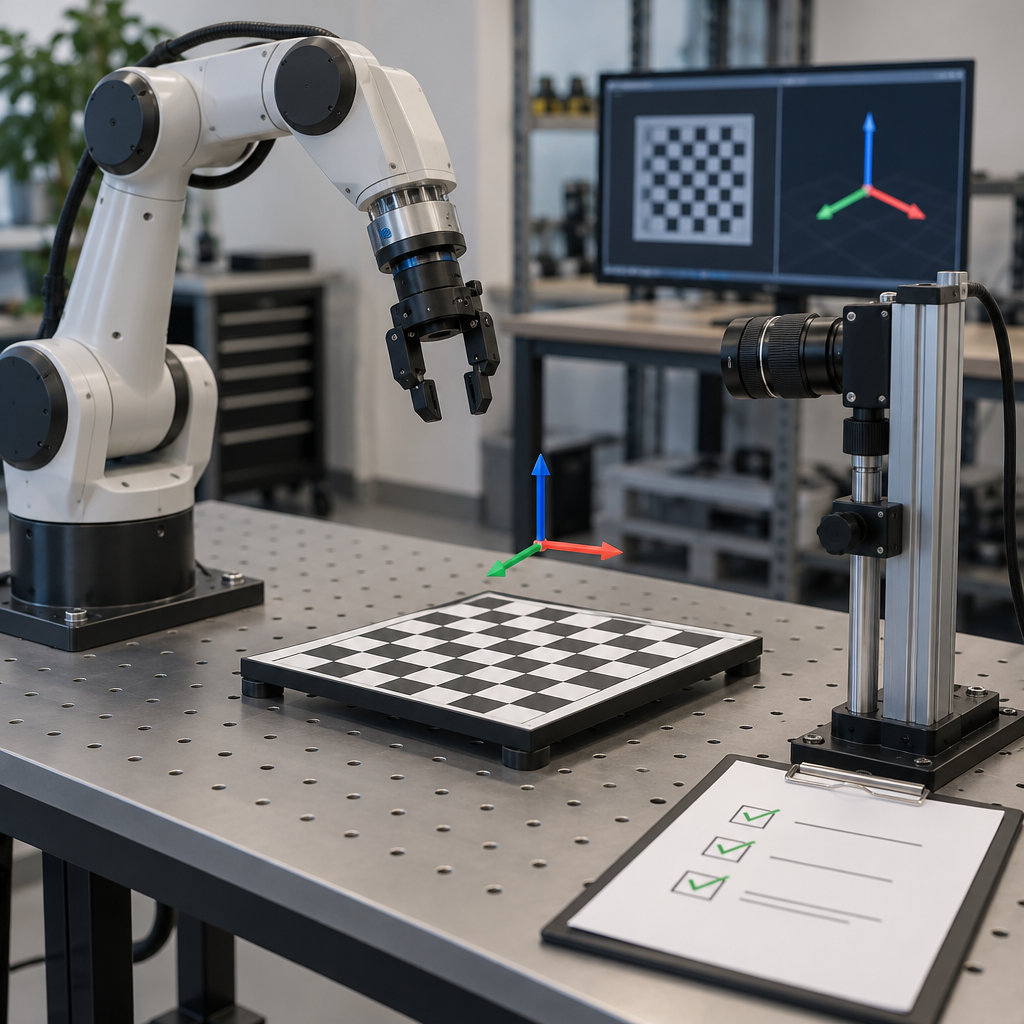
The OpenCV camera calibration tutorial describes estimating intrinsics and distortion from chessboard observations, and using solvePnP to estimate the pose of known geometry. Detecting the board is not, by itself, an evaluation of calibration quality.
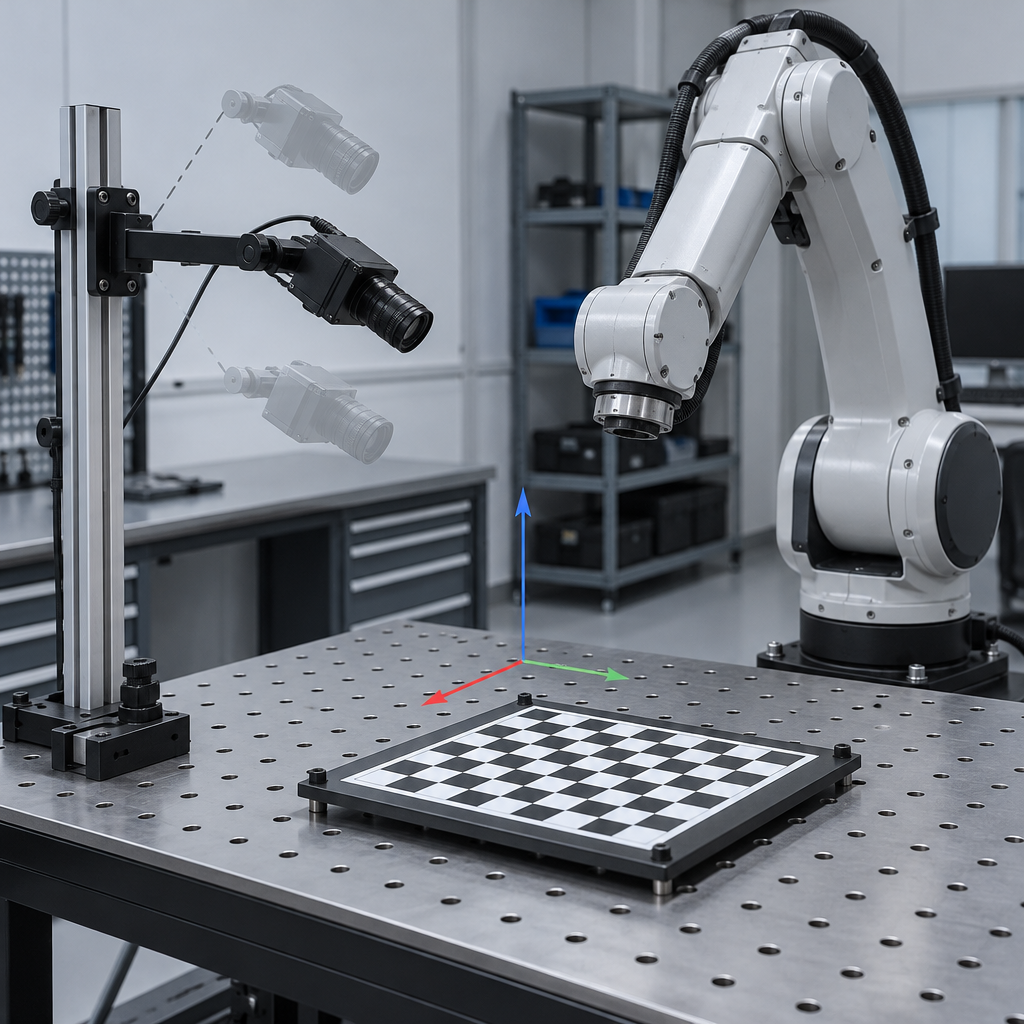
The MoveIt calibration explanation addresses the separate camera-to-machine relationship. For eye-in-hand calibration, camera-to-target and base-to-end-effector pose pairs support that relationship.
The practical recommendation is to map each change to the assumptions it may invalidate. Moving a camera mount should trigger review of extrinsic evidence. Changing imaging geometry should trigger review of intrinsic evidence. Replacing a target with different geometry should trigger review of the geometry supplied to pose estimation. These are review triggers, not a complete safety procedure.
Should the team repeat everything or only affected tests?
Neither automatic full retesting nor automatic acceptance is a good default. Instead, write a short change-impact assessment that identifies what changed, what stayed fixed and why particular results remain applicable.
A limited retest is easier to justify when the changed component and its dependencies are clearly documented. A broader retest is more appropriate when the team cannot establish which assumptions were affected. The trade-off is test effort versus unresolved uncertainty—not a promise that more testing guarantees acceptable operation.
For example, if a camera bracket is repositioned while the task and target remain unchanged, the review should focus first on the camera-to-machine relationship. It should also ask whether the earlier task observations still cover the revised view. Recalculating a transform alone does not answer that second question.
Treat this as a proposed evaluation method, not a claim that the supplied sources prescribe a particular retest sequence.
What should renewed evaluation demonstrate?
Use observations that challenge the revised configuration rather than merely reproducing the easiest demonstration. Before collecting results, agree on the task-specific acceptance criteria and how discrepancies will be recorded. The supplied evidence does not establish universal error tolerances, sample counts or acceptance thresholds.
Keep calibration evaluation distinct from task evaluation. One asks whether the estimated camera geometry and coordinate relationships are adequate for the intended use. The other asks whether the resulting estimates remain useful across the declared task conditions. Neither should be presented as proof that motion is safe.
Also distinguish an estimate from permission to act. A camera image, detected target or computed pose is not a validated safe motion command. Any decision to resume physical operation needs a separate assessment of the machine and application; the calibration references cannot supply that assessment.
What belongs in the revalidation checklist?
Use this checklist to make the review auditable:
- Change description: record the physical or software change precisely, including the configuration being evaluated.
- Baseline: identify which earlier calibration files and task results are being compared with the revised setup.
- Affected assumptions: separate intrinsic, extrinsic, known-geometry and task-condition questions.
- Evaluation criteria: define acceptable results before testing; do not invent a universal threshold from these sources.
- Test coverage: explain which intended conditions were examined and which remain untested.
- Exceptions: retain failed observations and unresolved discrepancies alongside successful results.
- Decision scope: state whether the evidence supports further evaluation, restricted continuation or no continuation of the pilot.
- Ownership: identify who reviews the evidence and who is responsible for the separate return-to-operation decision.
The NIST AI Risk Management Framework provides voluntary guidance for managing AI risks throughout design, development, use and evaluation. It can inform this ongoing review approach, but it is not product certification or approval of a particular robot installation.
SMERT is an OEM and integrator. For a SMERT Cobot project, an AI robotics consultation can be framed around the changed configuration, the evidence gaps and the evaluation scope—not around an unsupported claim that adding AI resolves motion risk.
Three useful follow-up questions
What configuration information should we preserve before changing the setup?
Preserve enough information to distinguish the old and new camera arrangement, calibration inputs, coordinate relationships and task conditions. Without that baseline, explaining which results remain applicable becomes harder.
Can we reuse the previous calibration if the image still looks normal?
Visual appearance alone does not establish calibration quality or the camera-to-machine relationship. Review the changed assumptions and evaluate the relevant geometry rather than relying on a familiar-looking image.
What if the revised setup passes calibration checks but task results disagree?
Keep that discrepancy open. Investigate the known geometry, coordinate relationship and declared task conditions before accepting the result. A calibration check should not overrule contradictory task evidence.
Related: AI consulting services
Transform Your Business with SMERT Robotics
Ready to experience the benefits of hospitality automation? Our team is ready to help you get started.