What Is a Cobot? A Plain-English Guide to Collaborative Robots (2026)
What is a cobot?
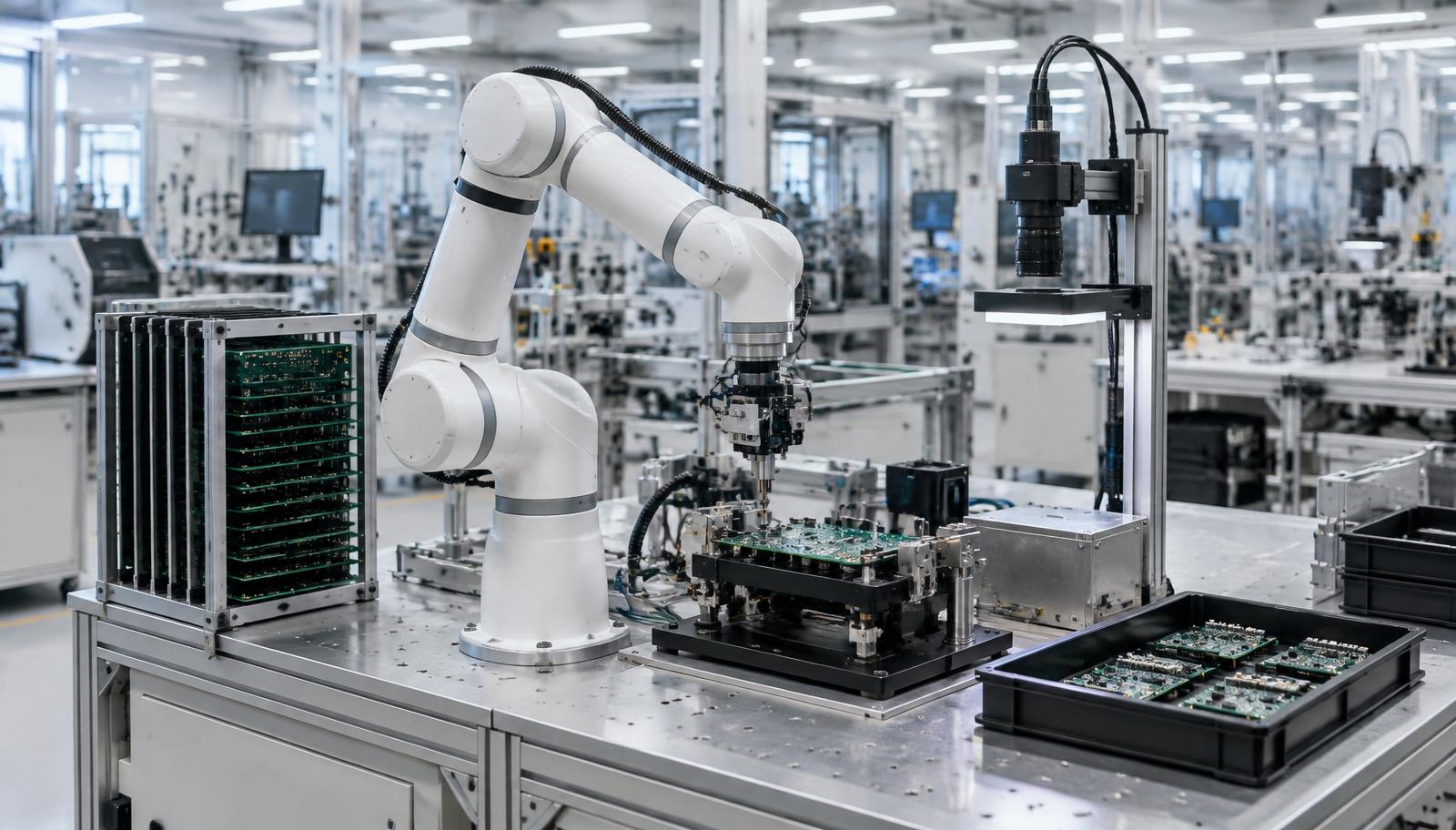
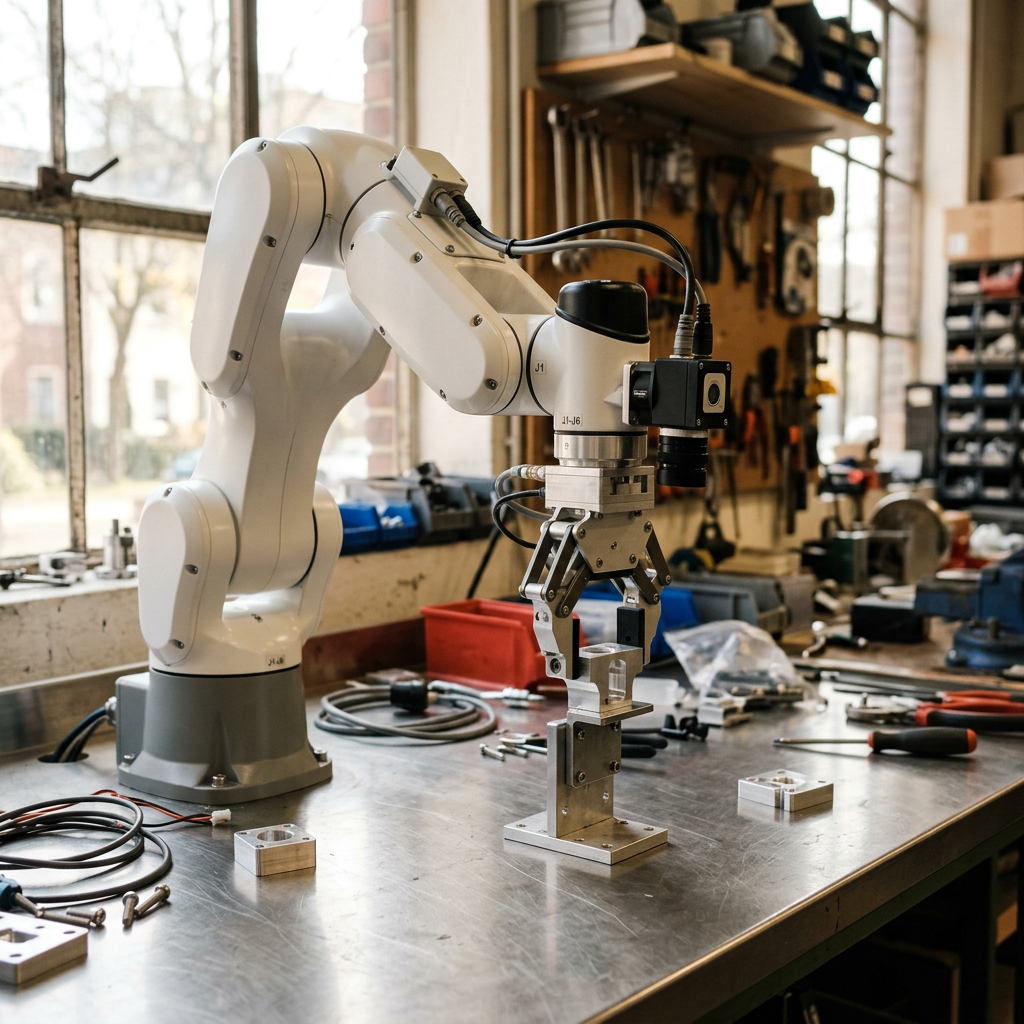
A cobot, short for collaborative robot, is a programmable system designed to support applications in which people and automation share a workspace or interact during a task. It typically combines an articulated arm, a task-specific tool, a controller and software that coordinates movement.
The important distinction is not simply that a cobot works near people. Its suitability for collaboration depends on the complete application: the tool, the object being handled, the surrounding equipment and how people approach it.
For businesses exploring automation in 2026, a cobot can be a practical way to automate a defined, repetitive step without redesigning an entire operation. However, it is not automatically the right solution for every task.
smert.ai is a Hong Kong-based cobot integration and AI consulting company, with a lab in Tsim Sha Tsui and a US branch in Delaware. We integrate arms from established makers into application-specific cobot solutions; we do not manufacture the arms.
How does a cobot work?
A useful way to understand a cobot is to follow a simple packaging task: picking a boxed item from a tray and placing it into a shipping carton.
The arm provides movement
The arm moves the tool between programmed positions. Its reach, payload capacity and movement envelope must suit the workstation. Payload planning includes the tool as well as the item being moved, while the layout must allow clearance throughout the motion.
The tool performs the task
The end-of-arm tool might be a gripper, suction device or dispenser. Tool choice depends on the product’s shape, material, weight and presentation.
A gripper that handles a rigid box may not suit a flexible pouch. Changing products can therefore require different tooling, revised settings or a new fixture—not just a software update.
Software coordinates the sequence
The controller runs instructions such as move, pick, place and wait. Integration connects these instructions to surrounding equipment: a conveyor might signal that an item is ready, while a downstream station confirms that space is available.
Where computer vision is appropriate, it can detect item presence, position or visible anomalies and flag relevant cases for human review. Lighting, camera placement and representative test images matter. Vision should not be treated as an infallible decision-maker or as a substitute for safety-rated safeguards.
What makes a cobot different from conventional automation?
Conventional industrial automation often prioritises sustained throughput inside a separated working area. A cobot application may instead be designed around shared tasks, smaller production batches or frequent operator involvement.
These are tendencies, not fixed categories. A cobot may still need guarding, restricted access or separation during parts of its cycle. Conversely, a conventional automated system can include carefully engineered interaction points.
The practical comparison is therefore between complete workstations, not product labels. Ask:
- What task must the system complete, and at what rate?
- When do people need to enter or reach into the working area?
- Which product changes happen during a normal week?
- What safeguards and recovery procedures are required?
- Who will operate, maintain and troubleshoot the system?
Explore our cobot integration services for the broader engineering scope beyond selecting an arm.
Where can a cobot be useful?
The strongest starting points are usually repetitive tasks with predictable inputs and a clear definition of success.
Packing and product handling
A cobot can transfer items between defined locations, load trays or support carton packing. Suitability depends on product variation, presentation and required cycle time.
For example, loading identical containers from a locating tray is usually easier to scope than picking mixed, overlapping products from a bin. Better fixtures can sometimes deliver more value than more complex software.
Machine loading and unloading
A cobot can load a machine, wait for its cycle and unload a finished part. The project must account for machine interfaces, access, workholding, part temperature and abnormal conditions.
Someone still needs to manage material supply, tool changes, rejected parts and maintenance. A realistic proposal identifies those responsibilities rather than assuming unattended operation.
Inspection support
A cobot can present an item to a camera or move it through repeatable viewing positions. Computer vision can detect visible conditions and flag suspected issues for human review.
The acceptance process should define what is visible, which variations are acceptable and what happens when an image is unclear. Automated detection does not eliminate the need for a quality process.
Supervised assistive workflows
In healthcare-related settings, a cobot may support defined non-clinical handling tasks under supervision. Such a deployment is assistive, supervised and not a medical device. Workflow design must address hygiene, access and staff oversight without implying clinical benefits.
See more cobot application examples to compare tasks rather than choosing by industry label alone.
Is a cobot safe to work beside?
Safety depends on a per-site risk assessment and the measures implemented for the actual application. Calling a system a cobot does not establish that it is safe to approach during every operation.
Integrators assess applications against relevant requirements and guidance, including ISO 10218 and ISO/TS 15066 where applicable. These standards are assessment references, not a guarantee of safety.
The assessment needs to consider the entire workstation, including:
- Trapping or crushing points between moving parts and fixed structures.
- Sharp edges, hot parts and dropped objects.
- Tooling hazards and unexpected workpiece movement.
- Access during loading, cleaning, troubleshooting and maintenance.
- Restart behaviour after a stop or interruption.
Depending on the findings, controls may include guarding, interlocks, safety-rated protective devices, operating restrictions and documented procedures. Operators need training, and changes to tooling, products or layout should trigger a review before operation resumes.
What should you check before buying?
Define one task precisely
Write a short task specification: input condition, required output, product range, cycle-time target and operating schedule. Record exceptions, such as damaged packaging or missing parts.
“Automate packing” is too broad. “Move these containers from this tray into these carton positions” is a testable starting point.
Measure the real workspace
Check floor space, bench stability, utilities, access routes and replenishment areas. In space-constrained Hong Kong premises, maintenance access can be just as important as the cobot’s footprint.
A layout study using a cobot simulator can help explore reach and positioning. Simulation supports planning; it does not replace physical testing or the site risk assessment.
Plan exceptions and ownership
Decide what happens after a missed pick, empty tray or interrupted machine cycle. Specify who can reset the system and when escalation is necessary.
Assign an internal owner for training, backups, maintenance scheduling and change control. A workstation is easier to sustain when ownership is clear from the start.
How do you assess cobot costs and ROI?
The budget should cover more than the arm. Include tooling, fixtures, guarding, controls integration, installation, training and ongoing support. Allow for commissioning time and any upstream changes needed to present products consistently.
Compare those costs with realistic operating benefits: reduced repetitive handling, additional usable capacity or staff time redirected to other work. Avoid treating every automated minute as a cash saving.
Use the cobot ROI calculator to explore assumptions, then test sensitivity to utilisation, changeovers and downtime. A pilot should verify the workflow before a larger rollout.
Frequently asked questions
What is a cobot in simple terms?
A cobot is a programmable system used to assist with physical tasks in applications designed around human interaction. Its suitability depends on the complete workstation, not just the arm.
Does every cobot need a safety fence?
No single answer applies. A per-site risk assessment determines whether guarding, separation or other protective measures are needed for the task and its operating modes.
Can existing staff operate a cobot?
Often, trained staff can run routine operations. Setup changes, fault recovery and maintenance require defined permissions and suitable training. Everyday usability should be tested with the intended operators.
How should a first project begin?
Start with one repeatable task, representative products and measurable acceptance criteria. Confirm layout, interfaces, safety requirements and exception handling before committing to a wider deployment.
Ready to assess a practical first application? Contact smert.ai to discuss your workflow, site constraints and a suitable evaluation plan.
Related: Cobot integration
Transform Your Business with SMERT Robotics
Ready to experience the benefits of hospitality automation? Our team is ready to help you get started.