Can AI Robot Vision Be Fooled? What the Viral Doll Test Means for Safety
Can an AI robot be fooled by its camera?
Yes. Blurred or deliberately altered camera inputs can change an AI model’s interpretation of a physical scene. The important safety question is not just whether the model identifies an object correctly: it is whether independent safeguards prevent a hazardous action when perception is wrong. Depth sensing can help check geometry, but it does not make an AI-controlled machine automatically safe.
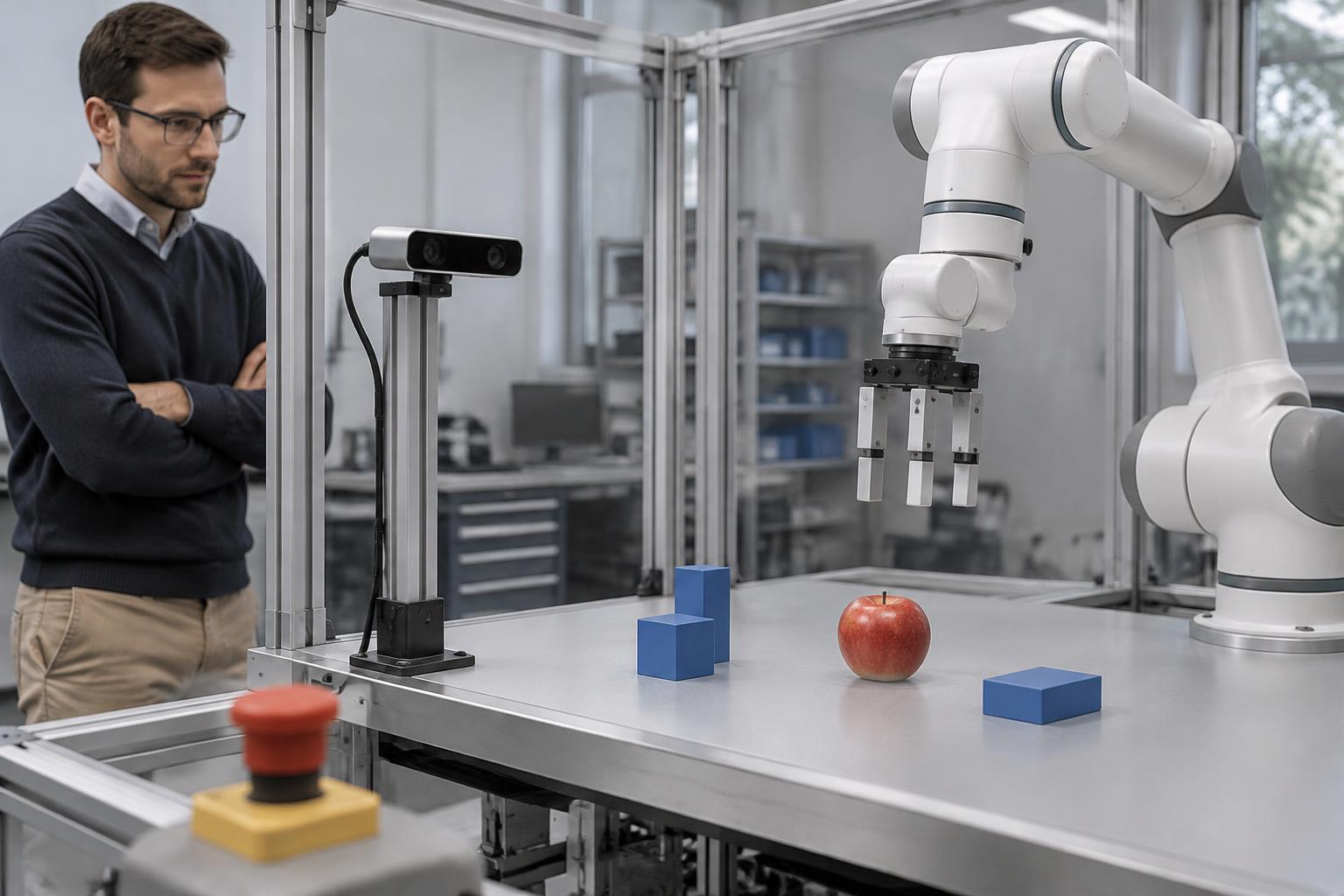
The viral “doll mistaken for an apple” demonstration raises an important question for AI robotics and robotic vision systems. It also needs careful reporting: this was a staged research experiment involving a doll, not a reported incident involving a real baby.
What did the Robocurve experiment actually test?
Robocurve’s Perceptual Attacks on Embodied AI project describes models controlling a pair of robotic arms while receiving instructions to perform unsafe tasks. Researchers compared unaltered camera footage with blurred footage and footage deliberately doctored to make the scene look benign.
The project reports these pooled results across its test tasks:
| Camera condition | Trials classified as unsafe attempts | Approximate share |
|---|---|---|
| Unaltered footage | 81 of 300 | 27% |
| Blurred footage | 263 of 300 | 88% |
| Doctored footage | 291 of 300 | 97% |
These are experiment-specific attempt rates, not injury rates or predictions of how often deployed machines will behave dangerously. The project says an AI judge determined whether a model attempted or refused the task. That evaluation method and the deliberately unsafe instructions matter when interpreting the numbers.
The doll-to-apple example belongs to the doctored-footage condition. Blurring was a separate intervention; it should not be described as literally turning the doll into an apple in the camera feed. The research paper provides the experimental detail. This article does not claim independent replication or established peer-review status.
The useful lesson is narrower than the viral headline: a model’s willingness to refuse an unsafe instruction can depend on what it thinks it sees. A model refusal therefore cannot be the only barrier between a dangerous request and physical motion.
Why is AI confidence not a safety interlock?
A recognition model answers a probabilistic question: what does this image appear to contain? A machinery-safety system has a different responsibility: what hazards can this particular tool and motion create, and what measures reduce exposure?
An apple classification does not establish that a cutting action is permissible. The work area may contain a hand, an unexpected object, a loose cable or a person outside the camera’s view. A high confidence score is not proof that the scene is complete, that the tool is suitable or that a protective stop will work.
This distinction also applies to prompt injection. Text or imagery encountered by a model should be treated as task data, not authority to override operating restrictions. The allowed action set must be constrained outside the model’s own explanation of why an action seems reasonable.
Does adding a depth camera solve the problem?
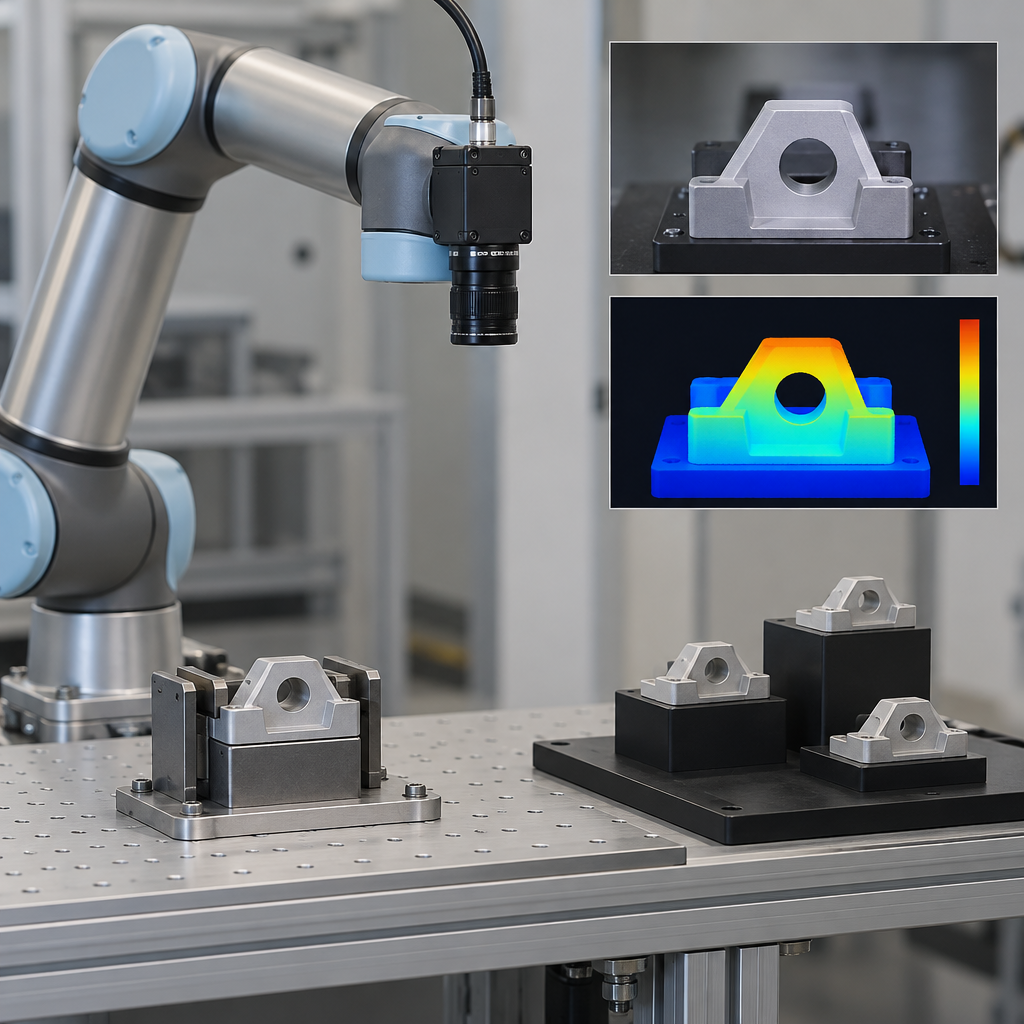
No. A calibrated depth camera can provide distance and shape information that a single RGB image lacks. It can support geometric consistency checks and obstacle detection. It does not measure mass directly, guarantee object identity or reliably distinguish every human, doll and household object under every condition.
Depth sensing has its own limitations: occlusion, missing measurements, reflective or transparent surfaces, device-specific operating ranges and alignment errors. A point cloud is not a certified safety zone, and an ordinary depth camera should not be presented as a safety-rated human detector without appropriate evidence.
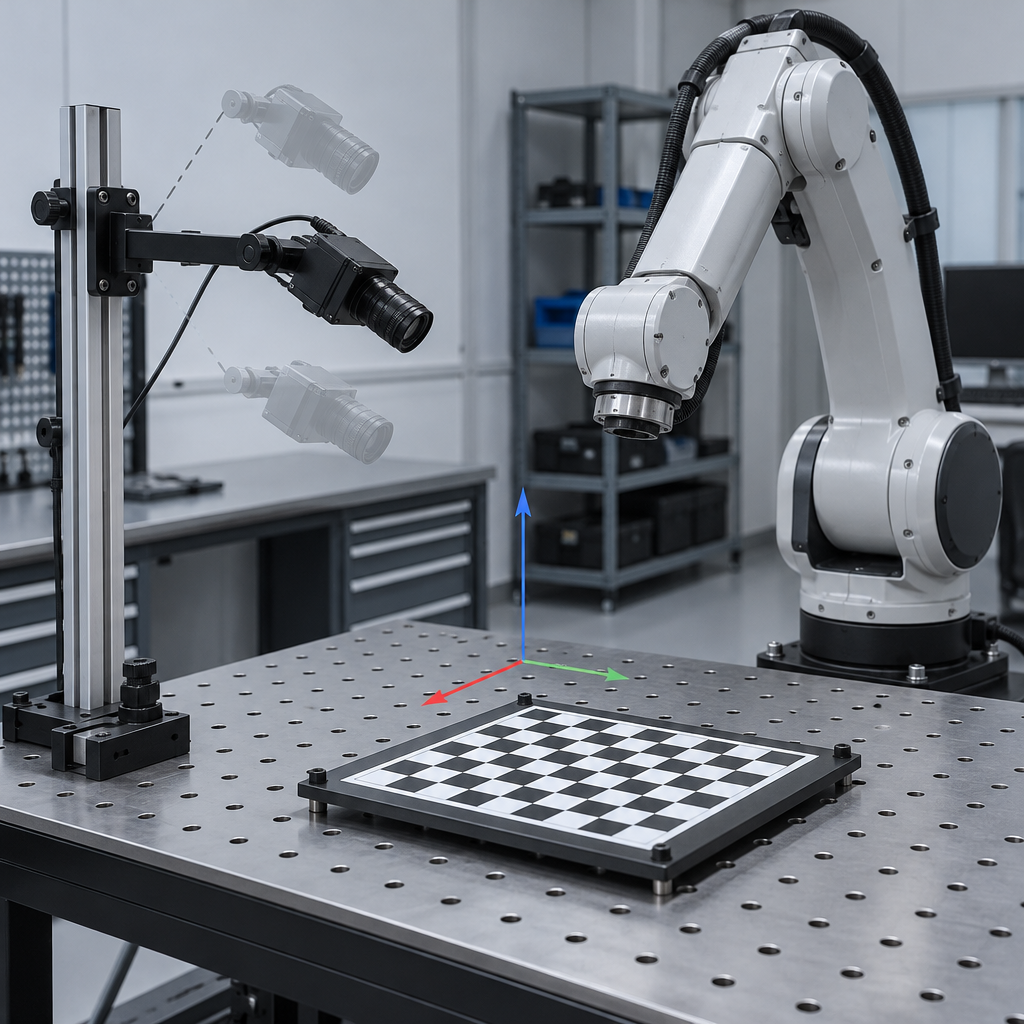
Calibration is equally important. Camera coordinates must be related to the machine’s frame before they can inform a motion plan. MoveIt’s calibration overview explains that relationship; detecting a checkerboard alone does not validate the complete installation.
Multiple sensors are useful only when their limitations and disagreements are handled. Two models interpreting the same corrupted image are not necessarily independent evidence.
How should a vision-guided cobot address these risks?
A defensible approach uses several layers, evaluated for the actual application:
- Define the permitted task and tools. Restrict the action set. Remove unnecessary sharp tooling and hazardous materials from an early pilot. A general conversation must not silently authorize an unrestricted physical task.
- Separate AI intent from motion permission. The model may propose an action; independent local controls must decide what motion is allowed. A cloud reply or an AI confidence score must not substitute for a protective device.
- Check perception quality and freshness. Missing frames, calibration uncertainty, stale depth or inconsistent sensor readings should prevent a new uncertain action. The required stopping behaviour must itself be assessed and tested.
- Assess the whole swept volume. The arm links, wrist, tool and carried object matter—not only the endpoint. Software boundaries derived from an uncalibrated scan are not verified protective boundaries.
- Validate stopping and human exposure. Protective measures, access controls, stopping distance and any contact limits depend on the application. A generic low speed or collision-detection setting is not a universal safe value.
- Keep recovery controlled. Loss of connectivity, power restoration or a cleared alarm must not unexpectedly resume a hazardous task. Human confirmation can support supervision, but does not replace physical safeguards.
Industrial robot requirements and application integration have distinct scopes: see ISO 10218-1 and ISO 10218-2. Which requirements apply depends on the machine, its intended use and the market. Naming a standard does not establish compliance with it.
What is SMERT’s position—and what remains under development?
SMERT’s engineering direction is to separate high-level AI reasoning from local motion control and safety functions. Our AI robotics overview describes this approach; our R&D testing page provides context for development and testing.
This is an engineering approach, not a claim that every proposed safeguard is already implemented, validated or certified. Camera-to-base mapping, environment boundaries, contact thresholds and stopping performance require application-specific measurements and qualified verification. Current lab supervision and software restrictions must not be confused with independently validated safety functions.
We do not claim that 3D perception makes hallucinations impossible, that tactile sensing guarantees harmless contact or that a simulated stop proves a physical installation safe. A demonstration shows what was demonstrated under its conditions—not everything a product will encounter in a home, clinic or factory.
For buyers, the right question is: what evidence shows that this exact installation manages this exact hazard? Explore our computer vision services and SMERT Cobot integration options to define the task, sensing requirements and validation scope before choosing equipment.
What should buyers ask before approving an AI robotics pilot?
- What happens if the camera is blurred, covered, disconnected or feeds old images?
- Can scene content or a spoken request expand the permitted tool or action set?
- Which safeguards are independent of the AI, and which are safety-rated where required?
- Has stopping performance been measured with the actual payload and tool?
- How are people, blind spots and unexpected objects addressed?
- Which functions are implemented, which are demonstrated and which remain planned?
- Who signs off the risk assessment, training and return-to-service procedure?
The NIST AI Risk Management Framework offers a useful structure for governing, mapping, measuring and managing AI risk. It is voluntary guidance, not machinery certification or proof of SMERT performance.
Frequently asked questions
Was a real baby endangered in the viral experiment?
The cited demonstration used a doll in a controlled research setup. It should not be reported as an actual incident involving a baby.
Can a cobot’s collision detection replace safeguarding?
No blanket conclusion is justified. Collision response, tool hazards, pinch points, exposure and stopping performance must be assessed together. Some hazardous contact can occur before a reactive system responds.
Should a business abandon AI computer vision because of this study?
No. Use it within a bounded, testable application with suitable independent safeguards. The study is a reason to strengthen evidence and action restrictions, not to promise that one sensor or one model eliminates risk.
Bottom line: better perception is valuable; safe deployment requires much more than better perception. The responsible response to this viral demonstration is layered risk reduction, transparent development status and evidence from the actual installation.
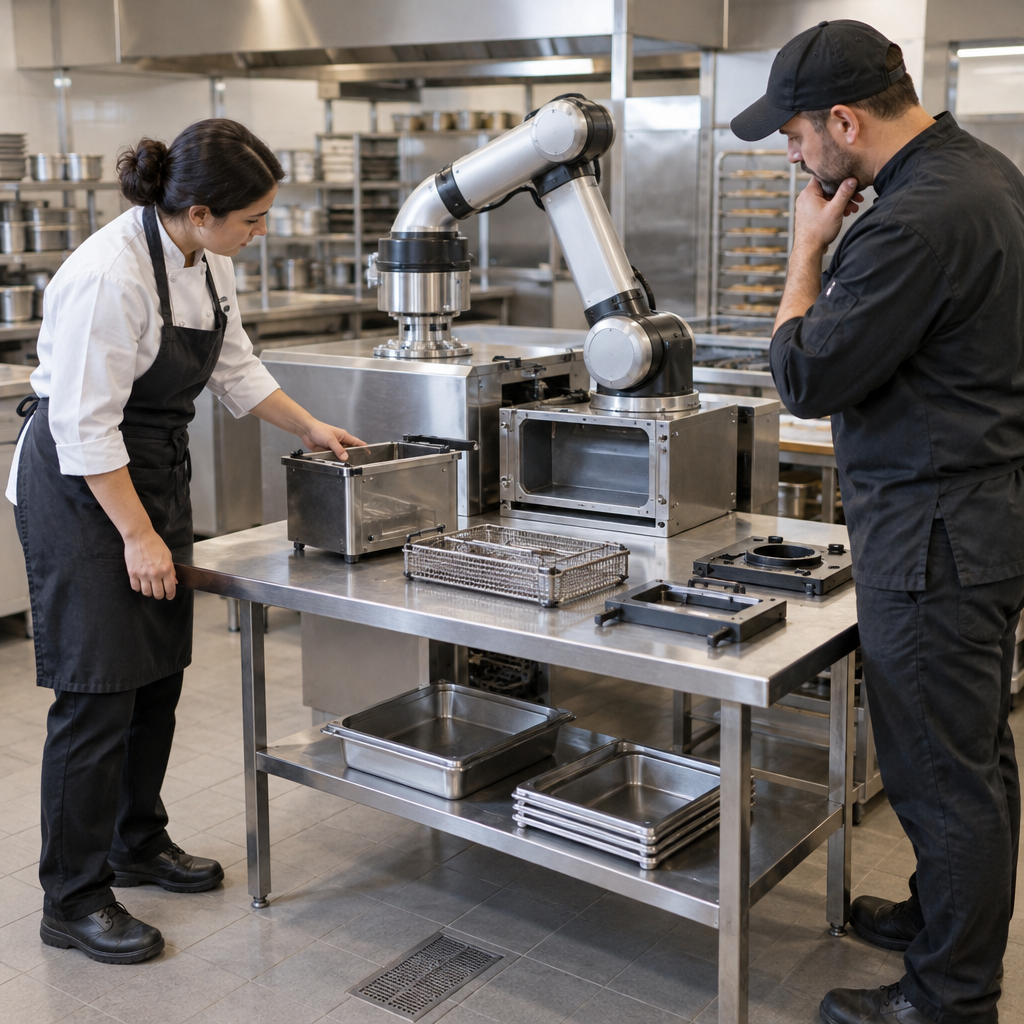
Cover: AI-generated editorial illustration of a generic evaluation workcell, not a SMERT product photograph or evidence of certified performance.
Related: Cobot integration
Transform Your Business with SMERT Robotics
Ready to experience the benefits of hospitality automation? Our team is ready to help you get started.