Humanoid Robots for the Home: A 2026 Buyer's Guide to What Actually Matters
The year the home humanoid became a real purchase
Until recently, "a humanoid robot for the home" meant a crowdfunding video and a delivery date that slipped forever. In 2026 there are real machines, real prices and real reservations — which means it's time to shop like a buyer, not a fan.
This guide is the checklist we use internally when we benchmark other machines against Smerty, our own home companion. Five things matter. Everything else is marketing.
1. Payload — the spec that decides if it's useful
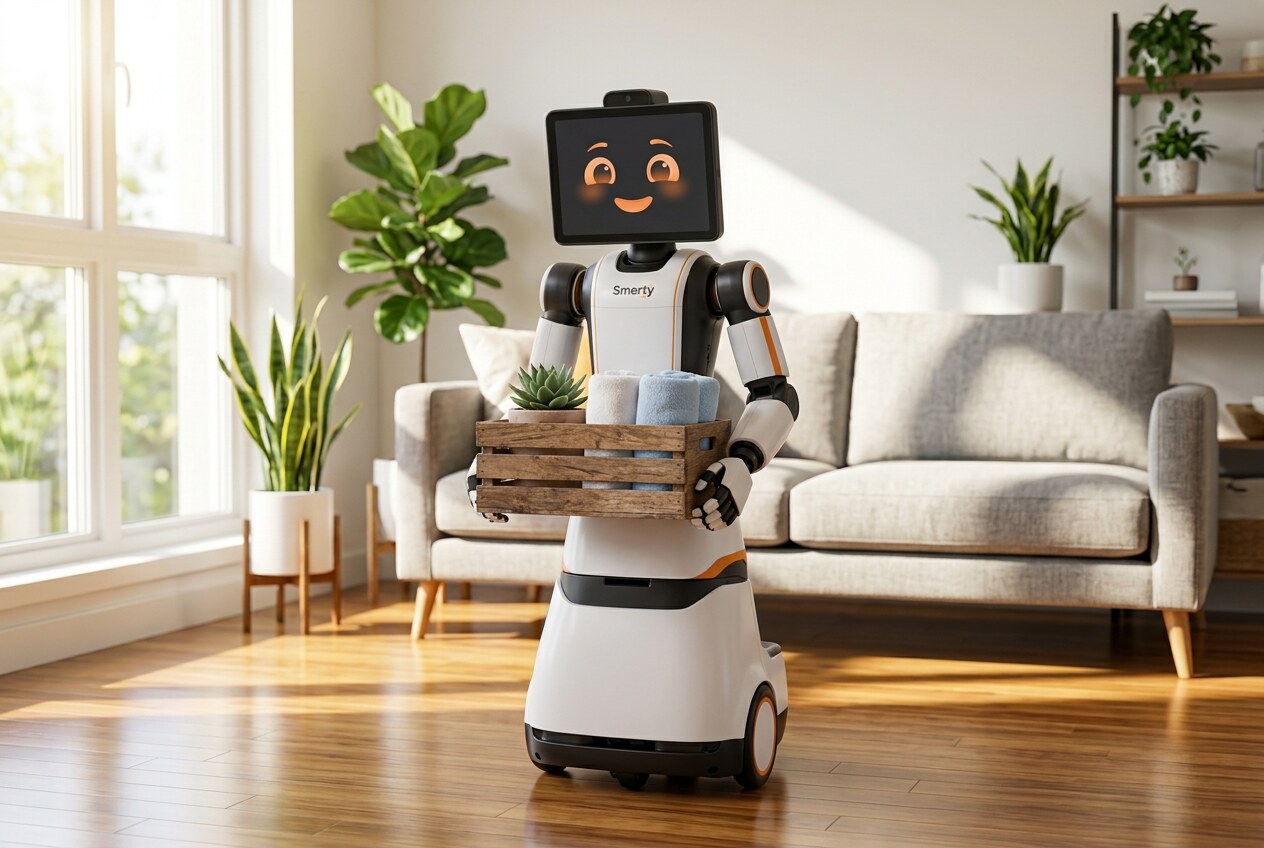
A home humanoid earns its place by carrying things: the laundry basket, the shopping, a tray with a full kettle, the box of toys back to the shelf. So the first question is brutally simple: how much can it actually carry, with both hands, all day?
Be careful with the numbers. Some vendors quote a single-arm peak lift measured in a lab pose; others quote what the machine can carry while balancing. What you want is the sustained, both-hands figure. Smerty is rated at 25 kg, and Smerty+ at 50 kg using both hands together — that's the difference between "holds a mug in a demo" and "does the laundry run."
2. Stability — the safety question in disguise
A home machine lives next to children, grandparents and pets. Ask: what happens when it loses power, or balance, or both?
- A dynamically balancing machine (legs) needs working software and power at all times to stay upright. A failure is a fall.
- A statically stable machine (a low, ballasted wheeled base) stands because of physics, not software. Power loss means it stops — not that it topples onto the dog.
This is why we build Smerty on a 100 kg ballasted wheeled base: stable enough that one adult at a time can lean on it for support, quiet on wood floors, and physically incapable of the "walking robot falls down stairs" failure mode — it doesn't do stairs at all.
3. Battery and self-charging — the all-day test
Ask two numbers: hours of useful work per charge, and does it dock itself? A machine that needs a human to plug it in is a machine that's dead every morning. Smerty self-docks to charge in a small storeroom corner and is designed for all-day availability — including the night watch, when it's the one checking that the hob is off.
4. The face — interaction is the product
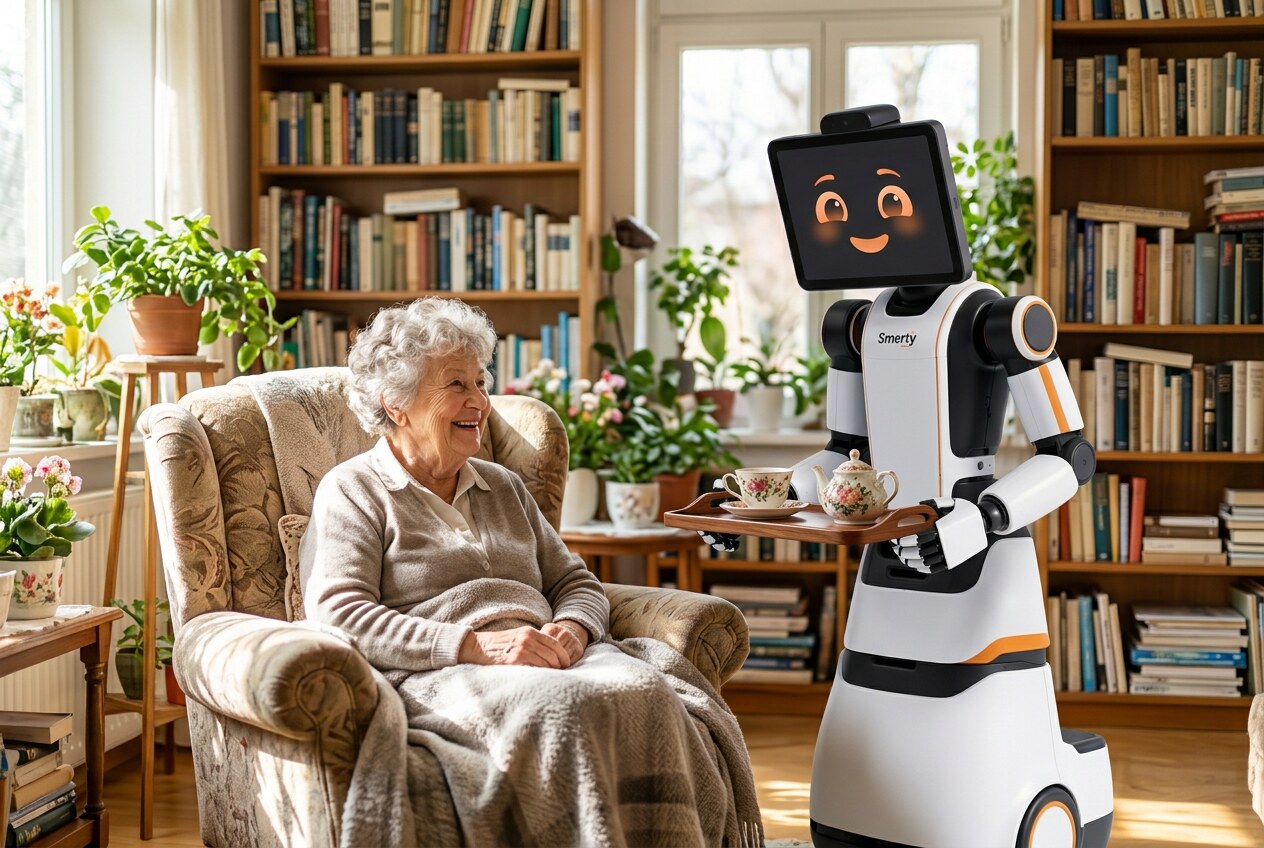
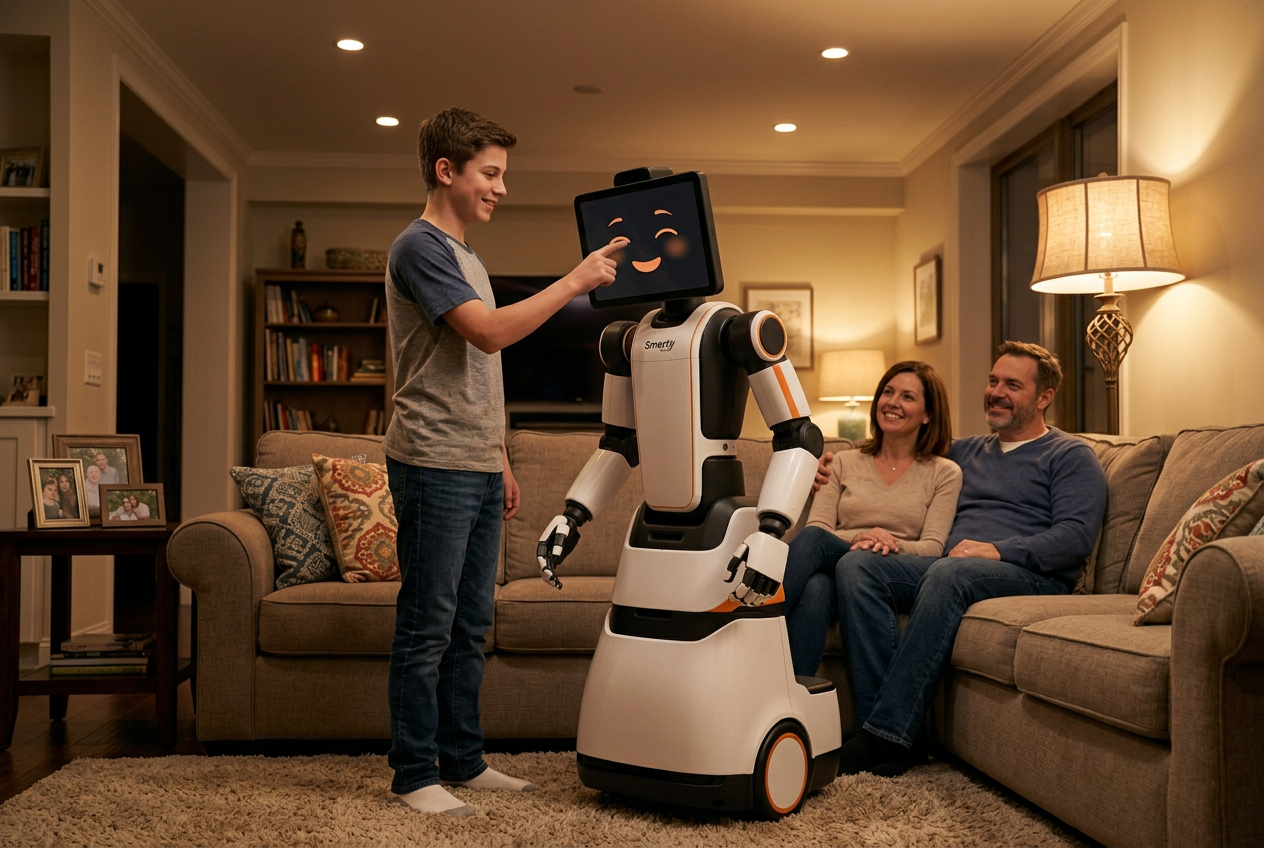
Here's the part most spec sheets undersell: in a home, the robot's face is how your family actually relates to it. A camera cluster with a status LED is an appliance. A screen face is a family member:
- Expressions — big friendly eyes and a smile that kids and grandparents read instantly, across languages.
- Video calls — the screen is a real two-way, encrypted video window. Grandma talks to the grandchildren on a 14-inch face, not a phone she can't find.
- Telepresence and takeover — an authorised family member or carer can connect live, see what it sees, and take over with named, speed-capped movements. STOP is always available, and the machine stops if the connection drops.
- Messages and reminders — medication prompts, calendar notes, "dinner in 20 minutes," read aloud and shown.
When you compare machines, don't ask "does it have a display?" Ask "what can my mother do with it without reading a manual?"
5. The fine print — price, deposit, service, honesty
- Total price, with taxes. Smerty is US$9,999 + taxes; Smerty+ is US$19,999 + taxes. If a vendor won't state a price, that is the answer.
- Deposit terms. Ours is a fully refundable 10% (US$999 / US$1,999) by card. "Refundable" should mean refundable on request, in writing.
- Ways to pay. Beyond the deposit we offer buy now, pay later instalments at checkout and Smerty as a Service — US$1,999/month all-inclusive on a 36-month contract covering the machine, the assistance plan, new skills and support.
- The support plan. A home humanoid without a support plan is a bet. Ours runs US$99/month or US$999/year (Smerty) and US$199/month or US$1,999/year (Smerty+), and includes 24/7 remote assistance with alarm overview, software updates with new skills, replacement hands dispatched within 24 hours if one malfunctions, and technician intervention across APAC, Europe and the Americas.
- Honesty about readiness. Smerty is in pilot development. First deliveries are planned for March 2027, and the final design may vary from what we show. Any vendor who tells you their machine is finished, perfect and shipping tomorrow is telling you something else too.
The short version
Buy payload you can use, stability you don't have to think about, a battery that outlasts the day, a face your family will actually talk to, and terms you can read in one sitting. That's the whole checklist — and it's the one we built Smerty against.
Transform Your Business with SMERT Robotics
Ready to experience the benefits of hospitality automation? Our team is ready to help you get started.