Robotics Safety, Standards & Compliance 2026: ISO 10218, ISO/TS 15066, CE, UL
Executive summary
Safety is not the box you tick at the end of a robotics project — it is the box you tick first, because it decides which arm you can even shortlist and how the workcell will be laid out. The good news is that the standards landscape has stabilised. In 2026 there are five documents every buyer must understand:
- ISO 10218-1 & -2 — the primary industrial-robot safety standard (revised 2025 edition now in force).
- ISO/TS 15066 — the collaborative-robot supplement.
- CE Machinery Directive / Machinery Regulation (EU) 2023/1230 — European compliance path.
- UL 1740 — the U.S./North American robotic-equipment standard.
- FCC Part 15 — for the wireless components of any modern robot.
The two ISO documents that matter most
ISO 10218-1 & -2 (2025 revision)
Two-part standard: Part 1 for the robot manufacturer, Part 2 for the integrator building the cell. The 2025 revision brought collaborative-operation content that was previously separate (in TS 15066) into the main standard's scope, and clarified requirements for AI-controlled robots.
Key requirements it imposes:
- Safety-rated stop functions (Categories 0, 1, 2 per IEC 60204-1).
- Safety-rated speed control.
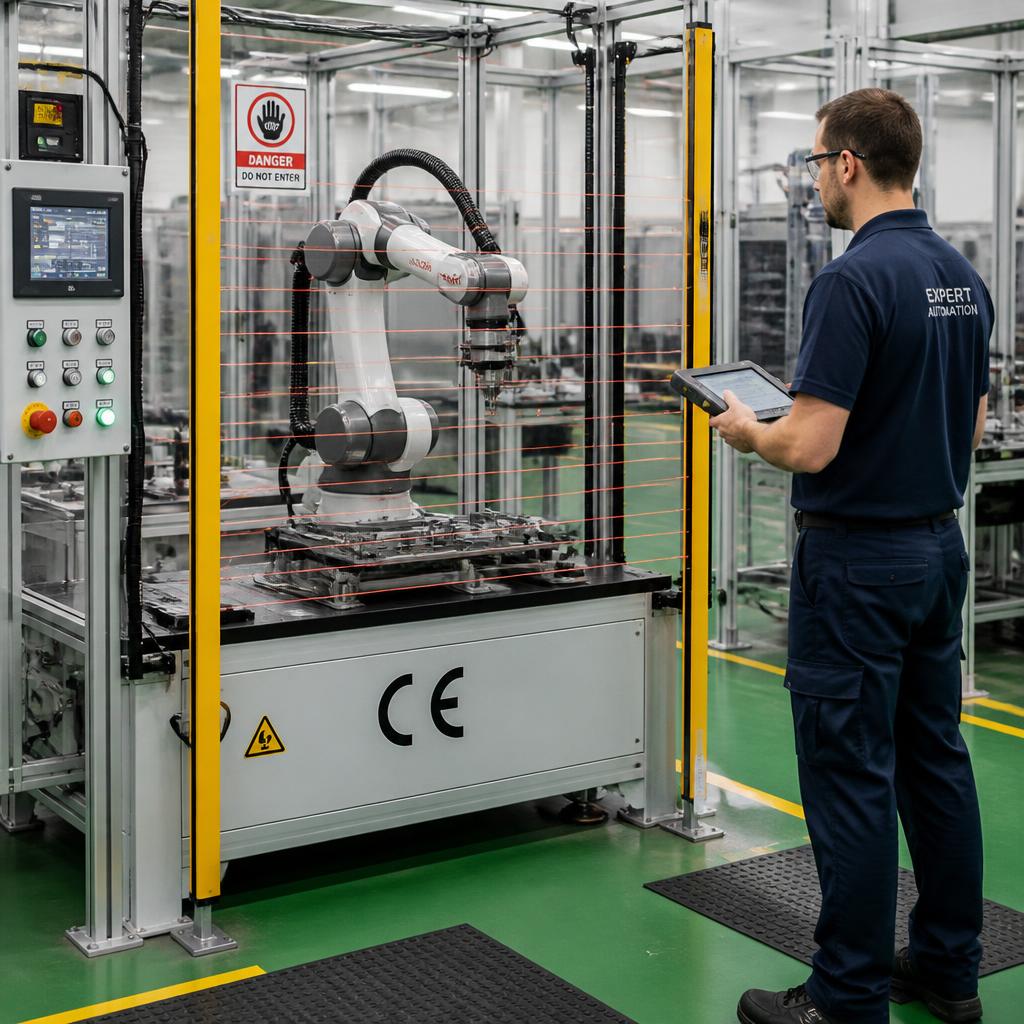
- Safe operating envelopes ("safe zones") monitored by the controller.
- Emergency stop within reach of every operator.
- Documentation of every safety function.
ISO/TS 15066
Introduced the four collaborative modes still referenced everywhere:
- Safety-Rated Monitored Stop (SRMS). Robot stops when human enters the collaborative workspace.
- Hand Guiding (HG). Operator physically guides the robot with a compliant handle.
- Speed and Separation Monitoring (SSM). Robot slows and stops based on human distance (measured by safety scanners or 3D vision).
- Power and Force Limiting (PFL). Robot's inherent design limits contact force to below biomechanical injury thresholds (published in Annex A of TS 15066).
Almost all modern cobots (Universal Robots, FANUC CRX, ABB GoFa/YuMi, KUKA iiwa, Doosan, Techman, Kassow, Elite, and SMERT cobots) support PFL and SSM out of the box; some (UR, Techman, Doosan) also support HG.
Regional compliance paths
Europe — CE marking under the new Machinery Regulation (EU) 2023/1230
The old Machinery Directive 2006/42/EC is being replaced by the Machinery Regulation, mandatory from January 20, 2027. Key changes:
- Explicit coverage of AI-based safety functions.
- Digital documentation now legally acceptable.
- Cyber-security is now a mandatory essential-health-and-safety-requirement (EHSR).
You still need: a risk assessment, technical file, EU Declaration of Conformity, and CE mark. For collaborative applications, essentially: ISO 10218-1/-2 + ISO/TS 15066 compliance.
North America — UL / ANSI
- UL 1740 covers robotic equipment safety.
- ANSI/RIA R15.06-2012 (aligned with ISO 10218) plus ANSI/RIA TR R15.606 (aligned with TS 15066).
- OSHA does not certify robots directly but will enforce against these standards during inspection.
Wireless / RF
Any robot with Wi-Fi, Bluetooth, 5G or LTE modules needs:
- FCC Part 15 (US)
- CE RED (EU)
- IC (Canada)
- MIC (Japan)
- SRRC / CCC (China)
- OFCA (Hong Kong)
The risk-assessment process in practice
Every cell must have a documented risk assessment. The steps:
- Define the task. What is the robot going to do, and where?
- Identify hazards. Pinch, crush, projectile, laser, thermal, chemical, ergonomic.
- Assess risk. Severity × probability × frequency of exposure × ability to avoid.
- Apply hierarchy of controls. Eliminate → substitute → engineer (guards, safety-rated stops, PFL/SSM) → administrative (training, procedures) → PPE.
- Re-assess. Residual risk acceptable?
- Validate. Physical testing of all safety functions.
- Document. Everything above, signed.
Advantages of standards-compliant design
- Insurance. Underwriters increasingly refuse to cover non-compliant cells.
- Speed to production. A cell designed to standards from day one avoids the 6-week teardown-and-retrofit that non-compliant cells almost always need.
- Sales. Enterprise buyers (Tier-1 automotive, medical, pharma) will not sign a PO without documented compliance.
- Injury rates. Published data (multiple US insurance industry reports) show properly-designed cobot cells have injury rates below the equivalent manual operations.
Limitations / failure modes
- "Cobot = safe by default" — false. A cobot with a sharp gripper or holding a knife is a hazardous machine. Risk assessment is per-cell, not per-arm.
- Bypassing safety scanners during commissioning and forgetting to re-enable them. Most common single cause of post-deploy incidents.
- Assuming CE covers everything. CE is the EU. UL is US. You'll need both for global.
- Ignoring cyber-security. A robot on your OT network is now in scope for IEC 62443 and, in the EU, the NIS2 directive.
Buyer's checklist
- Ask the vendor for the ISO 10218-1 declaration of conformity (for the robot itself).
- Ask the integrator for the ISO 10218-2 / TS 15066 risk-assessment package (for the cell).
- Confirm CE-MD or new Machinery Regulation compliance for EU deployments; UL 1740 for North America.
- Verify all RF certifications for the target country.
- Insist on a cyber-security threat model per IEC 62443.
How smert.ai fits
SMERT cobots ship with ISO 10218-1 certification, ISO/TS 15066 compliant safe-motion, CE-MD and pending CE Machinery Regulation compliance, UL 1740 listed, and full FCC / CE-RED / IC / SRRC / OFCA / MIC RF paperwork. Deployment includes a documented per-cell risk assessment. Full compliance details: /robotics.
Related: Cobot applications
Transform Your Business with SMERT Robotics
Ready to experience the benefits of hospitality automation? Our team is ready to help you get started.