Robotics in Retail & Vending 2026: Smart Shelves, Restocking, Autonomous Checkout
Executive summary
Retail robotics splits into two very different sub-markets. In-store consumer-facing robots (shelf scanners, greeters, cleaning) have had a mixed record — Walmart famously ended its Bossa Nova shelf-scanning contract in 2020 after finding humans + camera arrays could do the same job. But back-of-house and vending robotics are quietly scaling, and autonomous checkout has begun a second, more focused rollout in 2025–2026.
Market size and growth
- Global retail robotics: ~$14B in 2024 by MarketsandMarkets, growing 15%+ CAGR.
- Autonomous checkout: Amazon Just Walk Out is now deployed in 150+ third-party venues (stadiums, airports, colleges), plus Amazon-owned Amazon Go and Whole Foods pilots. Amazon shifted its Fresh strategy away from JWO in mid-2024 toward its Dash Cart, but continues to license the JWO platform (Reuters).
- Vending / autonomous retail: The global vending market is ~$25–30B; AI-powered / robotic vending is the fastest-growing slice.
- Micro-fulfilment: Ocado, AutoStore and Dematic ship dense automated fulfilment cells that let a grocer pick 50+ online orders/hour in a footprint the size of a shipping container.
Where robotics is winning in physical retail
1. Autonomous checkout (v2)
Amazon Just Walk Out, Grabango, AiFi and Trigo all ship computer-vision-based checkout that eliminates the queue. The 2025+ generation runs on fewer cameras, cheaper hardware, and licenses the software to third-party operators (Sainsbury's, Aldi, and stadium/travel operators).
2. Robotic vending machines
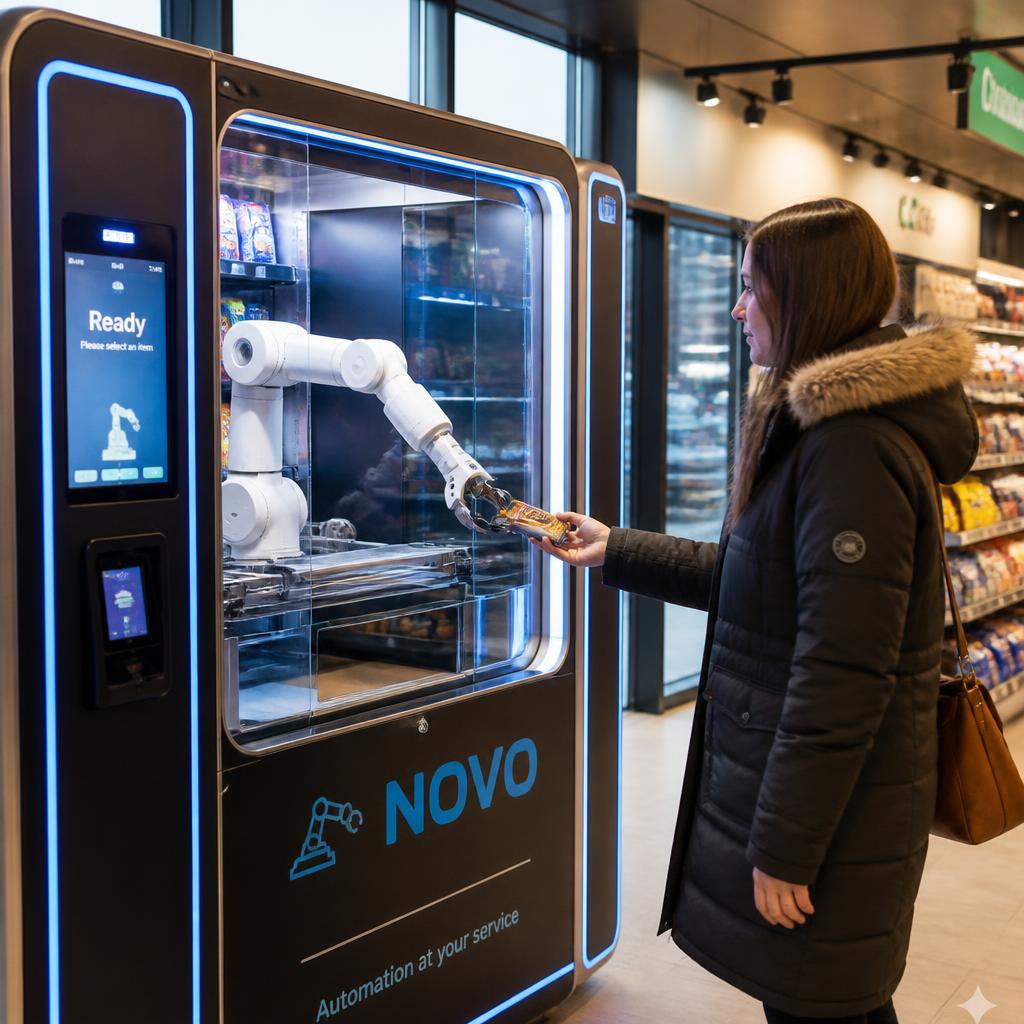
Vending is having its second life. Instead of a mechanical spiral pushing a bag of chips, a 6-axis arm behind glass picks any SKU — bottles, bento boxes, cosmetics, electronics. Companies like Yo-Kai Express (hot ramen), Briggo/Costa Genio (coffee), and a wave of Chinese and Korean systems now do fresh food, hot food, and packaged goods.
Advantages vs traditional vending:
- Fresh and refrigerated goods with proper handling.
- Any SKU shape (no more "bag stuck in the spiral").
- Better shrinkage control via camera-verified dispense.
- Real-time inventory to a cloud back-end.
3. Micro-fulfilment for grocery
Kroger + Ocado, Walmart + Alert Innovation, Instacart + Fabric — every major grocer is testing dense automated micro-fulfilment centres that live inside or attached to existing stores.
4. Cleaning robots
Brain Corp's autonomous scrubbers run in Walmart, Sam's Club, Kroger, Schnucks and a dozen other chains. Tens of thousands of units deployed globally. Payback is a straight labour trade.
5. Restocking and shelf-scanning (post-Bossa Nova)
The category didn't die; it consolidated. Simbe Robotics' Tally, Bossa Nova's successor deployments, and Amazon's own store-inventory systems continue. The best modern implementations combine an autonomous robot at night + fixed-ceiling cameras during the day, feeding one unified planogram-compliance dataset.
What has failed
- In-store greeter / customer-service robots. Consumers didn't want them; staff didn't trust them. Category collapsed.
- The first wave of shelf-scanning at Walmart scale. Not because the tech didn't work, but because humans + a smartphone camera app were cheaper for the same task.
- Fully autonomous drone delivery to consumer doorstep. Still not economical at retail scale outside a few controlled markets.
Advantages, quantified
- Autonomous checkout: Just Walk Out venues consistently report transaction times under 30 seconds vs 2–5 minutes at a manned register.
- Robotic vending: 24/7 availability with typical revenue-per-square-foot 3–5× a comparable manned kiosk.
- Cleaning: ~1 FTE-shift freed per store per day by an autonomous scrubber.
- Micro-fulfilment: Cuts online-grocery pick cost from ~$10/order manual to ~$2–3/order automated (published Kroger/Ocado analyst-day data).
Limitations and failure modes
- Shrinkage design. Any robot handling merchandise must design for shrinkage — vandalism, tampering, theft.
- SKU catalogue. Every new SKU is a new grasp/vision training case. Retailers with 1,000+ SKUs need continuous model updates.
- Refrigeration and food safety. Robotic vending of fresh food adds HACCP obligations most operators aren't ready for.
- Real-estate. Every square foot of robot occupies square feet you could sell merchandise on.
Buyer's checklist
- Start with a single-purpose deployment (cleaning, vending, or checkout in one lane).
- Insist on remote monitoring and 24/7 uptime dashboards.
- Budget for continuous ML retraining as your SKU catalogue changes.
- Model the payback on shrinkage reduction + labour, not just labour.
How smert.ai fits
Our robotic vending platform ships as a turnkey autonomous kiosk (6-axis 5 kg arm + vision + refrigerated cabinet + payments) — footprint of 2 traditional vending machines, revenue of 4. In-store cobots handle back-of-house pack-out, restocking cases, and cleaning workflows. Full portfolio: /robotics.
Related: Cobot applications
Transform Your Business with SMERT Robotics
Ready to experience the benefits of hospitality automation? Our team is ready to help you get started.