Robotics in Manufacturing 2026: A Deep Dive into Cobots, ROI and Deployment
Executive summary
Manufacturing is still, by a wide margin, the largest end-market for robotics. The International Federation of Robotics (IFR World Robotics 2024) reported a record 4,281,585 industrial robots operating in factories worldwide and 541,302 new installations in 2023 — the third-highest year on record. Automotive and electronics remain the two dominant verticals, but the fastest-growing segment for four consecutive years has been collaborative robots (cobots) — safe, sensor-rich arms designed to work directly next to people.
The buying question in 2026 is no longer "should we automate?" It's "which task, which arm, which gripper, and how fast can it pay back?" This deep dive answers those four questions.
Market size and growth
- Installed base: 4.28M industrial robots operating globally (IFR, 2024 report on 2023 data).
- China's share: China alone accounted for ~51% of new installations in 2023 (276,288 units), the sixth year running as the world's largest robotics market (IFR press release, 2024).
- Density leaders: South Korea is the world's most robot-dense manufacturing economy at 1,012 robots per 10,000 employees, followed by Singapore (770) and Germany (429) — the global average is now 162 (IFR World Robotics Report 2024).
- Cobots: Grew to represent roughly 10.5% of all industrial robot installations in 2023, up from a rounding error ten years ago (IFR).
- Forecast: Independent research houses (BCG, McKinsey, Interact Analysis) consistently model the industrial-robot market growing high-single-digits through 2030, with cobots and vision-guided systems taking share.
How manufacturing robotics actually works today
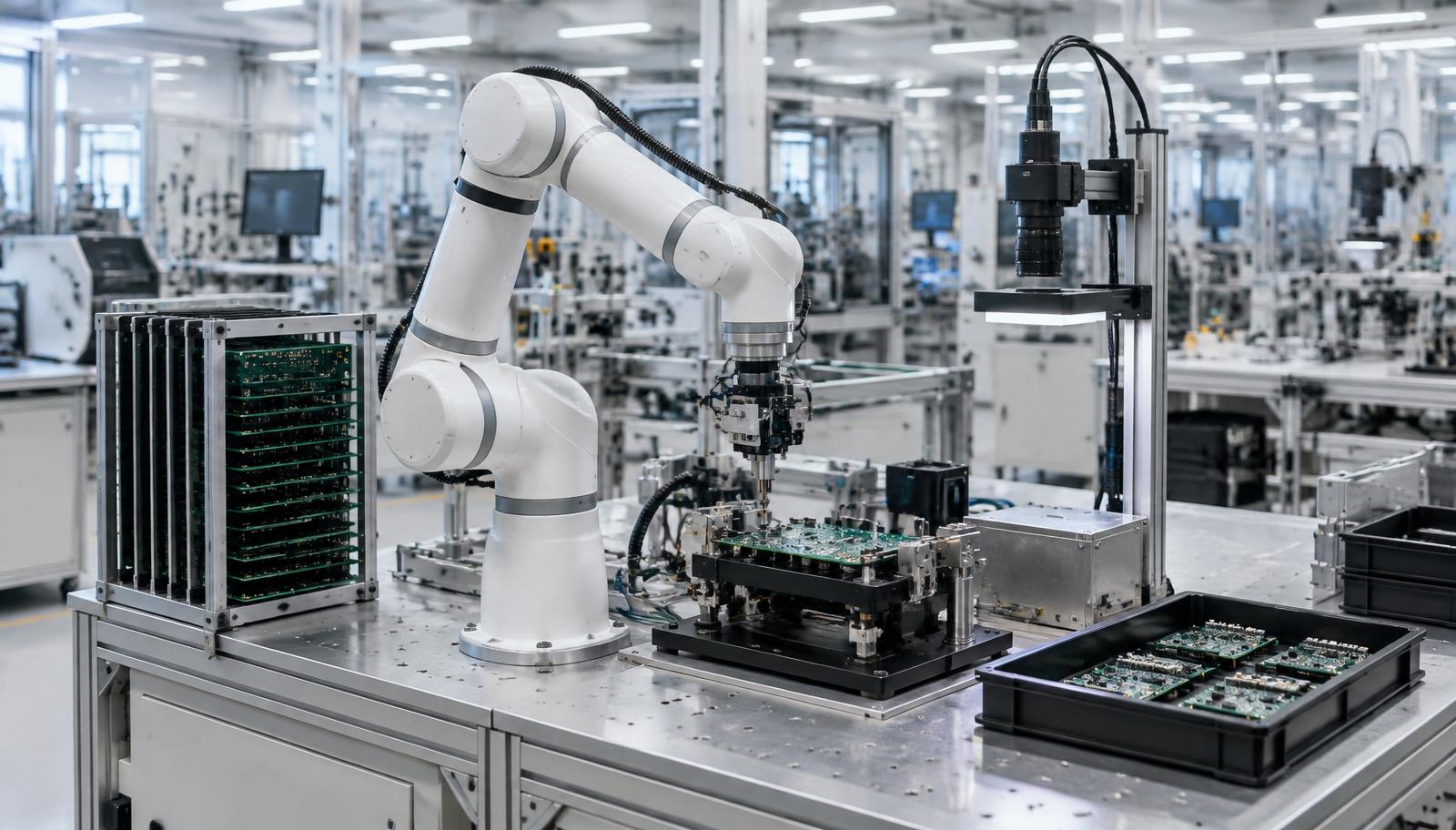
A modern factory cell is rarely "one big arm doing everything." It's usually a stack of four layers:
- Motion — the arm itself (industrial 6-axis, SCARA, delta, or cobot). Payload, reach and repeatability decide the shortlist.
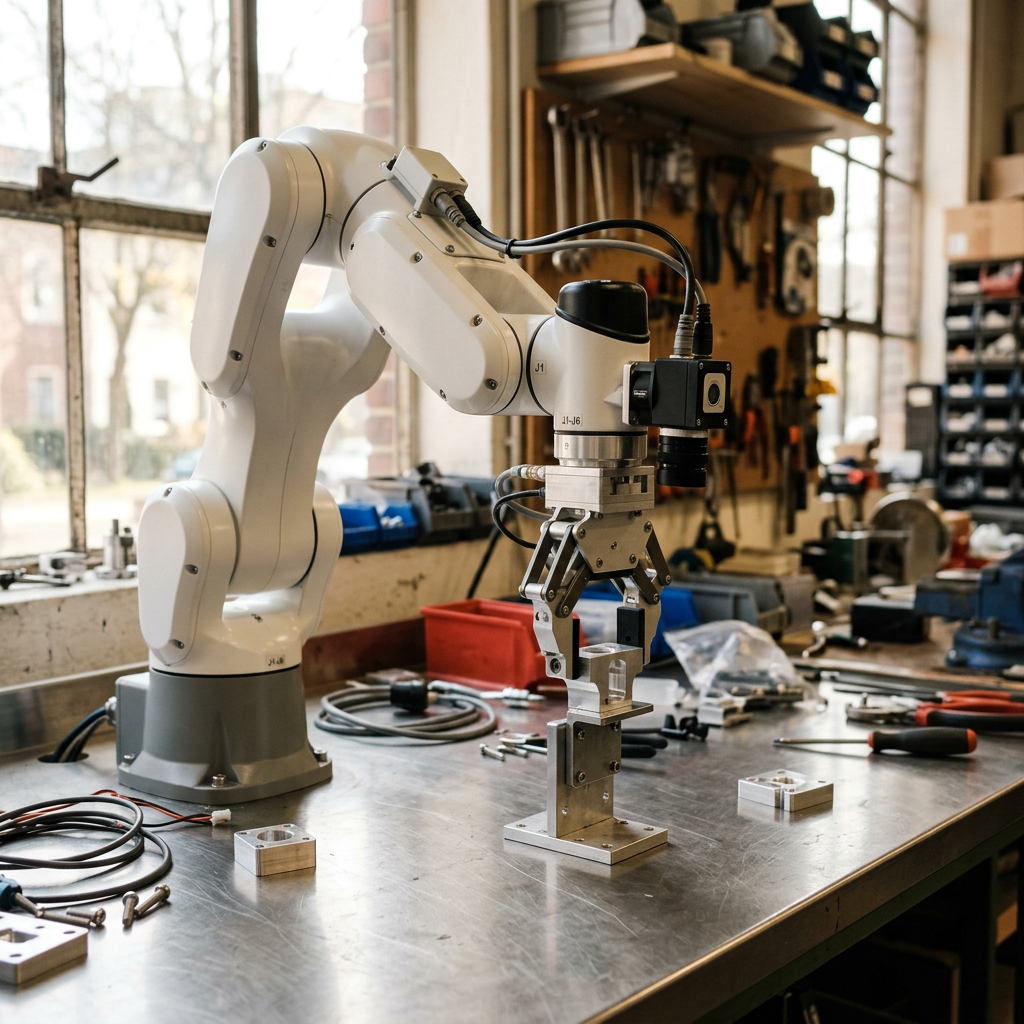
- End-of-arm tooling (EOAT) — the gripper, welding torch, dispensing head, screwdriver, or vision head. This is where 60% of application-specific engineering time goes.
- Perception — 2D or 3D cameras, force-torque sensors, structured-light scanners. Perception is what lets one arm do more than one thing.
- Orchestration — a PLC or an industrial PC that sequences the cell, talks to the MES/ERP, and handles safety I/O.
The 2026 shift is that layers 3 and 4 are increasingly AI-native. Instead of hand-coding pick coordinates, a vision model localizes parts in the bin and hands 6-DoF poses to the motion planner. This is what turned bin picking from a research demo into a production line.
The four applications that dominate factory ROI
1. Machine tending
Feeding CNC lathes and mills, injection-molding machines, or press brakes is the single most common cobot deployment. Universal Robots — the market leader in cobots by installed base — has consistently reported machine tending as its #1 application category (Universal Robots case studies). Payback is usually 9–18 months on 2- or 3-shift operations, because the arm eliminates one operator per shift on repetitive load/unload.
2. Assembly
Screw driving, snap-fit, adhesive dispensing, small-part insertion. This is where cobots outperform hard automation because product mixes change every quarter and reprogramming a cobot is a lead-through teach, not a re-engineering project.
3. Welding
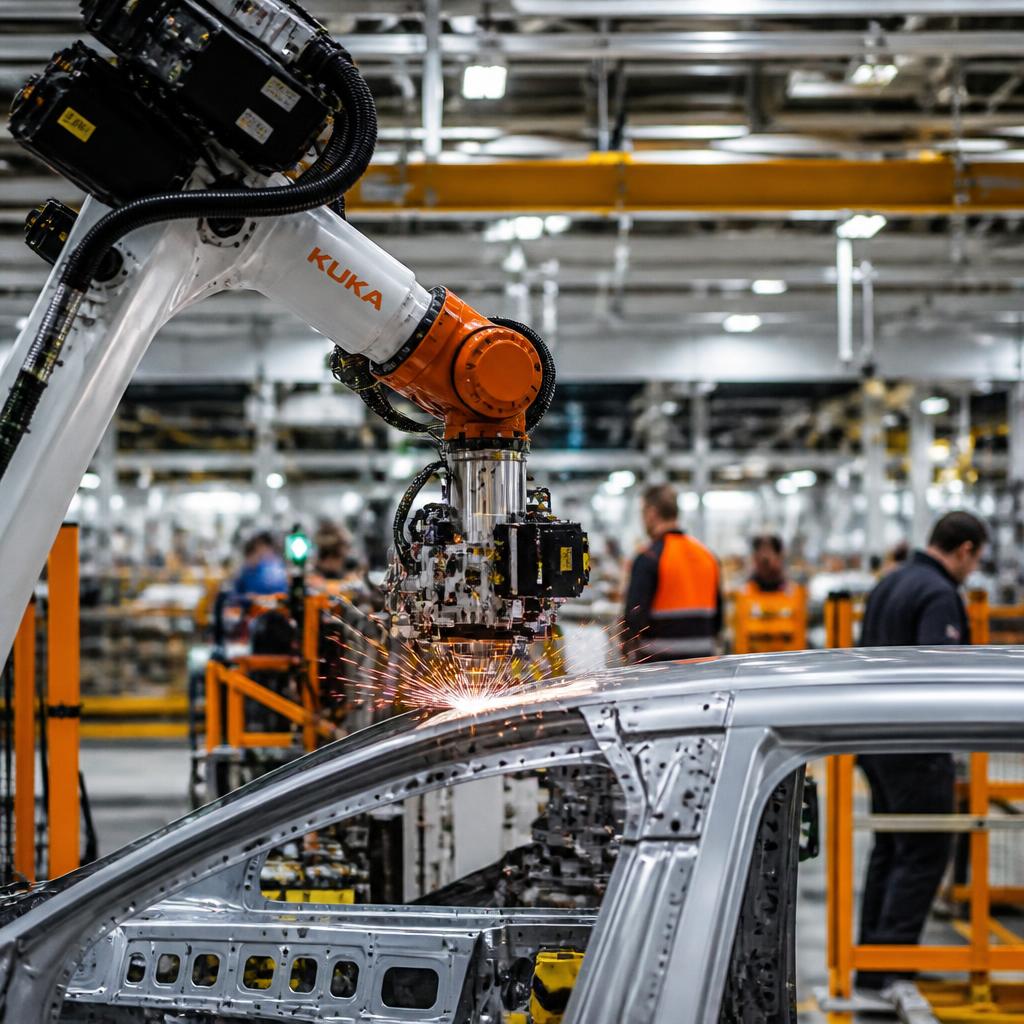
Robotic arc welding is 40 years old. What's new is cobot welding — a lightweight arm, a torch, and a wire feeder, priced so that a small metal fabricator can afford it. Companies like Hirebotics and THG Automation have built entire businesses on this, and every major cobot vendor now ships a welding-specific SKU.
4. Inspection and quality
AI vision has re-opened this category. Structured-light 3D scanners plus a trained defect model catch surface defects, missing components, and dimensional errors at line speed. Cognex, Keyence, MVTec, and Zebra all report vision as their fastest-growing manufacturing segment.
Advantages, quantified
- Cycle time: Fixed-purpose robots easily outrun humans on repetitive motion. Cobots run at ~30–70% of the speed of a caged industrial arm, but with 60–80% less integration cost.
- Defect rate: Vision-guided robotic inspection routinely reduces false-negatives to <0.1% on visible-surface defects, vs 1–3% for trained human inspectors on 8-hour shifts (published case studies from Cognex and Keyence).
- Uptime: A well-integrated cell runs 6,000–7,000 productive hours/year. Human labour on 2 shifts runs 3,800–4,200.
- Safety: ISO 10218-1/-2 and ISO/TS 15066 give a validated framework for collaborative operation. Correctly risk-assessed cobot cells have injury rates lower than the manual equivalent operations they replace (US Bureau of Labor Statistics OSHA reporting on machine-tending injuries pre- and post-automation).
Limitations and failure modes
Deployments fail — usually for one of five reasons:
- Wrong task selection. Any task with <30 seconds of repeatable motion, or with high-variability inputs, is a bad first pick.
- Gripper underestimated. Buyers spec the arm and treat the gripper as an afterthought. In reality, EOAT drives 40–60% of application risk.
- No fixturing. Robots need known part positions. Skip fixtures or vision, and cycle-time falls apart on day two.
- No process ownership. The engineer who integrated the cell leaves. Nobody re-teaches. The line stops.
- Safety cut corners. A missing risk assessment or a bypassed light curtain kills projects politically the first time somebody bumps their hand.
Buyer's checklist for 2026
- Payback under 18 months on a real, sourced BOM (not a vendor's spreadsheet).
- Two- or three-shift target — one shift almost never pays back.
- Certified safety design — ISO 10218, ISO/TS 15066, CE-MD in Europe, UL in North America.
- Vendor-neutral service plan — parts, spares, and re-programming support locally.
- Data out — the cell must publish cycle time, uptime and reject rate to your MES.
How smert.ai fits
Our SMERT cobots ship in 5, 10, 20, and 30 kg payload classes with integrated 2D/3D vision, ISO 10218-compliant safe-motion, and a normalised gripper interface (parallel, vacuum, and multi-finger). Pricing lands at $20k–$50k all-in for the full workcell. Full lineup: /robotics. Model our payback yourself: /tools/roi-calculator.
Ready to shortlist a cell? Book a 30-min technical call.
Related: Cobot applications
Transform Your Business with SMERT Robotics
Ready to experience the benefits of hospitality automation? Our team is ready to help you get started.