Robotics in Logistics & Warehousing 2026: The Full Stack, from Pick to Pallet
Executive summary
Warehousing is the second-largest robotics end-market behind manufacturing, and the one where new dollars are moving fastest. Interact Analysis and LogisticsIQ both project the mobile robots market alone to grow at ~20–30% CAGR through 2030. The reason is simple: e-commerce order profiles (many SKUs, small units, short SLAs) have broken traditional warehouse economics, and labour is unavailable at any price in most Tier-1 metros.
Market size and growth
- Amazon fleet: Amazon disclosed in 2024 that it operates more than 750,000 mobile robots worldwide, making it the largest single deployer of mobile robotics on the planet (Amazon corporate blog).
- Mobile robots: The AMR (Autonomous Mobile Robot) and AGV market is estimated by Interact Analysis at $5B+ in 2024 revenue, growing 20%+ annually.
- Warehouse robotics overall: LogisticsIQ tracks the total warehouse robotics stack (AS/RS, AMR, sortation, robotic arms) heading toward ~$40B by 2030.
- Piece-picking: Formerly the "last unsolved problem." In 2024–2026, Covariant (acquired by Amazon), Ambi Robotics, RightHand Robotics, and Berkshire Grey have all published real production throughput numbers in the hundreds-to-thousand-picks-per-hour range.
The five layers of a modern robotic warehouse
Every large fulfilment operation now buys some combination of these:
- Storage & retrieval (ASRS) — dense shelving with shuttles or cranes bringing bins to a pick station. Vendors: AutoStore, Exotec, Kardex.
- Goods-to-person (G2P) — mobile robots ferrying racks or totes to a stationary human or robotic picker. Vendors: Amazon Robotics (ex-Kiva), Geek+, HAI Robotics, Locus Robotics.
- Piece-picking arms — 6-axis arm with vision + gripper doing the actual "grab one unit from a mixed bin." Vendors: Covariant, RightHand, Ambi, Dexterity.
- Sortation — cross-belt or bomb-bay sorters routing packages to outbound doors. Vendors: Vanderlande, Bastian, Interroll.
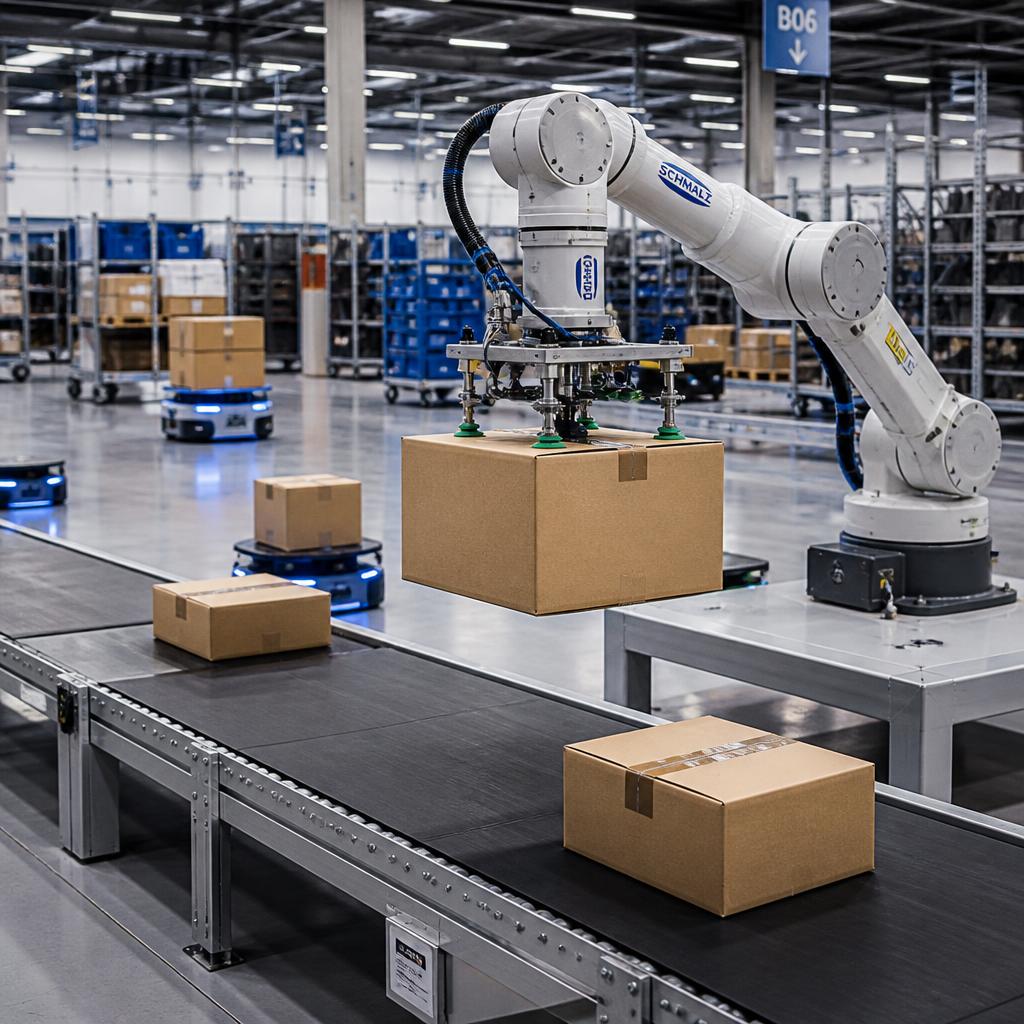
- Palletising / de-palletising — a robotic arm building a mixed-SKU pallet at the end of the line. Vendors: FANUC, ABB, Yaskawa, KUKA, plus cobot palletisers from Universal Robots + Robotiq.
The industry insight: you don't buy all five at once. Most operators start with G2P or palletising because payback is easiest to model.
How piece-picking actually works in 2026
The transformation of the last five years is that a robotic arm can now pick a novel SKU — one it has never seen before — from a mixed bin, and place it into a shipping tote, without an engineer pre-training a model per SKU.
The stack:
- 3D camera (usually structured-light or stereo IR) captures the bin.
- Neural network segments objects and predicts a set of graspable poses ranked by confidence.
- Grasp planner picks the highest-confidence pose that the arm can physically reach.
- Gripper — usually a hybrid: vacuum for boxes and poly bags, a parallel or multi-finger for irregular items — executes.
- Failure recovery — if the item slips or double-picks, the system re-scans and retries.
Best-in-class systems now do 600–1,000 picks/hour on general-merchandise SKU mixes, comparable to or better than a trained human on the same station. Amazon's April 2025 announcement of its "Vulcan" piece-picking system explicitly targeted mixed-SKU picking at production speed (Amazon news).
Advantages, quantified
- Storage density: Cube-storage ASRS (AutoStore et al.) achieves 4× the density of manual pallet racking in the same floor area.
- Labour: G2P systems cut walking time by ~70% per pick. Amazon's own numbers estimate its 750k+ mobile robots reduce order-fulfilment cycle times by 25%+.
- Accuracy: Robotic sortation runs at 99.99%+ read accuracy, vs 99.5% for barcode-scanning humans over 8-hour shifts.
- 24/7 operation: No shift breaks, no seasonal ramp-hiring pain.
Limitations and failure modes
- CapEx. A full G2P deployment for a mid-size DC is $5–20M. Financing structures (Robot-as-a-Service, revenue-share) exist but change unit economics.
- Long implementation. 9–18 months from PO to go-live for large systems. Cobot palletisers can install in weeks; ASRS cannot.
- Building constraints. ASRS wants a flat, tall, unobstructed footprint. Retrofit into an old low-ceiling warehouse is often uneconomic.
- Software integration. Every layer needs to talk to your WMS. Poor middleware is the single most common project killer.
- Peak-day fragility. A robot fleet at 100% utilisation has zero surge capacity. Design for 70% steady-state.
Buyer's checklist
- Start with the operation, not the technology. What's your pick-lines-per-order? What's your peak-to-average ratio?
- Model the labour baseline honestly, including turnover cost and training.
- Choose one payback vector first (usually G2P or palletising), prove it, expand.
- Insist on open WMS/WCS integration standards (VDA 5050 for AMRs is now the emerging standard).
- Budget 15% of CapEx per year for service, spares and continuous re-optimisation.
How smert.ai fits
We ship cobot arms optimised for case packing, palletising and pick-and-place at the point where an AMR/ASRS system hands off to human packers. Our 20 and 30 kg models with 3D vision handle general-merchandise picking; the 5 and 10 kg models handle carton and poly-bag sortation. Full logistics fit: /robotics/logistics. ROI model: /tools/roi-calculator.
Related: Cobot applications
Transform Your Business with SMERT Robotics
Ready to experience the benefits of hospitality automation? Our team is ready to help you get started.