Robotics in Hospitality & F&B 2026: Kitchens, Service, and Franchise Unit Economics
Executive summary
Food-service robotics is the most public-facing corner of the industry — every viral video of a burger-flipping arm belongs to this category — and also one of the most economically brutal. Restaurant margins are thin, labour turnover is savage, and a single day of downtime kills a location's month. That combination is exactly what makes cobots interesting here: not as a novelty, but as a capacity and quality guarantee on the highest-volume stations.
The 2026 reality: robotic drink-making, frying, grilling and delivery work in production. Full end-to-end "robot restaurant" experiments have mostly failed. The winners are hybrid kitchens where one or two stations are automated and humans handle the rest.
Market size and growth
- Global QSR industry: ~$1T annually; labour is 25–35% of operator P&L, and in most Tier-1 metros the labour is unavailable at posted wages.
- Food-service robotics: Estimated at $2–3B globally in 2024, projected to grow ~15–20% CAGR through 2030 (MarketsandMarkets, Allied Market Research).
- McDonald's AI pilot — the world's largest QSR brand tested AI-powered drive-thru order-taking with IBM in 2024, then paused for retooling in mid-2024, showing that even the largest brand is still iterating (Reuters coverage).
What works today
1. Coffee and cocktails
Robotic baristas (Cafe X, Rozum, Costa Genio, and a wave of Chinese systems) run reliably in airports, malls, and offices. Payback is straightforward on any location that would otherwise pay a barista 60+ hours/week. Cocktails (Makr Shakr, Barsys) follow the same logic on cruise ships, hotels, and event venues.
2. Frying
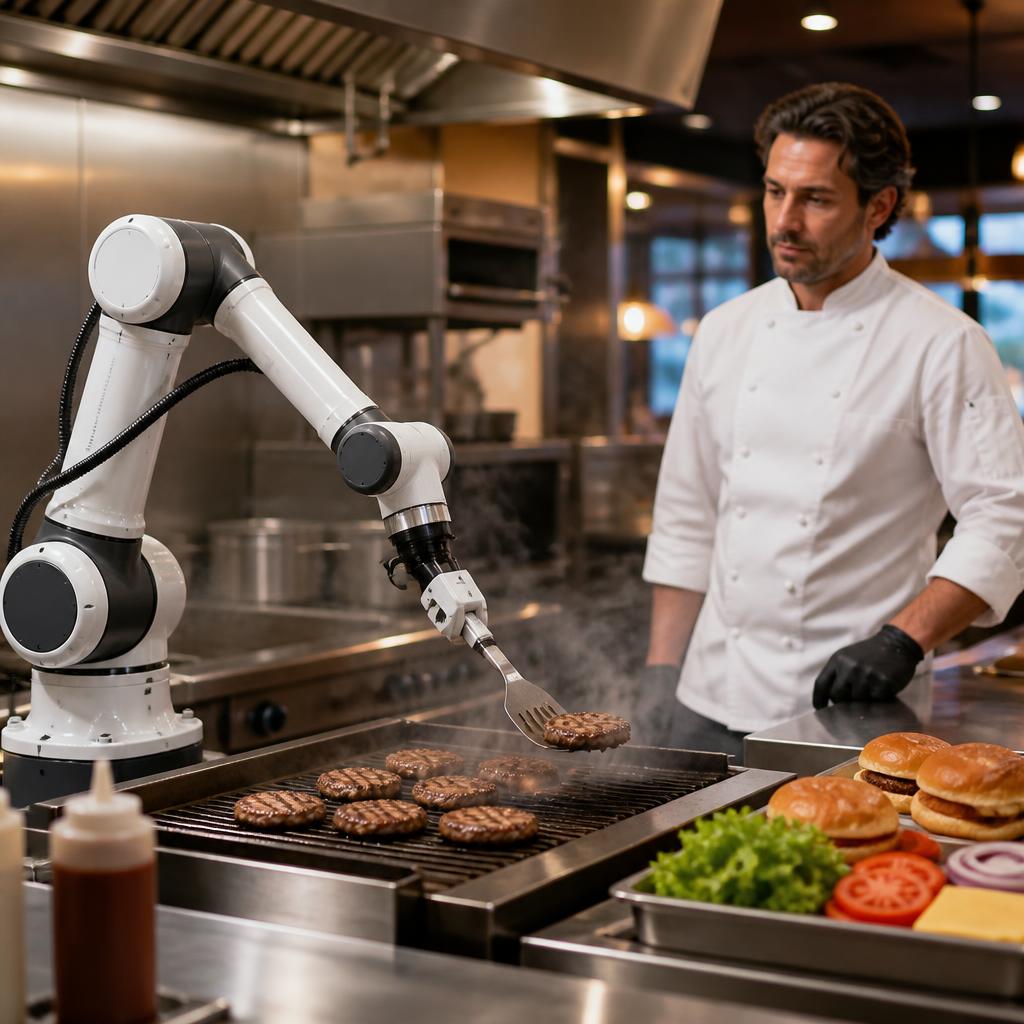
Miso Robotics' Flippy is the best-known example; White Castle deployed multiple units, Buffalo Wild Wings partnered on production trials. The fryer is a perfect first station: repetitive, hot, and the single most disliked human job in a QSR kitchen.
3. Wok and stir-fry stations
Ghost-kitchen operators in Asia and North America run robotic wok stations (Cala Systems' pasta robots, various Chinese wok-bots) at output levels a single chef can't match.
4. Pizza
Picnic, Piestro and other pizza-assembly robots ship measurable throughput: 300+ pizzas/hour on a Picnic line, per the company.
5. Service and delivery
Bear Robotics (Servi), Pudu (BellaBot), Keenon and OrionStar have shipped tens of thousands of front-of-house service robots into restaurants globally. Softbank invested $60M+ into Bear Robotics in 2024. These robots don't take orders — they carry food from kitchen to table, freeing servers for guest-facing work.
What has failed (so far)
- End-to-end "robot restaurants." Zume Pizza famously burned $500M+ and shut its robotic-pizza business in 2020. Creator (San Francisco burger robot) closed the same period. Lesson: full automation of a variable menu is currently uneconomic.
- Fully autonomous drive-thru voice AI. McDonald's IBM trial paused mid-2024 after viral order mishaps (Reuters). The technology is improving fast (GPT-5-class models change the equation), but it isn't a solved problem yet.
Advantages, quantified
- Throughput consistency: A robotic fryer holds ±5°C oil temperature and ±3-second cook time all shift. Humans drift under load.
- Labour re-allocation: One robotic station typically frees 0.7–1.2 FTE-equivalents per shift. On 2 or 3 shifts, that's 1.5–3.5 heads.
- Waste reduction: Consistent portioning cuts food-cost variance by 3–8 percentage points on the automated station.
- Recruitment: Franchisees consistently report that being an "automated kitchen" makes hiring the remaining staff easier — the work looks more modern.
Franchise unit economics — the honest version
For a mid-size QSR box doing $1.2M annual revenue:
- Labour cost baseline: ~$300k–$400k/year across 2 shifts.
- Cobot fryer station capex: ~$30–60k depending on integration.
- Labour saved: ~1 FTE per shift = ~$40–60k/year in fully loaded cost.
- Payback: 12–18 months at typical utilisation.
That's why our franchise programme bundles the cobot station into the fit-out. Details: /franchising.
Limitations and failure modes
- Menu complexity. Any station where the SKU list changes weekly is a bad first automation.
- Cleaning. Grease, batter, sauces. Any station has to be cleanable in the same time as a human station or ops staff will hate it.
- Front-of-house perception. Some customer segments love the robot; others associate it with poor value. Test-market first.
- Uptime. A dead robot at 12:30 lunch peak is a disaster. Service SLAs matter more than in any other vertical.
Buyer's checklist
- Pick one station, ideally the fryer, grill, or drinks bar.
- Insist on 4-hour local-service SLA in the contract.
- Design the workflow so a human can take over the station in under 5 minutes if the robot goes down.
- Track cook time, waste, and labour hours per shift for 90 days pre-deploy; measure the same for 90 days post-deploy.
How smert.ai fits
Our hospitality-tuned 5 and 10 kg cobots ship food-safe (IP66, food-grade gripper materials), pre-integrated with common QSR equipment, and priced so a single station lands ~$25–35k all-in. Franchise fit-outs bundle the station into the CapEx.
Related: Cobot applications
Transform Your Business with SMERT Robotics
Ready to experience the benefits of hospitality automation? Our team is ready to help you get started.