Robotics in Healthcare 2026: Pharmacy, Lab, Eldercare, Surgery — What's Real
Executive summary
Healthcare is the highest-stakes end-market for robotics — and therefore the one with the most rigorous evidence. Surgical robotics is a mature multibillion-dollar category dominated by Intuitive Surgical's da Vinci platform, which had more than 10,000 systems installed and over 2.8M procedures performed in 2024 (Intuitive Surgical 2024 Annual Report). Around that headline sit five other, faster-growing sub-markets: pharmacy automation, lab automation, sterilisation, service robots, and eldercare/disability assistance.
The 2026 opportunity for cobots (vs bespoke surgical robots) is in the non-surgical categories, where labour shortages are severe, regulatory bar is achievable, and payback is measurable in months.
Market size and growth
- Surgical robotics: Global market ~$8B in 2024, projected ~$20B by 2030 by multiple analyst houses; Intuitive Surgical alone reported $8.35B in 2024 revenue (ISRG press release).
- Pharmacy automation: Grand View Research estimates the global pharmacy automation market at ~$6B+ (2024), growing double digits through 2030.
- Lab automation: ~$5–6B market; Grand View and MarketsandMarkets both project low-double-digit growth.
- Service & assistive robots: IFR reports service robotics grew 30%+ YoY in 2023, with medical/logistics service robots the largest slice (IFR Service Robots 2024).
Six use cases, ranked by "shipping today"
1. Pharmacy dispensing (mature)
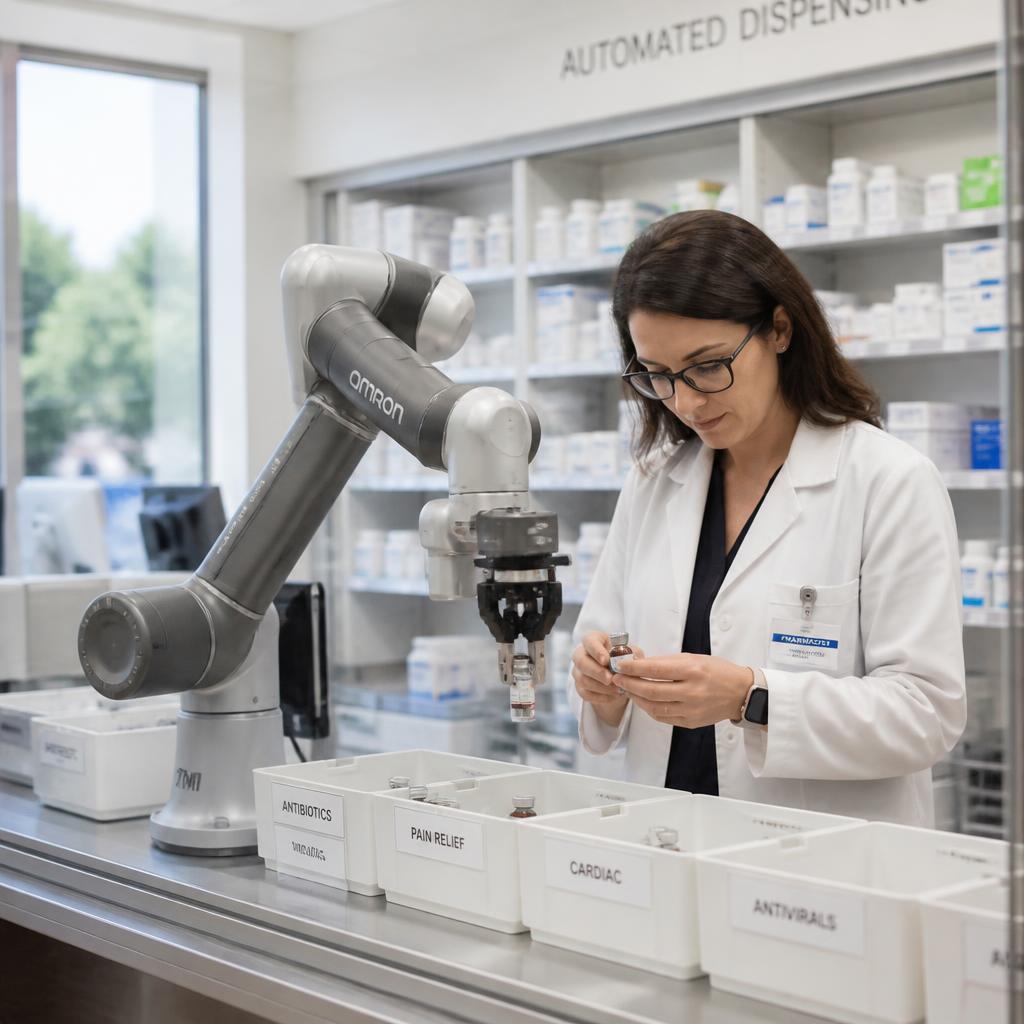
Central-fill pharmacy robots (Omnicell, Parata, McKesson) have been mainstream in hospital and mail-order pharmacies for a decade. What's new is small-footprint cobot dispensing for community and hospital-inpatient pharmacies — a 5–10 kg arm with a vision head, dispensing unit-dose vials into patient bins. Error rates fall from ~1 in 1,000 (manual) to well under 1 in 100,000 (robotic + barcode verify) per multiple published hospital studies.
2. Lab sample handling (mature-scaling)
Every major lab-automation vendor (Roche, Beckman, Thermo Fisher, Tecan, Hamilton) ships robotic liquid-handling and sample-transport systems. The cobot opportunity is at the edges: loading and unloading centrifuges, feeding analyzers, moving racks between benches — exactly the tasks large integrated lines don't cover.
3. Sterilisation and CSSD (Central Sterile Services Department)
Instrument sorting, tray building and load/unload of autoclaves is repetitive, high-volume and prone to human error. Cobots with vision are now deployed in European hospital CSSDs (Netherlands, Germany, France) at pilot to fleet scale.
4. Surgical assist (mature, specialist)
Intuitive Surgical (da Vinci), Medtronic (Hugo), Johnson & Johnson (Ottava, in development), CMR Surgical (Versius), and Asensus (Senhance) are the established players. This is not a cobot market — these are bespoke, class-III medical devices with billion-dollar development budgets.
5. Eldercare and disability assistance (emerging → real)
The most watched category in 2026. Toyota's Human Support Robot (HSR), Diligent Robotics' Moxi, and a wave of Japanese and Korean startups (Panasonic, Robocare, Cyberdyne HAL) are in real hospital pilots. Use cases: bed-to-chair transfer assist, medication delivery, hygiene support, mobility aids. IFR reports the number of professional service robots for elderly/disability assistance more than doubled in 2023.
6. Delivery and disinfection (post-COVID surge, now normalising)
Aethon TUG, Diligent Moxi and UVD Robots demonstrated during COVID that a mobile robot can deliver linens, meds and specimens, or run UV-C disinfection rounds, faster and more consistently than staff. Post-pandemic, adoption normalised but did not reverse.
Advantages, quantified
- Error reduction: Robotic dispensing cuts medication-error rates by 95%+ in published studies (e.g., Institute for Safe Medication Practices, multiple hospital case reports).
- Staff time: Diligent's Moxi is reported to save nurses ~30 minutes per shift by handling supply runs (published customer testimonials, Diligent Robotics).
- Consistency: Robotic sample handling reduces coefficient of variation in liquid-handling steps to <2%, vs 5–8% manual.
- Infection control: UV-C disinfection robots achieve documented 99.99% pathogen reduction on treated surfaces (peer-reviewed studies referenced by UVD Robots / Blue Ocean Robotics).
Limitations and failure modes
- Regulation. Any device touching a patient is Class II or III. Non-clinical cobots (pharmacy, lab, transport) are much simpler, but hospital IT/biomed sign-off is still required.
- Workflow integration. A robot that delivers a meal tray but can't open a patient-room door does not save any time.
- Union and staffing dynamics. Any deployment has to be positioned as staff-augmentation, not replacement, or it will be politically killed.
- Sterilisation of the robot itself. Anything entering a patient environment must be cleanable to hospital standards.
Buyer's checklist
- Start with a non-clinical task (pharmacy, lab, CSSD, transport) — regulatory path is 10× shorter.
- Insist on IEC 60601-1 or IEC 61010-1 compliance depending on the environment.
- Require an infection-control review of every touched surface.
- Model the payback on freed clinician time, not on headcount reduction.
How smert.ai fits
Our 5 and 10 kg cobots are deployed today in pharmacy dispensing, lab sample handling, and sterilisation-support workflows. Computer vision + force-torque sensing make them safe for shared workspace with clinicians. Eldercare and disability-assistance solutions integrate our mobile base + arm platform. Full healthcare portfolio: /robotics/healthcare.
Related: Cobot applications
Transform Your Business with SMERT Robotics
Ready to experience the benefits of hospitality automation? Our team is ready to help you get started.