Robotics on the Construction Site 2026: Layout, Rebar, Bricks, and Inspection
Executive summary
Construction is one of the two least-digitised sectors in the global economy (agriculture is the other). McKinsey has repeatedly documented that construction productivity has grown ~1%/year for two decades, vs 2.8%/year for the rest of the economy (McKinsey Global Institute, "Reinventing Construction"). Labour is aging out — the average U.S. construction worker is over 42, and the sector is ~500,000 workers short in 2024–2025 (Associated Builders and Contractors).
That gap is what's opening the market for construction robotics.
Market size and growth
- Construction robotics: Estimated at ~$500M–$1B in 2024 by multiple analyst houses, growing 15–25% annually — still small but the fastest-scaling early market.
- Global construction market: ~$13T annually. Even 1% penetration would rebase the robotics category by 100×.
What's shipping (2024–2026)
1. Autonomous layout
Dusty Robotics' FieldPrinter drives an inkjet printhead across a slab, printing full 1:1 building plans directly on the floor. Now on hundreds of active job sites across North America (Dusty Robotics case studies). Reduces layout time from days to hours and cuts layout errors that trigger expensive rework.
2. Bricklaying
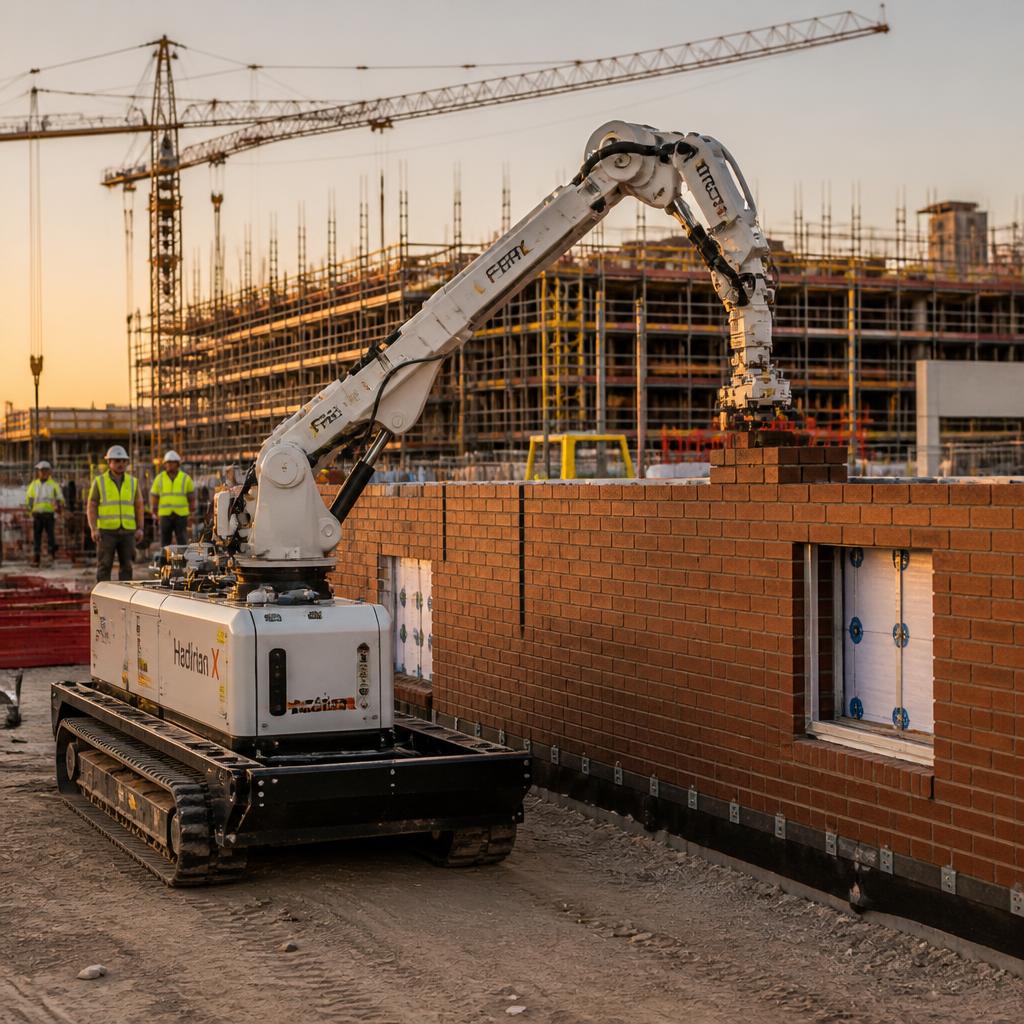
FBR (Fastbrick Robotics)' Hadrian X and Construction Robotics' SAM100 are the two production systems. FBR's Hadrian has been demonstrated laying up to ~200 bricks/hour on a moving-arm crawler (FBR investor updates). Not yet a mainstream tool, but multiple homebuilding pilots are active in Australia, the US and the Middle East.
3. Rebar tying
Advanced Construction Robotics' TyBot ties rebar intersections on bridge decks and slabs. In production on US Department-of-Transportation projects. Replaces one of the most physically punishing manual tasks on site.
4. Site inspection and monitoring
Boston Dynamics' Spot quadruped is deployed at scale for autonomous site walks by contractors including Foster + Partners, Skanska, Pomerleau and Bouygues. Companies like OpenSpace, Buildots and DroneDeploy overlay AI-powered progress tracking. The category grew fastest during COVID (contact-free site inspection) and has stuck.
5. Interior finishing (drywall, painting)
Canvas (drywall), Okibo, and Q-Bot ship robotic finishing systems in production trials. Drywall is a promising early application because the surface geometry is predictable.
6. 3D-printed structures
ICON in the U.S. and various European and Middle Eastern firms have delivered occupied 3D-printed homes at commercial scale — hundreds of units delivered by ICON alone.
The HK / Macao / dense-urban angle
Dense-urban construction (Hong Kong, Macao, Singapore, Tokyo, London) hits three constraints that make robotics uniquely attractive:
- Extreme labour cost and scarcity.
- Very restricted site footprint (no room for staging), so compact tracked robots beat wheeled ones.
- Regulatory push for lower on-site injury rates.
Hong Kong's Construction Industry Council has actively funded robotics pilots since 2022, and both the government and major contractors are early adopters.
Advantages, quantified
- Layout: Dusty Robotics reports 10× faster floor layout vs manual chalk-line, with sub-1/16" accuracy.
- Bricklaying: Robotic systems maintain 24-hour capability where humans stop at 8; laying speed is 2–3× a bricklayer on repeatable wall sections.
- Inspection: Autonomous Spot walks generate a full daily 3D scan of the site — impossible manually.
- Safety: Removing humans from confined spaces, high-fall zones and rebar tying reduces the two highest-injury task categories on site (OSHA data).
Limitations and failure modes
- Every site is a prototype. Unlike a factory, no two construction sites are the same. Robots must be robust to slope, weather, dust, and moving obstacles.
- Power and connectivity. Autonomous systems need reliable power and site Wi-Fi/LTE — often not available in early phases.
- Union and labour dynamics. Deployments must be framed around augmentation of scarce trades.
- Payback per project is short. A robot bought for one project must move to the next; leasing models fit this better than CapEx.
Buyer's checklist
- Robot-as-a-Service (RaaS) or short-term rental strongly preferred over outright purchase.
- On-site support included: a robot dead on Monday morning has no substitute if the crew has already been re-assigned.
- Chosen task should be repetitive and high-volume within one project — layout, rebar, drywall, painting.
- Data must integrate into your BIM (Autodesk Construction Cloud, Procore, PlanGrid).
How smert.ai fits
We ship mobile cobot platforms suited to layout, inspection and materials-handling tasks on urban sites. For dense-urban markets (HK, Macao, Singapore) our footprint and safe-motion certification are specifically designed for shared-floor operation. Full portfolio: /robotics.
Related: Cobot applications
Transform Your Business with SMERT Robotics
Ready to experience the benefits of hospitality automation? Our team is ready to help you get started.