Computer Vision in Robotics 2026: 6-DoF Pose, Bin Picking, Defect Detection, Safety
Executive summary
For 40 years, robots were blind. They ran deterministic programs against parts that arrived in known fixtures, at known poses, with known orientations. If anything moved, the program broke. Computer vision is what changed that — and, in 2026, is the single most important sub-technology inside every serious cobot deployment.
Two things happened between 2020 and 2026 that collectively rebased the field: (1) deep-learning object-detection and pose-estimation models became commodity, and (2) 3D cameras (structured light, active stereo, time-of-flight) fell in price by roughly an order of magnitude.
Market size and growth
- Machine-vision market: ~$16B in 2024 (Cognex, Keyence, Basler, IDS, MVTec), growing ~10% CAGR (multiple analyst houses).
- AI/deep-learning vision subset: Growing ~25%+ CAGR — the fastest-growing slice of the whole industrial-automation stack.
- 3D vision cameras: Under-$1,500 industrial-grade structured-light and stereo cameras now shipped by Intel RealSense, Zivid, Photoneo, Mech-Mind, Orbbec, Luxonis.
The perception stack, layer by layer
- Sensor. 2D RGB, 2D monochrome, 3D structured light, 3D active stereo, 3D time-of-flight, thermal, hyperspectral. Choice depends on lighting, part reflectivity, throughput.
- Calibration. Hand-eye calibration between camera frame and robot frame. Non-negotiable for any pick-and-place task.
- Detection / segmentation. Where in the image is the object? Modern models (YOLOv8/9, SAM, RT-DETR) run at 30–100 FPS on affordable GPU.
- 6-DoF pose estimation. In 3D space, what is the object's position (x,y,z) and orientation (roll, pitch, yaw)? Multiple learning-based approaches (PoseCNN, FoundationPose, MegaPose).
- Grasp planning. Given the pose and gripper model, which grasp is feasible and highest-confidence?
- Motion planning. Given the grasp and the environment, plan a collision-free trajectory to reach it.
Four applications where vision unlocks the ROI
1. Bin picking
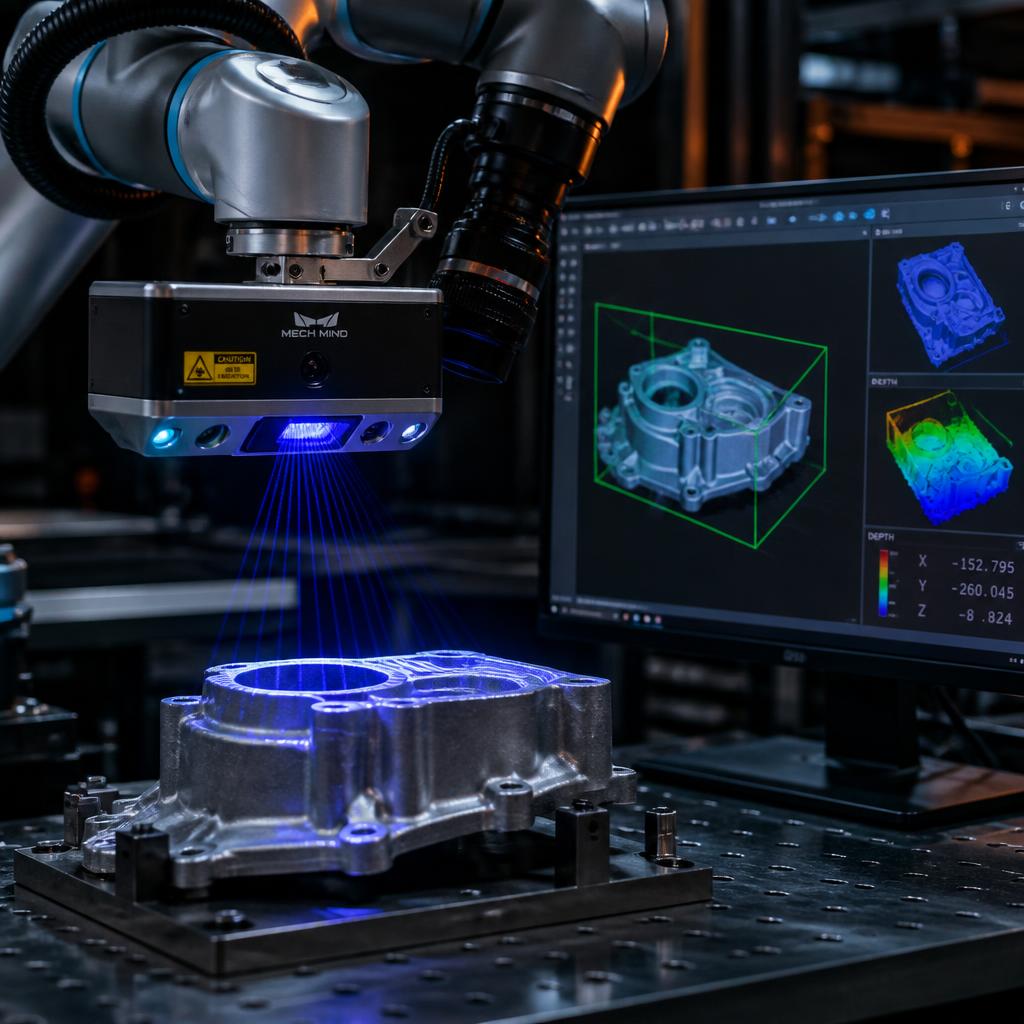
The single most-cited unlocked-by-vision application. A camera above a bin captures a scene; a model finds a graspable pose; the arm picks. Vendors: Mech-Mind, Photoneo, Zivid, Sereact, Nomagic. Best-in-class systems now do 600–1,000+ cycles/hour on general merchandise.
2. Inline defect detection
Cognex, Keyence, MVTec, and every open-source stack now ship trainable defect models that catch scratches, missing components, wrong colour, wrong label. Reject rates that used to require an in-line human are now automatic and running at line speed.
3. Assembly verification
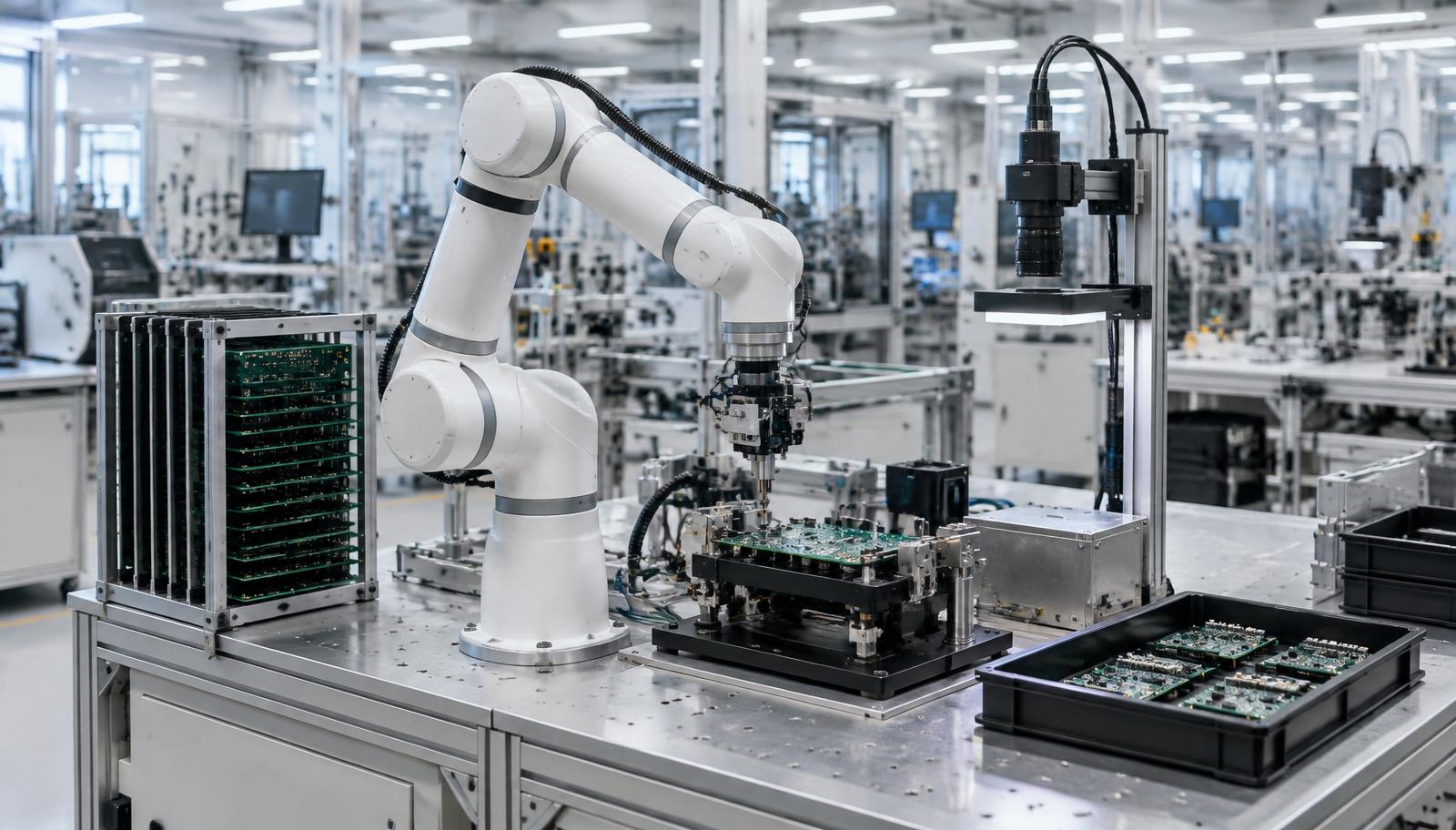
Camera on the wrist verifies each step: screw driven, gasket seated, wire routed. This eliminates the most common source of manufacturing warranty claims.
4. Safety and shared-workspace operation
Depth cameras + skeletal-tracking (Zivid, Fanuc, ABB SafeMove) let a cobot slow down or stop when a human enters its workspace — ISO/TS 15066-compliant Speed and Separation Monitoring (SSM).
Advantages, quantified
- Bin picking: From physically impossible ten years ago to production-throughput today.
- Defect detection: Trained models routinely reach >99.5% recall on visible defects, with false-positive rates <1% in published Cognex and Keyence case studies.
- Setup time: Modern no-code vision tools (Landing AI, Cognex ViDi, Keyence CV-X, MVTec HALCON) let a technician train a new model in hours, not weeks.
- Cost: Industrial-grade 3D cameras now start under $1,500; five years ago the same performance was $10k+.
Limitations and failure modes
- Lighting. Any vision system is only as reliable as the lighting design. Cheap out and it will fail.
- Reflective / transparent parts. Glass, mirror-finish steel, dark plastics are still the hardest cases. Structured light can help; polarised light helps more.
- Training data. Deep-learning models need labelled examples. For rare-defect detection, generating enough failure examples is a real project.
- Edge compute. A model that runs at 30 FPS on a $2k GPU may not run at 30 FPS on a $200 embedded board. Match model to hardware.
- Model drift. As parts age, tooling wears, and lighting changes across seasons, models silently degrade. Continuous evaluation is mandatory.
Buyer's checklist
- Lock the lighting before you buy the camera. Diffuse, dome or bar lights depending on part geometry.
- Pilot on your actual parts in your actual environment, not the vendor's demo.
- Insist on an ROC curve — what's the false-positive rate at your target recall?
- Own your data. The model trained on your parts is a company asset; make sure you keep it.
How smert.ai fits
Every SMERT cobot ships with an integrated 2D + 3D vision head, pre-calibrated to the robot frame, and a no-code training UI so your technicians can add new SKUs in an afternoon. Deep dive on our vision stack: /robotics/computer-vision.
Related: Cobot applications
Transform Your Business with SMERT Robotics
Ready to experience the benefits of hospitality automation? Our team is ready to help you get started.