Robotics in Healthcare in 2026: What Is Real, What Is Hype, and What Care Teams Can Use Today
Robotics in Healthcare: Start With the Task, Not the Demo
Robotics in healthcare attracts bold promises: autonomous wards, tireless assistants, and technology that gives clinicians their time back. In 2026, the useful question is narrower: which repetitive, non-clinical task could a supervised cobot help with, without creating more work elsewhere?
For care teams, a sensible starting point is a bounded workflow with predictable objects, clear supervision, and an easy manual fallback. A successful demonstration is not enough. The system must fit the room, cleaning procedures, staffing arrangements, and everyday exceptions.
smert.ai is a Hong Kong-based cobot integration and AI consulting company, with a lab in Tsim Sha Tsui and a US branch in Delaware. We integrate cobot arms from established makers rather than manufacture arms. The applications discussed here are assistive, supervised, and not medical devices; they do not diagnose, treat, or make clinical decisions.
What Is Real—and What Is Hype?
Real: bounded assistance in structured environments
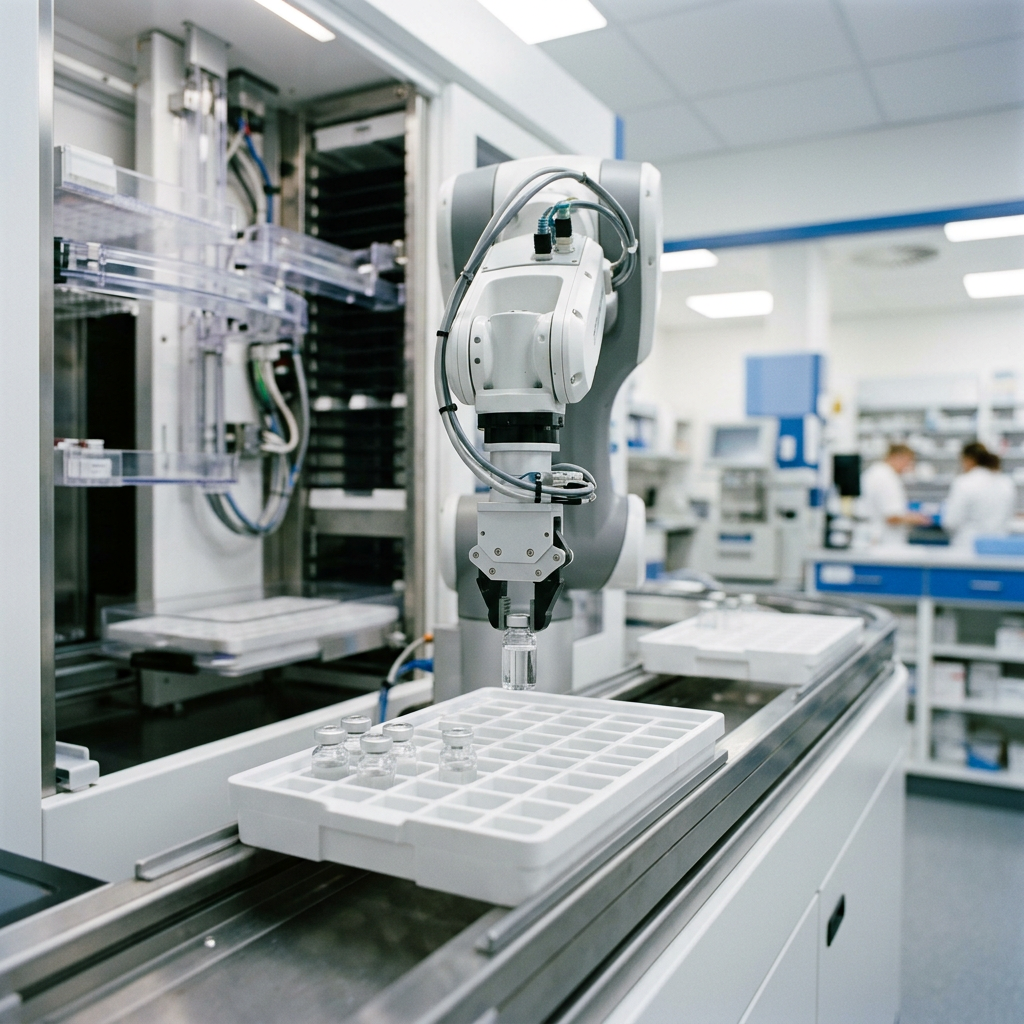
A cobot can be considered for repetitive handling tasks when object shapes, presentation, and destinations are sufficiently controlled. For example, a supervised station could place approved, non-clinical items into organiser trays for staff checking.
The engineering challenge extends beyond movement. Someone must replenish supplies, manage damaged packaging, approve cleaning methods, and recover from interruptions. Those responsibilities belong in the workflow design, not in a later training session.
Computer vision may support detection and flagging for human review—for example, flagging an apparently empty compartment. It should not be presented as independent verification that a clinical kit is safe or complete.
Hype: general-purpose care without supervision
Be cautious about claims that one installation can move freely between unfamiliar patients, rooms, objects, and care activities with little preparation. Healthcare environments change constantly, and people may behave unpredictably.
Another warning sign is a proposal built around cycle time alone. A fast demonstration may exclude replenishment, cleaning, exception handling, staff review, and downtime. A slower-looking workflow may be more useful if it is easier to supervise and recover.
Ask vendors to demonstrate exceptions, not just the ideal sequence: what happens when an item is missing, a tray is misplaced, or someone enters the working area?
Practical Cobot Workflows to Evaluate
Non-clinical supply preparation
A potential pilot is arranging sealed, non-medication items such as stationery or patient-information packs at a designated workstation. Start with a small, approved item set and consistent containers.
Staff should check the output before release. Exclude sterile processing, medication handling, and anything where a packing error could directly affect treatment. The objective is to test a support workflow, not automate clinical judgement.
Our healthcare cobot integration page provides a starting point for discussing application scope and integration requirements.
Supervised activity support
In a care or special-needs setting, a cobot could present activity objects or demonstrate a repeatable sequence under staff direction. Participation should be optional, with an accessible way to pause or stop the session.
Design around the individual: reach, seating position, attention, sensory preferences, and communication needs can all change suitability. Do not assume that an engaging demonstration establishes therapeutic benefit.
Explore special-needs cobot support as an assistive application area, not a substitute for professional assessment or human support.
Back-of-house demonstration and training
A training station can let staff rehearse loading, unloading, interruption, and recovery procedures using non-clinical materials. This is often a useful step before considering deployment near care activity.
It also reveals hidden work. If restarting requires a specialist every time an object shifts, the design may not be ready for routine use. Training should include permission to stop the system and revert to the manual process.
Safety Is a Site-Specific Engineering Decision
Calling a system a cobot does not make every application safe. Safety depends on a per-site risk assessment covering the complete installation: arm, end effector, payload, fixtures, software, surroundings, and foreseeable human behaviour.
ISO 10218 and ISO/TS 15066 are standards integrators assess against. They are not a blanket guarantee that a proposed healthcare workflow is suitable.
Assess the whole working area
A practical review should consider:
- Who can approach, including patients, visitors, cleaners, and staff unfamiliar with the system.
- Pinch points, dropped objects, sharp edges, and unexpected movement.
- Wheelchair access, walking routes, evacuation paths, and nearby equipment.
- Stop controls, restart permissions, isolation procedures, and manual fallback.
- Cleaning compatibility, contamination risks, and maintenance access.
The assessment may require separation, guarding, restricted access, or a different task design. Some proposed applications should not proceed.
Keep patient-facing scope conservative
An initial pilot should avoid lifting people, supporting body weight, administering medication, handling sharps, or contacting wounds. These activities introduce risks and requirements beyond the assistive scope described here.
Name a responsible supervisor for each operating period. Define when operation must stop, who may restart it, and what checks are required after an interruption or configuration change.
Use Computer Vision for Flags, Not Clinical Decisions
For robotics in healthcare, adding a camera creates privacy and governance questions as well as technical ones. Start by asking whether imaging is necessary at all.
Where computer vision is justified, keep its purpose narrow: detecting an object or flagging an apparent workflow exception for human review. Staff remain responsible for interpreting the flag and deciding what happens next.
Before a pilot, document:
- What the camera sees and whether patient areas can be excluded.
- Whether images are stored, where processing occurs, and who has access.
- Retention and deletion rules approved by the organisation.
- How staff handle missed detections and unnecessary alerts.
Avoid positioning cameras where patient records, screens, or private activity could be captured unnecessarily. For team preparation, see our AI in healthcare learning resources.
How to Run a Useful Pilot
Establish a baseline before installation
Observe the current manual workflow across representative shifts. Record task volume, handling time, interruptions, replenishment effort, checking requirements, and common exceptions.
Ask staff what makes the task difficult. The answer may be poor storage or inconsistent packaging rather than a need for automation. Fixing the underlying process may be the better investment.
Set measurable acceptance criteria
Choose criteria that reflect the whole workflow, such as staff time per completed batch, number of interventions, recovery time, and output requiring rework. Include setup, supervision, cleaning, and shutdown in the measurement.
Agree on stop conditions before testing. Examples include blocked access, repeated dropped items, unclear restart behaviour, or supervision demands that interfere with care duties. A pilot should be allowed to fail without pressure to justify the purchase.
Budget for integration and ongoing ownership
The arm is only one part of the cost. Include tooling, fixtures, software integration, site preparation, staff training, maintenance, spares, and any approved data infrastructure.
Assign owners for daily checks, cleaning, fault reporting, software changes, and periodic review. Changes to payloads, layouts, or tasks should trigger a review of the relevant risk assessment and operating procedures.
FAQ
Can a cobot replace a nurse or care worker?
That should not be the deployment goal. The applications described here support bounded, non-clinical tasks under supervision. They do not replace care judgement, communication, or responsibility.
Is a cobot automatically safe around patients?
No. Suitability depends on a per-site risk assessment and the complete application. Additional protective measures—or a decision not to deploy—may be necessary.
Can computer vision check whether care was delivered correctly?
Not in the scope described here. Computer vision can detect and flag defined conditions for human review; it does not determine clinical appropriateness or care quality.
What should we prepare for an initial discussion?
Bring a task description, layout, sample items, workload estimates, cleaning requirements, and known constraints. Identify the staff who perform and supervise the current process.
Ready to evaluate a practical use of robotics in healthcare? Contact smert.ai to discuss a bounded workflow, integration requirements, and a supervised pilot.
Related: Robotics in healthcare
Transform Your Business with SMERT Robotics
Ready to experience the benefits of hospitality automation? Our team is ready to help you get started.